Cookieless marketing is an advertising strategy that reduces reliance on third-party cookies. It uses consented first-party data, contextual targeting, server-side tracking, conversion APIs, modeled measurement, and aggregated analysis to reach customers and evaluate performance as browser and platform signals become less reliable.
For ecommerce companies, local retailers, and service-based businesses, the advertising landscape has already changed. Safari includes protections against cross-site tracking, while Firefox enables Total Cookie Protection by default to confine cookies to the websites where they were created.[¹][²]
Google is no longer pursuing its previous plan to eliminate third-party cookies from Chrome through a universal phaseout. In April 2025, Google announced that it would maintain Chrome’s existing approach to third-party-cookie choice rather than introduce a new standalone prompt.[³]
That decision does not restore the cross-site visibility advertisers once had. Businesses still need a durable strategy built around direct customer relationships, accurate conversion signals, transparent consent practices, and privacy-focused measurement.
Key Takeaways
- Cookieless marketing usually means reducing dependence on third-party cookies, not eliminating every cookie from a website.
- Google is not moving forward with its previous universal third-party-cookie phaseout in Chrome.[³]
- Safari and Firefox already restrict cross-site tracking through built-in privacy protections.[¹][²]
- First-party data, contextual targeting, conversion APIs, and server-side tracking can make advertising programs more resilient.
- Cookieless measurement requires CRM integration, qualified conversion data, testing, and business-level reporting.
- Businesses that strengthen their data and measurement systems will be better prepared for future browser, platform, and regulatory changes.
What Is Cookieless Marketing?
Cookieless marketing means reaching, re-engaging, and measuring customers without depending heavily on third-party cookies.
A third-party cookie is created by a domain other than the website a person is currently visiting. Advertisers have historically used these cookies to follow activity across websites, build behavioral audiences, manage ad frequency, retarget visitors, and attribute conversions.
A first-party cookie is created by the website a person visits directly. First-party cookies can support essential functions such as login sessions, shopping carts, saved preferences, consent choices, and website analytics.
Cookieless marketing does not always mean that no cookies are used. In most marketing discussions, the term refers to a shift away from cross-site third-party tracking and toward data collected through direct, consented customer relationships.
Are Third-Party Cookies Still Going Away?
The answer depends on the browser.
Safari includes privacy features designed to defend users against cross-site tracking. Apple also allows users to control cross-site tracking through Safari’s privacy settings.[¹]
Firefox uses Total Cookie Protection, which creates a separate “cookie jar” for each website. This limits the ability of cookies to track activity across unrelated sites. Mozilla enables this protection by default in Firefox’s Standard mode.[²]
Chrome has taken a different path. In April 2025, Google announced that it would maintain its existing approach to user choice for third-party cookies rather than introduce a new standalone prompt. Google also confirmed that Chrome’s Incognito mode blocks third-party cookies by default.[³]
This means advertisers should not build their plans around one date when every third-party cookie will disappear.
The more important issue is that third-party identifiers are already inconsistent across browsers, devices, apps, consent decisions, and advertising platforms. A strategy that works only when cross-site cookies are available will continue to lose reach and measurement clarity.
Cookieless Marketing Is Really About Signal Loss
Signal loss describes the reduction in information that advertising and analytics platforms can use to identify audiences, connect customer activity, and measure campaign outcomes.
Third-party-cookie restrictions are one source of signal loss, but they are not the only source.
Businesses may lose advertising signals because of:
- Browser privacy protections
- Mobile app tracking restrictions
- Cookie consent choices
- Ad blockers
- Cross-device customer journeys
- Platform data limitations
- Disconnected CRM and sales systems
- Untracked phone calls or offline purchases
- Incomplete conversion setup
- Customer activity across multiple devices or email addresses
Signal loss can affect several parts of an advertising program.
Retargeting audiences may become smaller. Ad platforms may have fewer conversion signals for automated bidding. Reported conversions may not match CRM records. Marketers may struggle to determine which campaigns generated qualified leads, repeat customers, or profitable sales.
The goal of a cookieless strategy is not to recreate every piece of individual-level tracking that advertisers once had. The goal is to build a more reliable system using signals a business can collect, govern, and apply appropriately.
Cookies vs. Cookieless Marketing: What Changes?
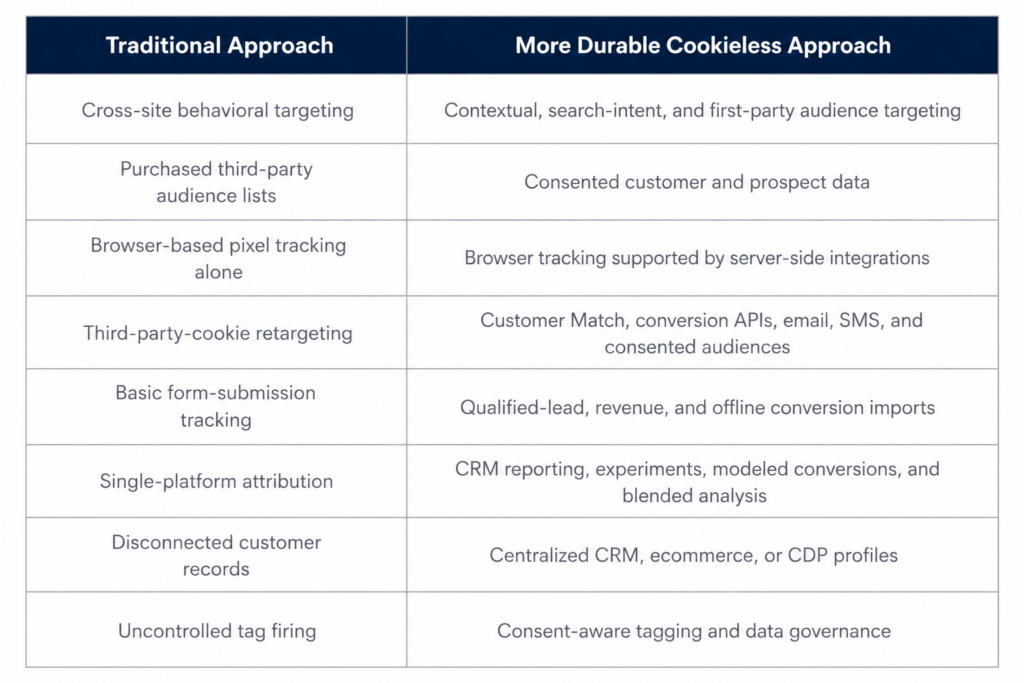
The transition does not require businesses to abandon personalized advertising. It requires them to rely on more direct, transparent, and measurable sources of customer information.
How to Build a Cookieless Marketing Strategy
1. Audit Your Current Measurement
Before adding new tools, determine what your advertising platforms can and cannot currently measure.
Review:
- Website analytics events
- Google Ads and Meta conversion actions
- Ecommerce purchase tracking
- Phone-call tracking
- Appointment bookings
- Form submissions
- CRM lead stages
- Offline sales
- Repeat purchases
- Customer lifetime value
- Consent settings
- Tag-firing rules
The audit should identify where customer information is lost between the initial ad interaction and the final business outcome.
For example, a lead-generation campaign may report 100 form submissions, while the CRM shows that only 15 became qualified opportunities. If the ad platform receives only the original form submission, it may continue finding more low-quality leads.
A stronger setup sends qualified-lead or completed-sale information back to the advertising platform where technically and legally appropriate. Google’s enhanced conversions for leads can use hashed, user-provided data to improve the accuracy of offline conversion imports and support bidding.[⁴]
2. Build a First-Party Data Foundation
First-party data is information a business collects through its own interactions with customers and prospects.
Examples include:
- Purchases
- Website registrations
- Email subscriptions
- SMS sign-ups
- Quote requests
- Phone calls
- Customer-service interactions
- Loyalty-program activity
- Appointment bookings
- CRM lead stages
- Product preferences
- Repeat-purchase behavior
Zero-party data is information a customer intentionally provides, such as communication preferences, budget ranges, product interests, quiz responses, or service needs.
Businesses can expand first-party and zero-party data collection by:
- Offering useful email or SMS content
- Creating loyalty or rewards programs
- Using post-purchase surveys
- Asking customers about product or service preferences
- Encouraging account creation with practical benefits
- Offering saved carts, order tracking, or faster checkout
- Collecting lead-qualification details through forms
- Recording consent and communication preferences
The value exchange should be clear. Customers are more likely to share information when they understand what they will receive and how the business plans to use their data.
3. Select Technology That Matches Your Business
Not every company needs a full customer data platform.
A smaller company may be able to manage its data through a properly configured CRM, ecommerce platform, email system, analytics platform, and advertising accounts.
A larger or more complex organization may benefit from a CDP that combines data from multiple sources into unified customer profiles.
The right system depends on:
- Customer volume
- Sales-cycle length
- Number of marketing channels
- Ecommerce or offline sales complexity
- Data-governance needs
- Internal reporting resources
- Personalization requirements
- Existing technology integrations
Technology should solve a defined data problem. Adding a CDP without a clear activation or reporting plan can create another expensive system that the marketing team does not fully use.
4. Use Contextual and Intent-Based Targeting
Contextual advertising places an ad based on the subject of the page or content surrounding it rather than a person’s browsing history.
A running-shoe company might advertise alongside marathon-training content. A home-services provider might target searches or content related to a specific repair problem. A business-to-business software company might advertise within content about the operational challenge its platform addresses.
Search advertising is also naturally connected to expressed intent. The search query provides a signal about what the person needs at that moment.
Strong contextual and intent-based targeting depends on:
- Accurate keyword research
- Clear customer problems
- Relevant landing pages
- Strong negative-keyword controls
- Audience exclusions
- Geographic accuracy
- High-quality creative
- Useful offers
- Consistent testing
Cookieless targeting works best when the message, placement, search intent, and landing page support the same customer need.
5. Build Consent-Based Retargeting Audiences
Retargeting is not limited to third-party cookies.
Businesses may be able to re-engage customers through:
- CRM-based customer lists
- Google Customer Match
- Email campaigns
- SMS campaigns
- Loyalty programs
- Consent-based website audiences
- Platform conversion APIs
- Google enhanced conversions
- Publisher first-party audiences
- On-site recommendations
- Abandoned-cart campaigns
Google Customer Match allows eligible advertisers to use first-party information collected from online and offline interactions to reach and re-engage customers across Google properties.[⁵]
Audience availability and match rates will vary. Businesses must have the necessary permissions and comply with platform requirements and applicable privacy rules.
6. Improve Data Collection With Server-Side Tracking
Traditional client-side tracking sends data from a user’s browser directly to analytics and advertising vendors.
Server-side tagging moves part of the measurement process from a website or application into a server-side processing container. Google states that server-side tagging can help improve page performance, provide more detailed privacy controls, and improve data quality.[⁶]
Server-side tracking can give businesses more control over what information is sent to approved platforms, but it is not a method for bypassing consent requirements or browser privacy choices.
A responsible implementation should define:
- What data is collected
- Why it is collected
- Which platforms receive it
- How long it is retained
- How consent choices affect transmission
- Which identifiers are removed or transformed
- Who can access the information
7. Use Enhanced Conversions and Conversion APIs
Enhanced conversions supplement existing Google Ads conversion tracking with hashed first-party customer information, such as an email address or phone number provided during a conversion.
Google states that enhanced conversions can improve conversion-measurement accuracy and support more effective bidding. The feature uses the SHA-256 hashing algorithm before eligible first-party customer data is sent to Google.[⁷]
Other advertising platforms offer conversion APIs that send approved events through server-to-server connections.
These tools can help reduce measurement gaps, but they do not guarantee that every conversion will be recovered. Results depend on implementation quality, consent, available customer information, platform eligibility, and match rates.
8. Import Qualified Leads and Revenue
One of the most valuable cookieless marketing improvements is moving beyond basic lead counts.
Advertising platforms frequently optimize toward whichever conversion action receives enough data. If the primary conversion is a form completion, the system may seek more form completions without knowing which leads become qualified customers.
Businesses should consider importing deeper outcomes such as:
- Marketing-qualified leads
- Sales-qualified leads
- Completed consultations
- Approved applications
- Scheduled appointments
- Completed service calls
- Closed sales
- Revenue
- Gross profit
- New-customer purchases
- Subscription renewals
Google’s offline conversion and enhanced-conversion tools are designed to help advertisers connect later customer outcomes with earlier advertising interactions.[⁴]
This information also helps marketing teams evaluate cost per qualified lead, cost per sale, customer acquisition cost, return on ad spend, and long-term customer value.
How to Measure Marketing Without Cookie-Based Attribution
Cookieless measurement should include several layers.
Platform Measurement
Google Ads, Meta Ads, analytics tools, and ecommerce systems can provide useful directional reporting. Their attribution models should not be treated as a complete view of business performance.
CRM and Sales Reporting
CRM data helps connect campaigns with qualified leads, closed sales, revenue, and customer quality.
Incrementality Testing
Incrementality testing compares exposed and non-exposed groups to estimate how many outcomes occurred because of advertising rather than happening independently.
Depending on the channel and available data, a business may use:
- Geographic tests
- Audience holdouts
- Campaign pause tests
- Conversion-lift studies
- Matched-market experiments
Marketing Mix Modeling
Marketing mix modeling uses aggregated historical data to estimate the relationship between marketing investment and business outcomes.
It may be useful for companies with enough spending, time, channel diversity, and reliable business data. It is not always practical for smaller businesses with limited historical information.
Blended Business Metrics
Businesses should also evaluate broader performance indicators, including:
- Total customer acquisition cost
- Blended return on ad spend
- Revenue by channel
- New-customer revenue
- Repeat-purchase rate
- Lead-to-sale rate
- Contribution margin
- Customer lifetime value
- Marketing efficiency ratio
No attribution model can provide perfect certainty. Using several measurement methods creates a more credible view than depending on one browser cookie or one platform dashboard.
How Cookieless Marketing Changes PPC Management
Cookieless advertising places greater importance on the quality of the information provided to automated bidding systems.
A strong PPC strategy should:
- Define meaningful primary conversions
- Remove duplicate or low-value conversion actions
- Import qualified outcomes
- Maintain accurate revenue values
- Consolidate campaigns when excessive segmentation restricts learning
- Use negative keywords to control irrelevant traffic
- Align ads with search intent
- Improve landing page relevance
- Test creative themes
- Separate new-customer goals from repeat-customer goals
- Review lead quality with the sales team
- Compare platform reports with CRM outcomes
Automation can only optimize based on the inputs it receives. Incomplete or low-quality conversion data can encourage a campaign to pursue the wrong results at scale.
Cookieless Marketing for Ecommerce Businesses
Ecommerce companies often have access to valuable first-party information through purchases, product views, carts, accounts, subscriptions, reviews, and loyalty programs.
A durable ecommerce strategy may include:
- Accurate purchase and revenue tracking
- Enhanced conversions
- Customer Match
- Product-feed optimization
- Email and SMS lifecycle campaigns
- Loyalty segments
- New-customer acquisition goals
- Contextual product advertising
- Post-purchase surveys
- Repeat-purchase analysis
- Customer lifetime value modeling
- Abandoned-cart recovery
The goal is to connect advertising with profitable customer behavior rather than optimizing only toward traffic or isolated transactions.
Cookieless Marketing for Local and Service-Based Businesses
Local businesses often face a different measurement challenge. Many customer journeys move from online research to phone calls, consultations, appointments, estimates, or offline sales.
A stronger local measurement plan may include:
- Dynamic call tracking
- Recorded lead sources
- Appointment-booking integrations
- CRM lead-stage tracking
- Offline conversion imports
- New-customer identification
- Completed-job revenue
- Service-area performance
- Qualified-call measurement
- Lead-response-time reporting
A plumbing company, medical practice, financial service, or home-improvement business may receive dozens of calls from advertising. The final business outcome is the qualified appointment, completed job, approved customer, or generated revenue.
The Technology Behind Cookieless Marketing
Several tools support a cookieless advertising strategy, but they perform different functions.
Consent Management Platform
A consent management platform collects, stores, and communicates user privacy choices.
Consent Mode
Consent mode adjusts the behavior of supported Google tags based on the consent status communicated by the website.
Tag Manager
A tag-management system controls when analytics and advertising tags run.
Server-Side Tagging
Server-side tagging moves measurement processing into a server container and provides additional controls over data quality, privacy, and tag execution.[⁶]
CRM
A CRM stores lead, customer, sales, and communication information.
Customer Data Platform
A CDP combines customer information from several sources and may support segmentation, personalization, and audience activation.
Conversion API
A conversion API sends approved conversion events directly from a business-controlled system to an advertising platform.
Analytics Platform
An analytics platform reports website, application, and campaign behavior.
These technologies work together, but one tool does not replace the others.
Privacy and Consent Still Matter
First-party data is not automatically compliant simply because a business collected it directly.
Businesses must consider the purpose of data collection, applicable legal basis, notice requirements, consent, opt-out rights, data security, retention, and permitted uses.
Under the GDPR, consent is one possible legal ground for processing personal information. When consent is required, the European Commission states that it must be freely given, specific, informed, and unambiguous. The person must also be able to withdraw consent.[⁸]
The CCPA gives covered California consumers rights that include knowing how their personal information is collected and used, requesting deletion in certain circumstances, correcting inaccurate information, and opting out of the sale or sharing of personal information.[⁹]
Privacy requirements vary by jurisdiction, data type, technology, and business activity. Companies should consult qualified legal counsel about their specific compliance obligations.
A Cookieless Roadmap for Small and Mid-Sized Businesses
Foundation Stage
- Audit advertising and analytics tags
- Confirm that primary conversion actions are accurate
- Review consent and privacy settings
- Connect forms, calls, purchases, and appointments to a CRM
- Build email and SMS capture
- Remove duplicate conversion events
- Compare platform conversions with business records
Growth Stage
- Implement enhanced conversions
- Add platform conversion APIs where appropriate
- Import qualified leads and offline sales
- Build first-party audience segments
- Test contextual campaigns
- Improve landing pages
- Connect ad spend with revenue reporting
- Develop retention and lifecycle campaigns
Advanced Stage
- Implement server-side tagging
- Use customer lifetime value in campaign decisions
- Run incrementality tests
- Evaluate marketing mix modeling
- Develop advanced audience exclusions
- Connect campaign data with profit reporting
- Coordinate paid media, CRM, analytics, and sales operations
The right starting point depends on the business’s current tracking quality, data volume, internal resources, and advertising investment.
Signs Your Advertising Data Needs an Audit
Your business may need a cookieless advertising audit if:
- Advertising platforms and CRM reports show different conversion totals.
- You track form submissions but not qualified leads.
- Phone calls generate sales, but completed sales are not connected to campaigns.
- Customer data is spread across disconnected systems.
- Retargeting audiences are shrinking.
- Campaigns generate leads that the sales team considers low quality.
- Consent choices are not communicated to advertising tags.
- Revenue is not imported into ad platforms.
- New and existing customers are measured the same way.
- Automated bidding is optimizing toward low-value actions.
- Marketing and sales teams disagree about which campaigns work.
These gaps can lead to wasted spending even when website traffic and lead volume appear strong.
How National Positions Builds Durable Ad Strategies
A cookieless marketing strategy requires coordination across paid media, analytics, CRM systems, consent management, landing pages, sales reporting, and customer retention.
National Positions applies its PACE methodology to connect these areas.
Plan
We audit the customer journey, identify signal-loss risks, define meaningful conversions, and determine which first-party data can support targeting and measurement.
Analyze
We compare advertising-platform reports with CRM, sales, revenue, and customer-quality data to find measurement gaps and wasted spending.
Convert
We improve campaign signals, audience activation, landing pages, conversion tracking, and revenue feedback so platforms can optimize toward stronger business outcomes.
Expand
We test contextual audiences, new campaign structures, retention programs, creative strategies, and measurement methods based on verified performance.
As a Google Premier Partner with more than 22 years of digital marketing experience, National Positions helps businesses build advertising programs that are less dependent on unstable third-party signals.
Request a Cookieless Advertising Readiness Assessment
A cookieless strategy should begin with an assessment of what your business can currently measure and where valuable information is being lost.
A National Positions cookieless advertising readiness assessment can evaluate:
- Conversion tracking coverage
- Google Ads and Meta signal quality
- Consent configuration
- CRM integration
- Offline conversion tracking
- First-party audience readiness
- Enhanced conversion opportunities
- Server-side tracking opportunities
- Lead-quality reporting
- Revenue attribution
- Landing page performance
- Campaign optimization goals
Schedule a free strategy consultation with National Positions to identify practical, ROI-focused improvements for your paid media, first-party data, and advertising measurement.
Frequently Asked Questions
What is cookieless marketing?
Cookieless marketing is an approach to targeting, retargeting, and measurement that reduces dependence on third-party cookies. It uses methods such as first-party data, contextual advertising, customer lists, server-side tracking, conversion APIs, enhanced conversions, and aggregated measurement.
Is Google Chrome still eliminating third-party cookies?
No. In April 2025, Google announced that Chrome would maintain its existing user-choice approach rather than continue with its earlier universal phaseout plan. Google also confirmed that third-party cookies are blocked by default in Chrome’s Incognito mode.[³]
Businesses should still prepare for signal loss because Safari, Firefox, mobile platforms, consent decisions, and advertising systems already limit cross-site tracking.[¹][²]
Can businesses retarget customers without third-party cookies?
Yes. Businesses can use consented customer lists, Customer Match, conversion APIs, enhanced conversions, email, SMS, loyalty programs, publisher audiences, and on-site personalization. Google Customer Match uses eligible first-party information to help advertisers reach and re-engage customers across supported Google properties.[⁵]
Availability depends on the platform, customer permission, data quality, and applicable privacy requirements.
What is the difference between first-party data and first-party cookies?
First-party data is information a company collects through direct interactions with customers, such as purchases, form submissions, account activity, or CRM records.
A first-party cookie is a browser file created by the website a person visits. It may support sessions, preferences, analytics, or other website functions.
Does server-side tracking bypass cookie consent?
No. Server-side tracking changes how selected information is processed and transmitted. It does not remove the need to honor consent choices, provide required notices, follow platform policies, or comply with applicable privacy laws.
How can small businesses collect first-party data?
Small businesses can build first-party data through email and SMS sign-ups, loyalty programs, account creation, purchases, forms, surveys, appointment bookings, phone calls, and CRM activity.
The information should be collected for a defined purpose with appropriate disclosures and permissions.
Does a small business need a customer data platform?
Not always. A smaller business may be able to use its CRM, ecommerce system, email platform, analytics setup, and advertising accounts.
A CDP becomes more useful when a company needs to combine large amounts of customer data from several disconnected channels.
Can cookieless marketing improve advertising performance?
A stronger first-party data and measurement system can improve the information used for audience creation, reporting, and automated bidding. Google states that enhanced conversions can improve conversion-measurement accuracy and support bidding by supplementing existing conversion data with hashed first-party information.[⁷]
Performance still depends on campaign strategy, data quality, consent rates, creative, landing pages, offer strength, sales follow-up, and market demand.
Sources
- Apple, “Safari Privacy” and “Prevent Cross-Site Tracking in Safari on Mac.”
- Mozilla Support, “Enhanced Tracking Protection in Firefox for Desktop” and “Introducing Total Cookie Protection in Standard Mode.”
- Google Privacy Sandbox, “Next Steps for Privacy Sandbox and Tracking Protections in Chrome”, April 22, 2025.
- Google Ads Help, “Import Conversions From Ad Clicks Into Google Ads Using Enhanced Conversions for Leads.”
- Google Ads Help, “About Customer Match.”
- Google for Developers, “Server-Side Tag Manager” and “Server-Side Tagging Overview.”
- Google Ads Help, “About Enhanced Conversions.”
- European Commission, “When Is Consent Valid?”
- California Department of Justice, “California Consumer Privacy Act.”