Quick answer: To track AI search visibility, combine three sources: Google Search Console and Bing Webmaster Tools for free AI Overview, AI Mode, and Copilot data; a dedicated AI visibility tracker (such as Peec AI, Otterly.AI, Profound, Semrush, Ahrefs Brand Radar, or SEOmonitor) that runs your buyers’ prompts across ChatGPT, Perplexity, and Gemini; and a GA4 channel group that isolates AI referral traffic. The tool comparison below shows what each tracker costs and covers.
Key Takeaways
- The 3-Layer Measurement Stack: Complete visibility requires combining platform-native dashboards, recurring prompt sampling tools, and custom first-party referral analytics.
- Massive Traffic Acceleration: Adobe Digital Insights data indicates AI-referred traffic to retail sites doubled year-over-year, with quarterly AI referral spikes reaching up to 393% for U.S. retailers [¹].
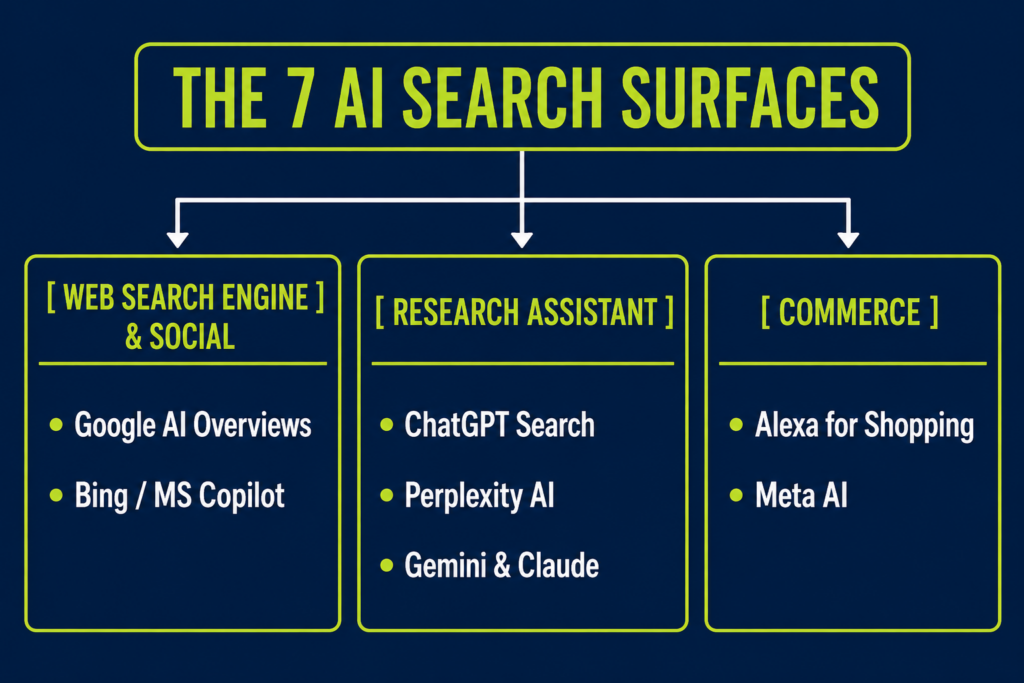
- 7 Distinct Surfaces: Google AI Overviews, ChatGPT, Perplexity, Microsoft Copilot, Gemini, Claude, and Meta/Amazon shopping engines operate on distinct retrieval models requiring isolated tracking.
- Native Search Console Reporting: Google Search Console (Search Generative AI performance reports) and Bing Webmaster Tools (AI Performance reports) now supply native impression and click data for AI queries [²].
- Downstream Conversion Intent: Visitors navigating to a site from an AI citation convert at significantly higher rates than average organic search traffic, as they enter the site pre-qualified by generative answers [¹].
What Does “Tracking AI Search Visibility” Actually Mean?
Tracking AI search visibility is the systematic process of monitoring how often, in what context, and with what financial return your brand appears within generative search engines.
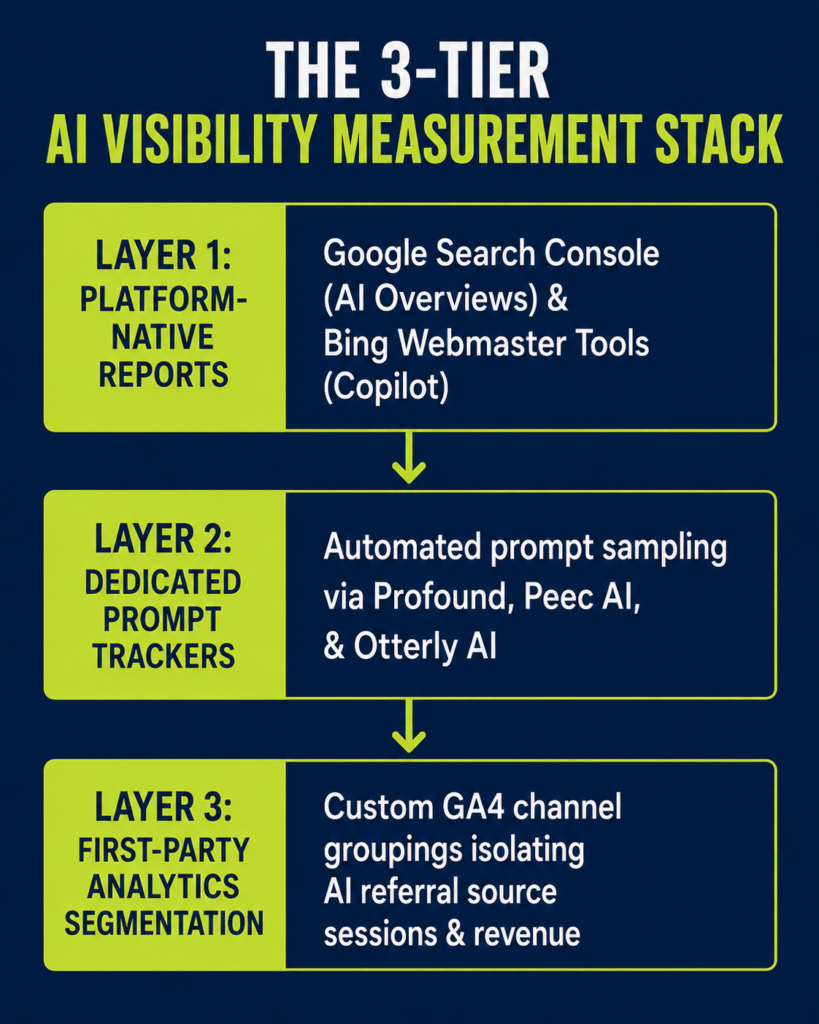
A complete measurement program answers three sequential questions:
- Brand Presence: Is your brand mentioned in generative answers for target customer prompts?
- Attribution & Citations: Is the mention backed by an explicit hyperlink or brand citation?
- Downstream Conversion: Are AI-driven referrals visiting your site and converting into revenue?
To establish baseline prompt-testing habits before building an automated tracking pipeline, read our guide on AI search visibility fundamentals.
The 4 Core AI Visibility Metrics to Track
Rankings alone can’t tell you whether AI answers are working for your brand. These four metrics give you the full picture, from how often you’re cited to whether that visibility turns into revenue.
1. Citation Frequency
How often AI engines cite or link to your site when answering a defined set of prompts. Run the same prompt set on a regular schedule, because AI answers vary from one run to the next and a single check can mislead you.
2. Share of AI Voice
Your brand’s mentions and citations as a percentage of all brands named for the same prompts. This is the metric that shows whether you are gaining ground on competitors, not just appearing.
3. AI Referral Traffic and Conversions
Sessions that arrive from ChatGPT, Perplexity, Copilot, Gemini, and other AI platforms, and what those visitors do next. Track this in GA4 with a dedicated channel group (covered below) so it doesn’t get lost in referral or direct traffic.
4. Brand Accuracy and Sentiment
Whether AI answers describe your brand, products, and pricing correctly, and whether the framing is positive, neutral, or negative. Being mentioned with outdated or wrong information can cost you more than not being mentioned at all.
The 7 AI Search Surfaces to Track
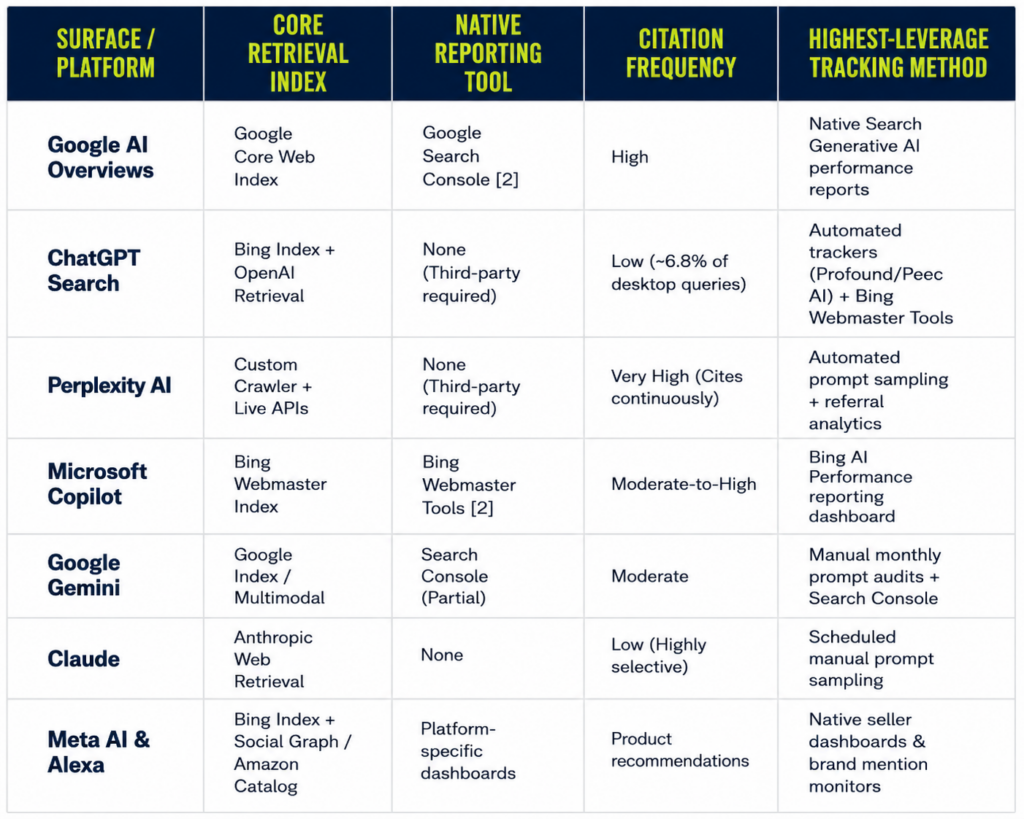
Each major AI engine utilizes different indices, citation models, and analytics access.
1. Google AI Overviews & AI Mode
The highest-volume surface in search. Google supplies native tracking through Google Search Console performance reports [²].
2. ChatGPT Search
Functioning as a primary research and shopping engine, ChatGPT relies heavily on Bing’s search index for live web queries. Review The ChatGPT Search Playbook to understand how Bing indexing dictates ChatGPT citations.
3. Perplexity AI
The most citation-dense platform, making it highly transparent for tracking source links and verifying information accuracy.
4. Microsoft Copilot
Runs on Bing’s web index and integrates natively into Windows, Edge, and Microsoft 365, serving a high volume of enterprise and B2B users.
5. Google Gemini
Embedded across Android, Google Workspace, and Google Search interfaces. While citation mechanics remain less transparent than AI Overviews, tracking Gemini share of voice is critical for total Google ecosystem coverage.
6. Claude (Anthropic)
Features no public advertising layer or native brand reporting. Claude requires manual prompt sampling to evaluate presence among technical and professional user bases.
7. Amazon Alexa for Shopping & Meta AI
Context-specific discovery surfaces operating within commerce and social networks. Explore our tactical guides on Alexa for Shopping optimization and Meta AI’s quiet turn into a search engine.
7 AI Search Surfaces Comparison Matrix
How to Track Google AI Overviews and AI Mode
In June 2026, Google introduced dedicated Search Generative AI performance reports inside Google Search Console [²]. This report isolates queries where your URL appeared as a source inside an AI Overview or AI Mode response from standard organic listings.
How to Analyze Search Console AI Data:
- Account for Impression Definitions: An impression registers whenever your page is cited as a source inside a synthesized answer, even if the user does not scroll to view the link card. Expect click-through rates (CTR) on AI Overviews to run lower than standard top-3 organic blue links.
- Identify Zero-Click Exposure: Filter AI performance data against your core product and transactional terms. High AI impressions coupled with low CTR indicate where zero-click search behavior is concentrating across your catalog.
- Cross-Reference with Bing Webmaster Tools: Bing’s AI Performance reports track Copilot citations while providing diagnostic visibility into the index that feeds ChatGPT’s search layer.
Tools for Tracking AI Overviews and AI Mode
Search Console shows when your pages are cited, but not which competitors are cited instead, or how often an AI Overview appears for your keywords at all. For that, use a tracker that records AI Overview and AI Mode results for your keyword list. SEOmonitor and Semrush check them alongside your regular rankings, while Peec AI and Otterly.AI treat AI Overviews and AI Mode as engines you can add to your prompt tracking.
AI Visibility Tracking Tools Compared
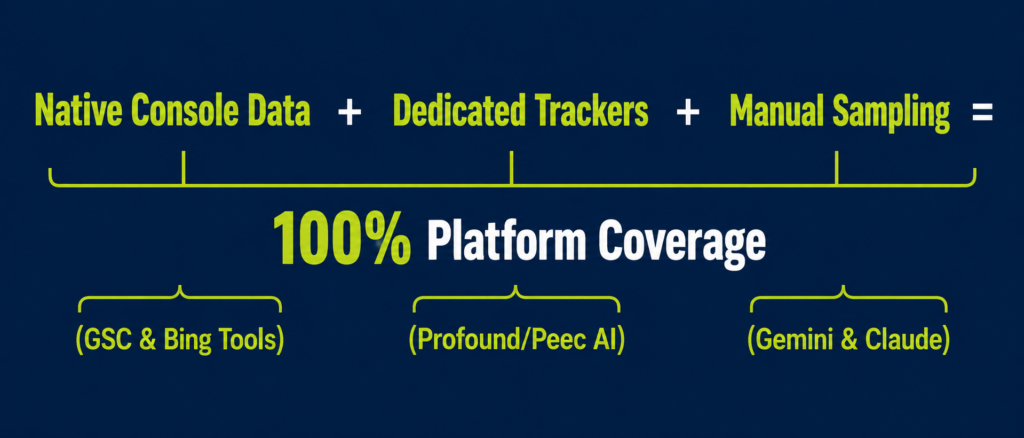
No single tool covers every AI platform, so most brands pair one paid tracker with the free reports from Google and Bing. Here is how the main options compare as of November 2026. Pricing in this category changes often, so confirm on each vendor’s pricing page before you buy.
| Tool | Starting price | AI platforms tracked | Best for |
|---|---|---|---|
| Google Search Console | Free | Google AI Overviews and AI Mode (pages cited from your site) | Every brand; your baseline for Google |
| Bing Webmaster Tools | Free | Microsoft Copilot and Bing AI answers | Every brand; also a read on the index behind ChatGPT search |
| Otterly.AI | €29/mo (Lite, 16 prompts); €189/mo (Standard, 120 prompts) | 4 engines on paid plans, chosen from ChatGPT, Google AI Overviews, AI Mode, Gemini, Perplexity, Copilot, and Claude | Small teams testing prompt tracking on a budget |
| SEOmonitor | €79/mo (Starter, 500 keywords) | Daily AI Overviews; one LLM of choice (ChatGPT, Gemini, or Perplexity) on Starter; ChatGPT, Claude, Gemini, and Perplexity on Pro (€299/mo) | Agencies tracking AI Overviews next to keyword rankings |
| Peec AI | $95/mo (Starter, 50 prompts, 3 engines) | Choose from ChatGPT, Perplexity, AI Overviews, AI Mode, Gemini, Bing AI Mode; more on Enterprise | Brands that want daily tracking on the engines their buyers use |
| Semrush AI Visibility Toolkit | $99/mo (25 prompts) | ChatGPT and Google AI Mode, among others | Teams already working in Semrush |
| Ahrefs Brand Radar AI | From $199/mo add-on; custom prompt packs from $50/mo | Google, ChatGPT, Gemini, Perplexity, Copilot, Claude | Benchmarking brand mentions against competitors at scale |
| Profound | Custom (Enterprise only for brands; free trial) | ChatGPT, Perplexity, Google AI Overviews and AI Mode, Gemini, Claude, and more | Large brands that need enterprise reporting and many markets |
How to Choose
- Just starting out: Otterly.AI Lite or SEOmonitor Starter lets you test AI tracking for under $100 a month.
- Already paying for Semrush or Ahrefs: add their AI module first so AI data sits next to your rankings and backlinks.
- Need daily tracking across several engines: Peec AI lets you pick the engines that matter to your buyers and add more later.
- Enterprise reporting across many brands: Profound now sells custom enterprise plans to brands, so expect a sales process.
Pricing sources (checked November 2026): Otterly.AI, SEOmonitor, Peec AI, Semrush, Ahrefs, Profound.
Why Trackers Report a Citation Rate, Not a Rank
AI answers change from one run to the next, so the same prompt can cite different sources each time. Good trackers run each prompt several times and report the share of runs where your brand was cited. Judge trends over weeks, not single checks.
Manual Prompt Sampling
For Claude and any engine your tool doesn’t cover, run 20 to 30 core buyer questions each month and log whether your brand is mentioned, cited, or missing.
Isolating AI Referral Traffic in GA4 Analytics
Standard Google Analytics 4 (GA4) properties route incoming traffic from AI engines into broad channels like Organic Search, Referral, or Unassigned. Isolating this traffic requires custom channel groupings.
Recommended Custom Channel Grouping Setup:
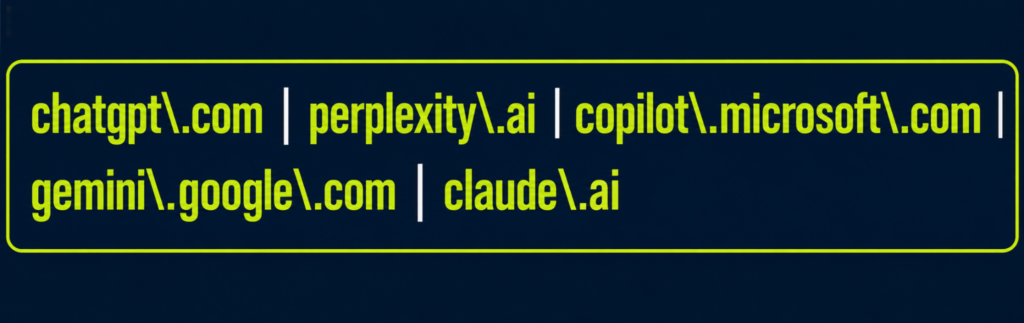
Create a custom channel definition named AI Search Referrals filtering by Session Source using standard regex matching:
.*(chatgpt\.com|openai\.com|perplexity\.ai|gemini\.google\.com|copilot\.microsoft\.com|claude\.ai|meta\.ai).*Place this channel above Referral in your channel group so GA4 checks it first.
Key Measurement Nuances:
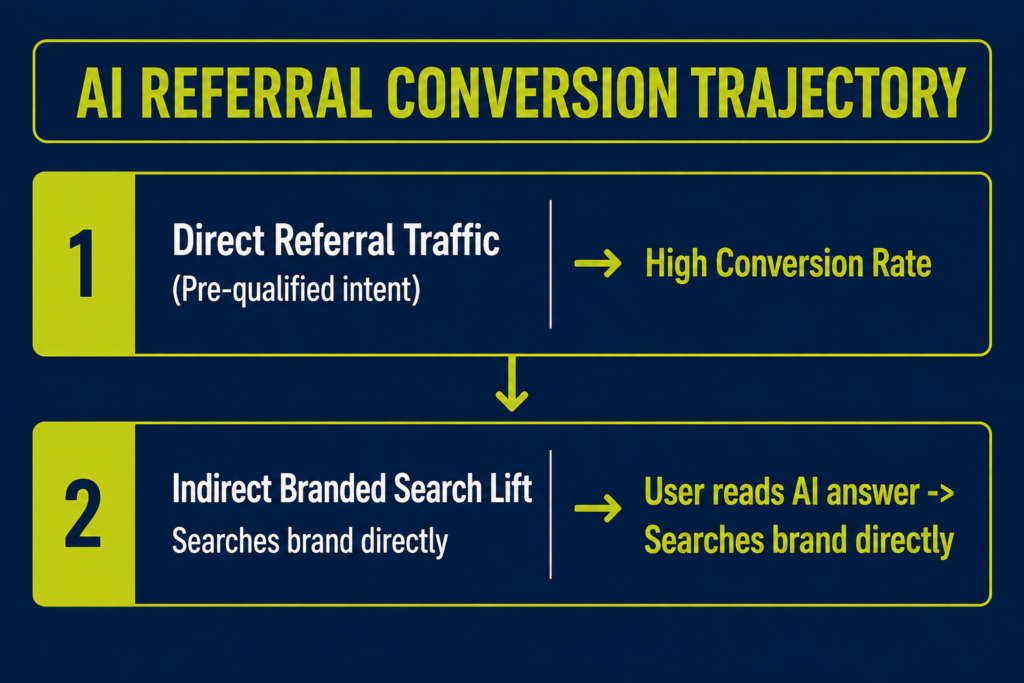
- The Dark Social Effect (Indirect Search Lift): A significant portion of AI discovery does not result in a direct citation click. Users often read an AI recommendation, close the chat window, and search for the recommended brand name directly. Monitor Branded Search Volume alongside direct AI referral sessions.
- High-Intent Conversion Rates: Industry data indicates that visitors arriving via direct AI citations convert at higher rates than average organic search traffic [[1]]. Users who click an AI citation have already digested a synthesized answer and enter the funnel with higher buying intent.
Connecting fuzzy AI discovery touchpoints to direct orders is why we developed our first-party attribution platform, AdBeacon, giving marketing teams accurate source attribution without relying on spreadsheet estimates.
The Monthly AI Search Scoreboard Framework
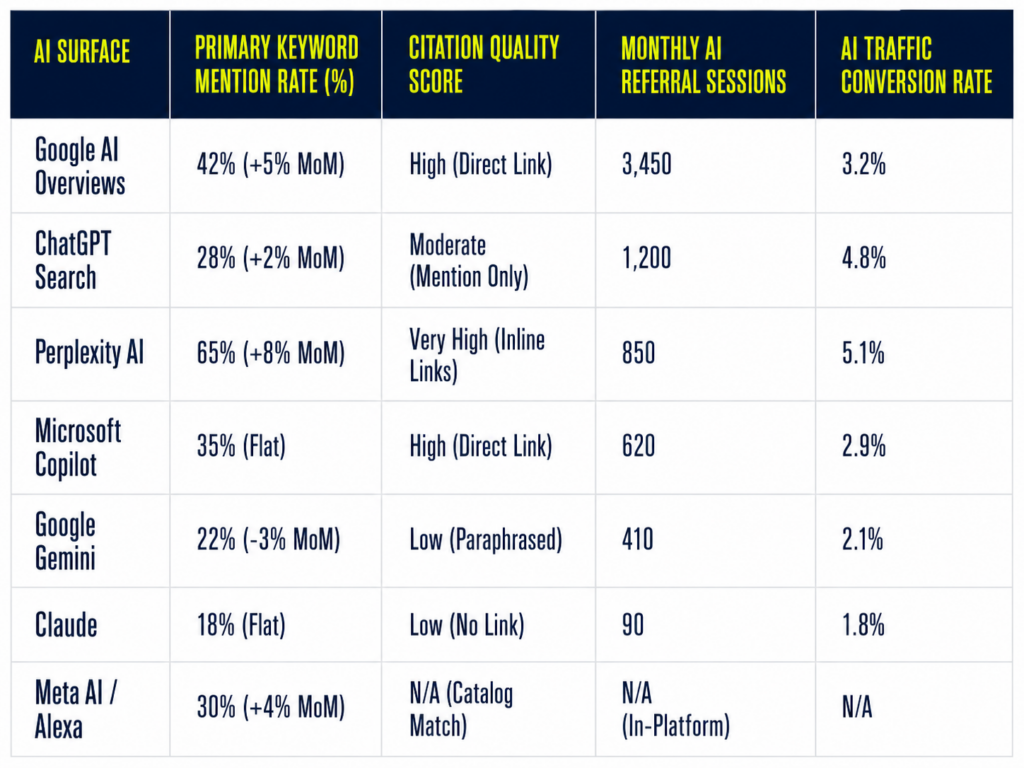
Avoid complex 12-tab dashboards. Instead, build a clean, single-page monthly scoreboard that tracks performance across all seven surfaces.
Executive AI Visibility Scoreboard Format
5 Common Measurement Pitfalls to Avoid
- Waiting for “Perfect” Unified Measurement: Postponing tracking until a single tool monitors all seven platforms leaves your brand blind to shifting customer discovery patterns. Directional data beats no data.
- Relying Solely on a Single Tool: No single platform provides complete coverage across all generative engines. Combine search console data, point-solution trackers, and manual sampling.
- Overreacting to Short-Term Citation Shifts: Generative models are probabilistic. A single day’s citation drop often reflects sampling variance rather than lost visibility. Evaluate performance trends over monthly or quarterly windows.
- Ignoring Traffic-Sparse Engines: Low referral traffic on platforms like Claude or Gemini does not justify ignoring them. Content structured to earn citations on one engine improves machine readability across all LLMs.
- Equating AI Impressions with Conversions: Appearing inside an AI Overview answer represents brand exposure, not a sale. Report impressions and converted sessions on separate line items.
Your 30-Day AI Visibility Tracking Implementation Plan
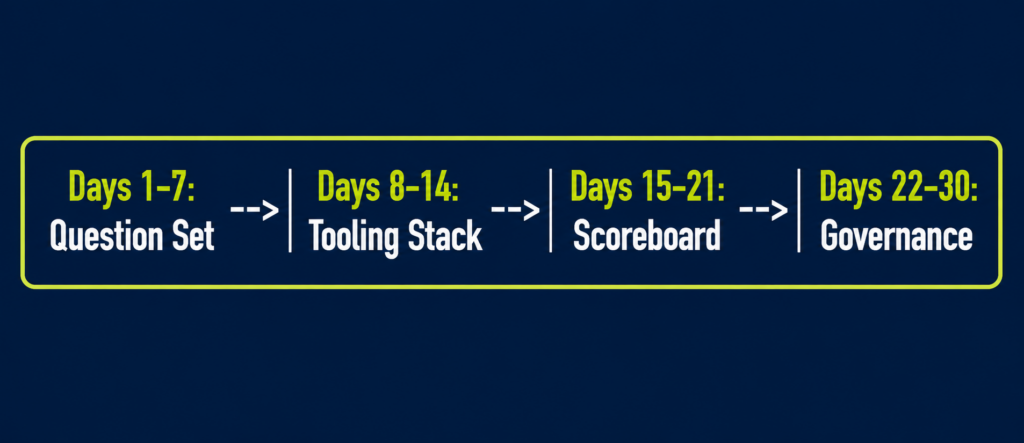
Days 1 to 7: Build Query Sets & Analytics Filters
- Compile 30 to 50 high-intent questions your buyers ask prior to purchasing.
- Verify domain ownership in Google Search Console and Bing Webmaster Tools.
- Build the custom AI Referral regex filter in GA4 to isolate incoming chat traffic.
Days 8 to 14: Select Your Tooling Stack & Run Baseline Tests
- Implement a dedicated point-solution tracker (e.g., Profound, Peec AI) for ChatGPT, Perplexity, and Copilot.
- Run manual prompt tests across Gemini and Claude, recording initial mention rates.
- Export baseline AI performance data from Google Search Console and Bing Webmaster Tools.
Days 15 to 21: Construct the Monthly Scoreboard
- Consolidate your tracking sources into a single monthly scoreboard.
- Distribute baseline figures to marketing leadership and executive stakeholders.
Days 22 to 30: Establish Ongoing Reporting Cadence
- Assign clear internal ownership for monthly scoreboard updates.
- Schedule a monthly performance review to reallocate content and optimization resources toward underperforming platforms.
If your team requires expert support to build and maintain this measurement infrastructure, our specialized AI Search Optimization program provides comprehensive tracking and optimization across all major AI platforms.
Partner with National Positions
Establishing clear visibility across seven evolving AI search platforms requires advanced analytics engineering, continuous prompt sampling, and data integration expertise.
National Positions delivers complete measurement solutions for growing brands:
- 22+ Years of Growth Analytics: Managing and optimizing search performance for over 300 e-commerce and SMB brands.
- Google Premier Partner Leadership: Recognized in the top tier of performance agencies worldwide.
- The PACE Framework: Our integrated strategy (Plan, Analyze, Convert, Expand) grounds every campaign in verified revenue metrics.
- Proprietary Attribution Infrastructure: Our first-party attribution platform, AdBeacon, bypasses platform self-reporting to link AI citations and multi-touch discovery directly to sales revenue.
Book a Consultation to Audit Your AI Visibility
Ready to evaluate your true share of voice across ChatGPT, Perplexity, Google AI Overviews, and Copilot? Book a call with National Positions to receive a comprehensive AI search audit and build a custom visibility scoreboard for your brand.
Frequently Asked Questions
Is there a single tool that tracks AI search visibility across all platforms?
No. Complete coverage requires a hybrid tracking stack: Google Search Console and Bing Webmaster Tools for native search data [²], point-solution trackers (Profound, Peec AI) for ChatGPT and Perplexity, and manual sampling for Claude and Gemini.
What is the difference between an AI Overview impression and an actual click?
An impression registers whenever your page is included as a source inside an AI-generated answer, regardless of whether the user scrolls to view or click the link. A click represents a user actively navigating from the AI citation to your website.
How can I verify whether ChatGPT or Perplexity traffic is converting?
Build a custom channel grouping in GA4 filtering for referral sources like chatgpt.com or perplexity.ai. Compare conversion rates and Average Order Value (AOV) for this segment against your overall organic site averages [¹].
Should my brand track platforms that currently drive low referral volume, like Claude?
Yes. The structural optimization signals required to earn citations on platforms like Claude (clean entity data, well-structured content, verifiable authority) enhance machine readability across all LLM platforms.
How often should an e-commerce brand update its AI visibility scoreboard?
Monthly. Updating weekly leads to overreacting to probabilistic sampling noise, while quarterly updates are too slow to keep pace with algorithmic changes across AI search platforms.
Are Google Search Console’s native AI performance reports accurate?
Yes, Google Search Console AI reports provide directionally accurate data for tracking impressions and clicks within AI Overviews [²]. Use it as a trailing metric evaluated over multi-week windows.
Sources & References
- Adobe Digital Insights, “E-commerce AI-Referred Traffic Growth & Conversion Benchmarks,” Retail Analytics Report (2026).
- Microsoft Webmaster Documentation, “Search Generative AI & Bing AI Performance Reporting Frameworks,” Bing Technical Documentation (Updated June 2026).
Related Guides & Next Steps
Continue building your generative search optimization strategy with our platform-specific playbooks:
- Master ChatGPT Retrieval: Read The ChatGPT Search Playbook to optimize for Bing index dependencies and OpenAI search features.
- E-Commerce Voice Search: Read Alexa for Shopping Optimization to adapt your Amazon product catalog for AI voice shopping.
- Social Discovery: Read Meta AI’s Quiet Turn into a Search Engine to optimize content for social AI assistants.