How do you get cited in Google AI Overviews? Google builds AI Overviews from passages it can lift cleanly from pages it already trusts. Most citation wins come from making your best answer easy to find, easy to extract, and clearly credible.
How to Get Cited in Google AI Overviews
- Answer the question first. Put a 40 to 60 word direct answer right under a heading that matches the search.
- Make the page easy to extract. Use descriptive H2 and H3 headings, short paragraphs, lists, and tables so each passage stands on its own.
- Show real expertise. Add a named author with credentials, first-hand data or examples, and cited sources.
- Keep it current. Refresh stats and dates and show a last-updated date, because Google favors fresh answers on changing topics.
- Add structured data that matches the page. Article, FAQ, or Product schema helps Google understand the content, though it doesn’t guarantee a citation.
- Make sure Google can use it. Check that the page is indexed and that you aren’t blocking snippets with nosnippet or max-snippet tags.
Then measure what changes. Search Console now reports AI Overview and AI Mode appearances, and our guide to AI search visibility tracking covers the tools that show where competitors are cited instead. The full 8-step pipeline is further down this page.
Key Takeaways
- Passage-Level Extraction: Google evaluates relevance at the paragraph level. A single, tightly written 40-to-60-word answer can earn an AI Overview citation even if the page ranks fifth or sixth organically [²].
- Organic Baseline Required: Over 80% of cited sources in AI Overviews come from pages already ranking in the top 10 organic search results [²]. Traditional SEO remains the mandatory entry floor.
- The 4 Citation Levers: AI Overview inclusion is driven by passage-level relevance, E-E-A-T (Experience, Expertise, Authoritativeness, Trustworthiness), structured HTML markup (JSON-LD schema), and content freshness [¹] [²].
- Zero-Click Acceleration: Over 60% of generative search interactions resolve without an outbound click [³]. Earning brand placement and inline citations within the AI Overview box is the primary metric for maintaining share of voice.
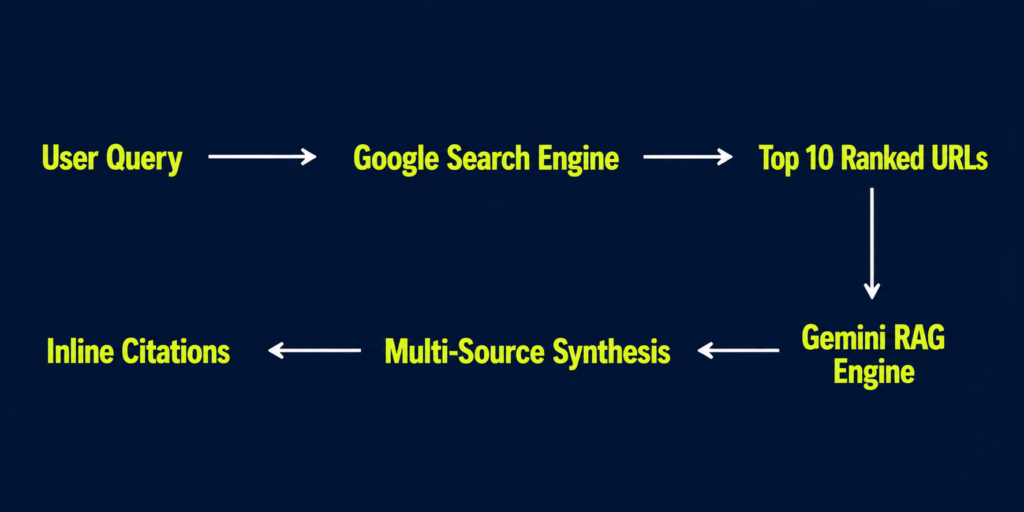
- Multi-Source Synthesis: Unlike traditional featured snippets that extract text from a single source, AI Overviews stitch together complementary facts from multiple domains [¹].
What Exactly Are Google AI Overviews?
Google AI Overviews (AIO) are generative answer modules powered by Gemini that appear at the top of Google search results for informational, comparative, and complex multi-part queries [¹].
Featured Snippets vs. Google AI Overviews
How Google Chooses Which Sources to Cite
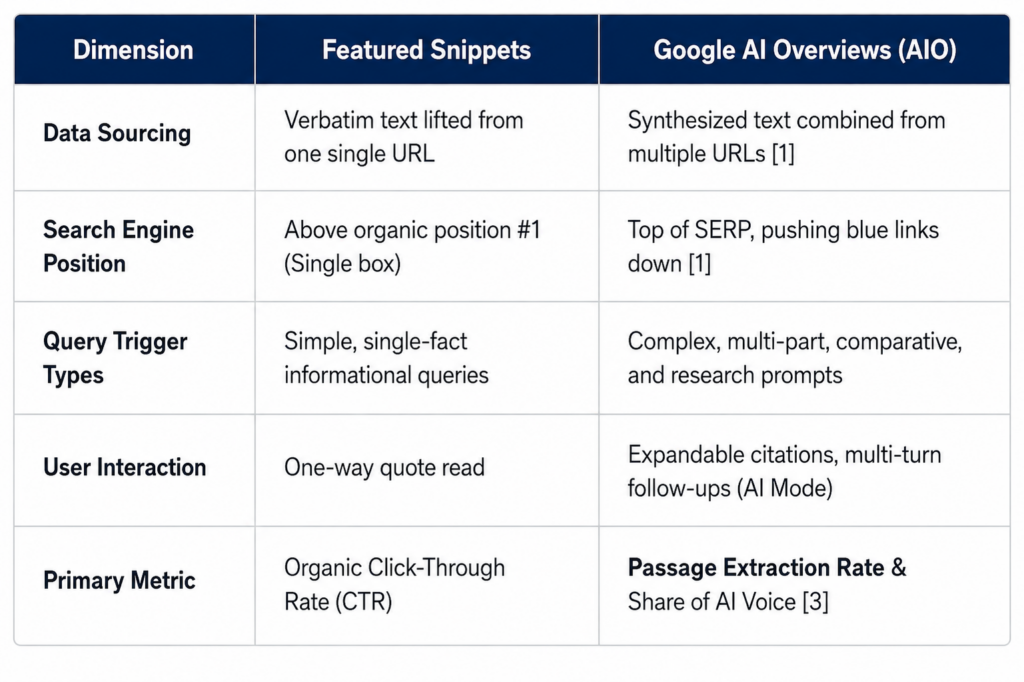
Google uses Retrieval-Augmented Generation (RAG) to build AI Overviews [¹]. The system queries Google’s core web index, retrieves candidate URLs, and extracts passages to generate a synthesized response [²].
The 4 Selection Criteria:
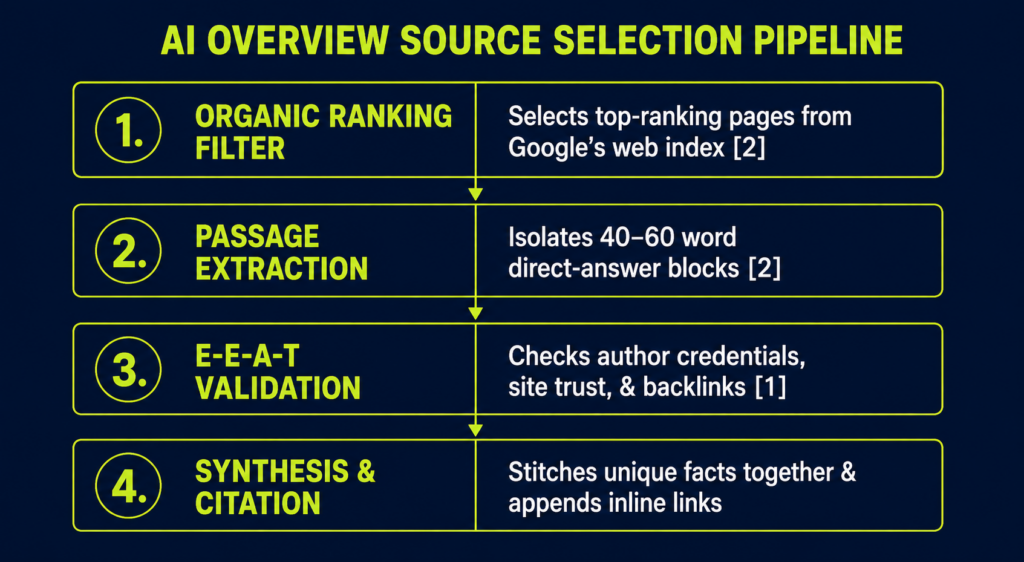
- Top-10 Organic Presence: Pages must demonstrate baseline organic search relevance. Google rarely cites URLs sitting outside the first page of search results [²].
- Passage-Level Precision: Google’s indexing engines evaluate text in discrete blocks. Pages that state a clear, concise answer within the first two sentences of an HTML section are prioritized for extraction [²].
- Information Density & Unique Value: Gemini avoids repeating duplicate facts. Pages providing unique data points, original case studies, or explicit spec tables earn higher citation weights [¹].
- Domain Trust and E-E-A-T: Google requires high confidence in source accuracy. Verified author credentials, clear organization metadata, and external digital PR mentions drive selection algorithms [¹].
To understand how Google’s AI interfaces compare against ChatGPT, Perplexity, and Copilot, explore our guide on AI Search Visibility in 2026.
The 4 Core Levers of AI Overview Citations
To optimize your content for Google AI Overview extraction, focus execution on four core architectural levers.
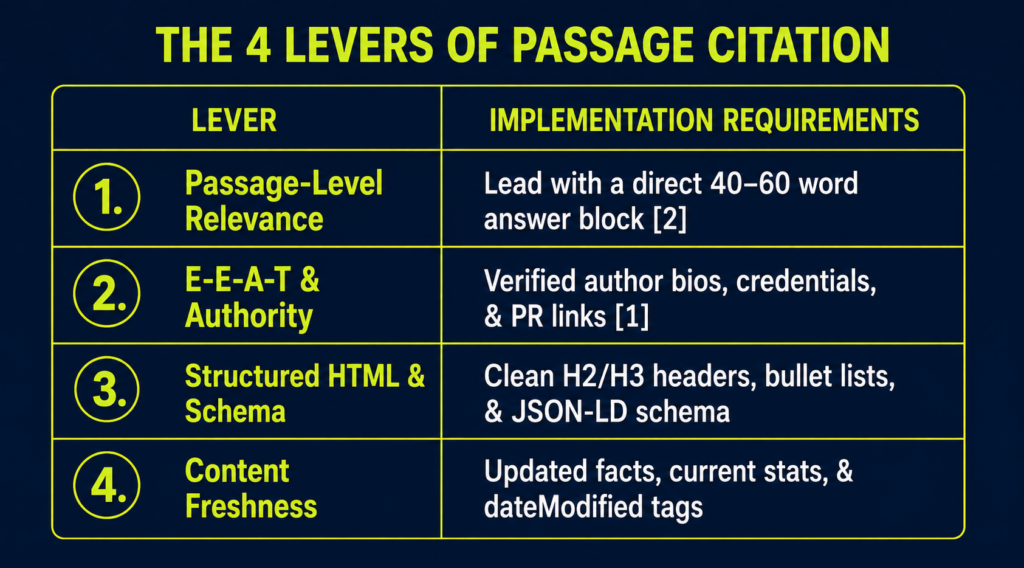
1. Passage-Level Relevance (The “Front-Loaded Answer” Rule)
Place a self-contained 40-to-60-word summary directly beneath every query-targeted H2 or H3 heading. State the direct fact first, then elaborate with supporting details in subsequent paragraphs [²].
The Passage Extraction Test:
If Google extracts only the first 40 words below your heading, does it form a complete, factually accurate answer? If yes, the passage is AI-citation ready.
2. Authority and E-E-A-T Signals
Anchor every major article to a verified author profile containing professional credentials, social media links, and industry background [¹]. Boost domain trust by earning brand mentions and co-citations across authoritative industry publications [³].
3. Structured, Scannable Content Architecture
Organize content using clear HTML hierarchies:
- Use query-based subheadings matching real user search intent (e.g., <H2>How Much Does Server-Side Tracking Cost?</H2>).
- Use ordered lists (<ol>) for sequential procedures and unordered lists (<ul>) for feature specifications.
- Implement structured JSON-LD schema markup (Article, FAQPage, Product, HowTo) to eliminate machine parsing ambiguity.
4. Content Freshness and Temporal Validity
Update cornerstone commercial and informational content regularly. Ensure dateModified schema tags reflect genuine updates to statistics, pricing models, and product specifications. Stale dates lower retrieval weights in live Gemini passes [²].
On-Page Optimization: What to Fix vs. What to Stop
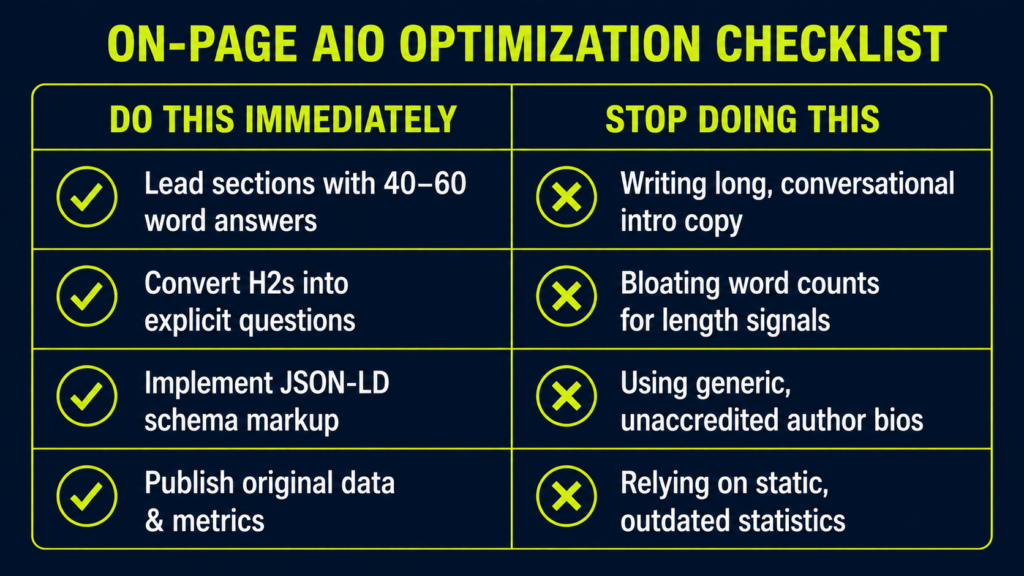
Bad Habits to Eliminate:
- Stop Writing for Word Count: Word count is not an AI Overview ranking factor. Gemini extracts precise passages. Padded copy buries key facts and lowers extraction scores [²].
- Stop Chasing Manipulative “AI Hacks”: There are no hidden CSS tricks or secret schema codes that force an AI Overview citation. Focus on structural clarity and E-E-A-T [¹].
- Stop Blocking AI Crawlers: Restricting search crawlers destroys visibility across both organic search and generative AI summaries [²].
Step-by-Step AI Overview Optimization Pipeline
Follow this 8-step pipeline to systematically optimize existing content for passage extraction.
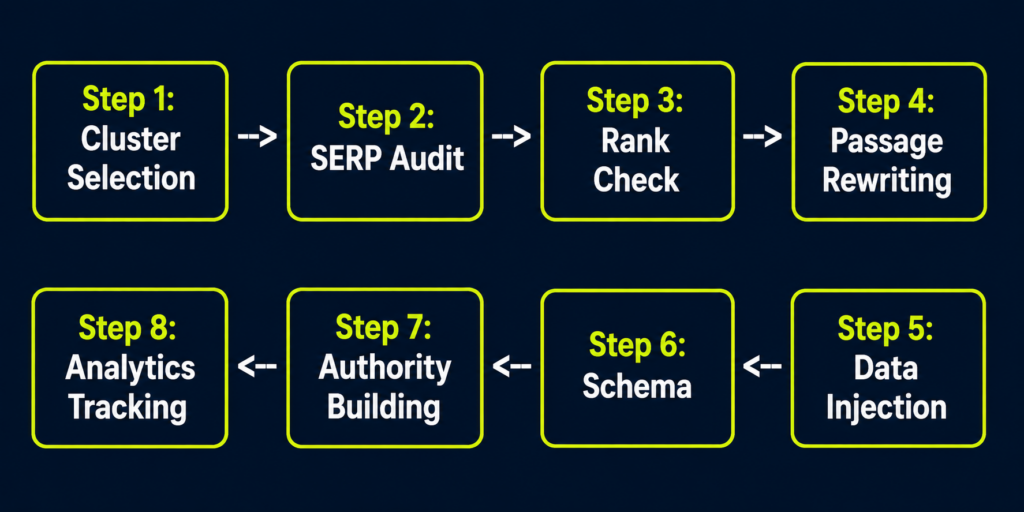
- Select High-Intent Query Clusters: Target 15 to 25 commercial or informational search queries where AI Overviews already appear.
- Audit Current Cited Sources: Inspect the live AI Overview for each target query. Document which competitor URLs are cited and analyze the exact text structure of extracted passages.
- Verify Organic Ranking Baseline: Ensure your target page ranks within the top 10 organic results. If the page sits on page two or lower, resolve traditional technical and backlink SEO issues first [²].
- Rewrite Sections for Direct Extraction: Reframe H2 subheadings as direct questions and insert a 40-to-60-word direct answer immediately below each heading [²].
- Inject Proprietary First-Party Data: Add unique metrics, original survey results, or specific case study outcomes to provide citable value that competitors lack [¹].
- Deploy JSON-LD Schema Markup: Implement valid FAQPage, Article, and Product schema markup to provide structured machine-readable context.
- Strengthen Author & E-E-A-T Metadata: Add detailed author bios, link to verified professional profiles, and execute digital PR campaigns to earn high-authority media mentions [¹].
- Establish a Quarterly Refresh Cadence: Schedule regular updates for cornerstone pages to maintain high freshness scores.
If you need a dedicated partner to execute this framework across your catalog, explore our specialized AI Search Optimization services.
How to Measure and Track AI Overview Visibility
Because AI Overviews resolve many queries directly on the SERP, tracking success requires monitoring citation presence alongside traditional traffic metrics [³].
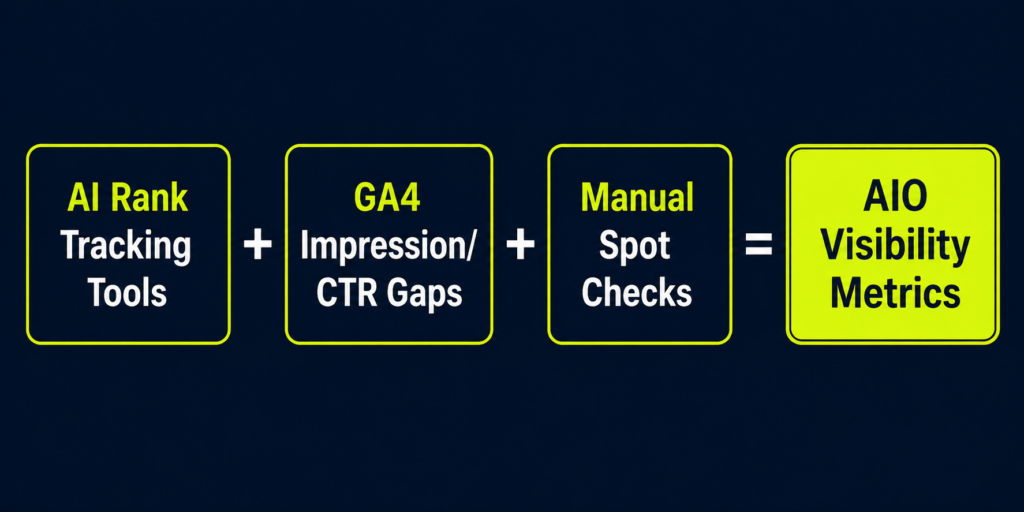
- Enterprise Rank Trackers: Utilize rank tracking platforms (Semrush, Ahrefs, BrightEdge) that detect AI Overview occurrences and report whether your domain is cited inside the box [²].
- Search Console CTR Discrepancy Analysis: Monitor Google Search Console for queries where impressions increase or hold steady while Click-Through Rates (CTR) drop. This pattern frequently indicates an AI Overview answering the prompt on the SERP [³].
- Manual Verification Audits: Perform regular spot checks in clean, unpersonalized browser sessions for your top 20 revenue-driving search terms.
- Brand Share of AI Voice: Calculate the percentage of category-level AI Overviews that cite your brand versus direct competitors.
Connecting top-of-funnel AI discovery touchpoints to direct orders is why we developed our first-party attribution platform, AdBeacon, giving marketing teams clear revenue attribution without relying on spreadsheet estimates.
Partner with National Positions for Advanced GEO
Transitioning from traditional SEO to Generative Engine Optimization requires technical data engineering, content extraction modeling, and cross-platform citation monitoring.
National Positions provides complete Generative Engine Optimization solutions:
- 22+ Years of Growth Engineering: Managing search and performance analytics for over 300 e-commerce and B2B brands.
- Google Premier Partner Leadership: Recognized in the top tier of performance marketing agencies globally.
- The PACE Framework: Our methodology (Plan, Analyze, Convert, Expand) grounds AI search strategies in verified revenue metrics.
- First-Party Attribution via AdBeacon: Our proprietary first-party attribution platform, AdBeacon, measures traffic, attribution, and conversion impact across paid, organic, and AI-driven channels.
Ready to audit your brand’s AI Overview visibility? Book a call with our team to evaluate your current citation baseline and build a platform-specific GEO strategy.
Frequently Asked Questions
Do I have to rank #1 organically to get cited in a Google AI Overview?
No. Google evaluates relevance at the passage level [²]. A clear, direct answer can be extracted from a page ranking fifth or sixth organically. However, over 80% of cited sources sit within the top 10 organic results [²].
Will AI Overviews reduce my organic website traffic?
For high-level informational queries, AI Overviews increase zero-click behavior, which can lower organic CTRs [³]. However, users who click inline AI citations demonstrate higher buying intent, resulting in improved downstream conversion rates [³].
Can a website block Google from using its content in AI Overviews?
While webmasters can use preview controls (such as max-snippet tags) to limit text extraction, blocking Google entirely removes your site from organic search indexing as well [¹]. Earning citations provides significantly higher commercial value than opting out.
How does optimizing for AI Overviews differ from traditional SEO?
Traditional SEO focuses on page-level keyword density, backlinks, and click satisfaction. AI Overview optimization focuses on passage-level extraction quality, concise direct answers, structured JSON-LD schema, and strong E-E-A-T signals [¹] [²].
How long does it take to earn citations in AI Overviews?
Pages already holding top-10 organic rankings can see AI Overview citations within weeks of restructuring section leads into direct answer blocks [²]. Pages requiring foundational authority and organic ranking improvements typically take several months.
Does JSON-LD schema markup guarantee an AI Overview citation?
No. Schema markup helps Google’s parsers understand page structure, but it does not force a citation [¹]. Passage relevance, E-E-A-T, and content freshness remain the primary selection factors [¹] [²].
Sources & References
- Google Search Central, “Documentation on AI Features in Search, Helpful Content, and E-E-A-T Frameworks,” Technical Webmaster Documentation [¹].
- BrightEdge & Semrush Research, “AI Overviews Citation Patterns, Organic Rank Overlap, and Passage Retrieval Benchmarks,” Industry Search Analytics (2025–2026) [²].
- Search Engine Land & Pew Research, “Zero-Click Search Trends, Generative SERP Adoption, and Referral Traffic Benchmarks,” Industry Reporting [³].
Related Deep-Dive Guides
- Cross-Platform Strategy: Read What Is Generative Engine Optimization (GEO)? to master cross-platform LLM citation factors.
- Google’s Ecosystem: Read Google AI Mode vs. AI Overviews to optimize for Google’s conversational search tab.
- OpenAI Integration: Read The ChatGPT Search Playbook to capture citations across OpenAI and Bing search networks.