Executive Summary: Structured data implemented as Schema.org JSON-LD translates unstructured website text into explicit, machine-readable facts [¹]. While schema markup does not guarantee AI Overview or LLM citations on its own, it eliminates semantic ambiguity, enabling AI answer engines—such as Perplexity, Google Gemini, and Microsoft Copilot—to parse page entities, verify authorship, and extract direct passages with high attribution confidence [¹] [²].
Key Takeaways
- Eliminates Machine Ambiguity: Structured data provides explicit semantic definitions (authorship, dates, organization entities, product attributes) that help large language models (LLMs) parse webpage meaning without guesswork [¹] [²].
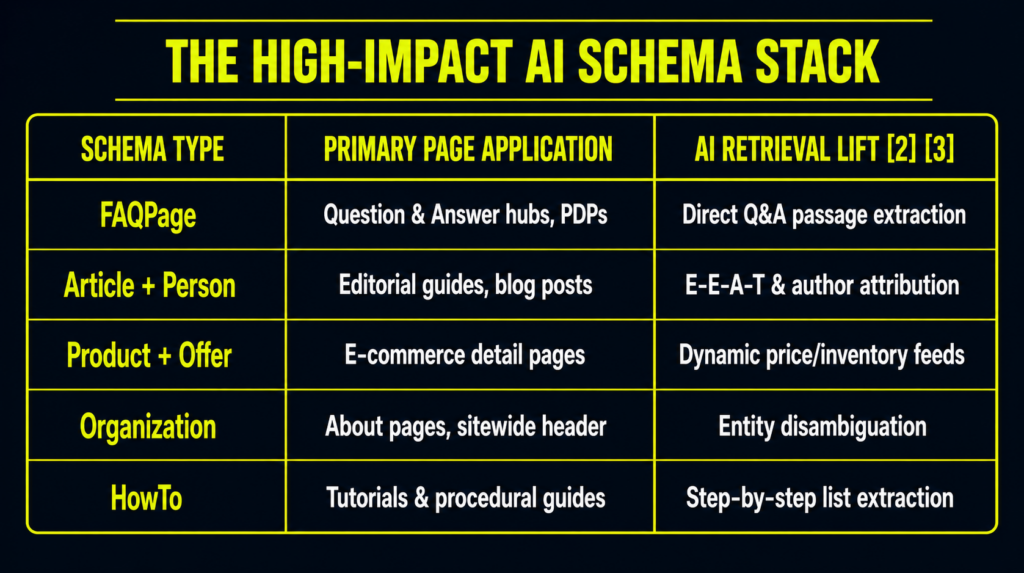
- High-Impact Schema Stack: The most effective schema types for generative search are Article (with Person), FAQPage, Product (with Offer), Organization (with sameAs), and HowTo [²] [³].
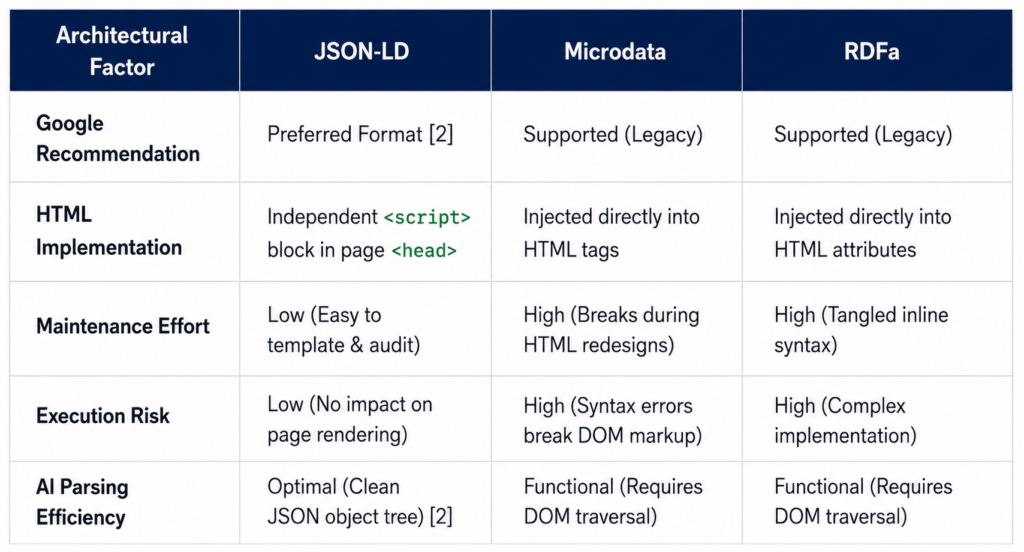
- Format Standardization: Google and AI retrieval engines strongly recommend JSON-LD script blocks over Microdata or RDFa due to ease of maintenance and clean separation from HTML content [²] [³].
- Strict Alignment with Visible Content: Marking up hidden content or fabricating properties violates search engine guidelines and risks manual penalties [¹] [²].
- Force Multiplier for Quality: Schema markup amplifies the extraction potential of high-quality, authoritative content; it cannot manufacture value for thin or unverified articles [¹] [²].
Why Structured Data Matters for AI Search
AI answer engines operate differently than traditional search crawlers. While standard search engines evaluate pages to return a ranked list of blue links, generative engines like Perplexity, Google Gemini, and Microsoft Copilot extract specific passage chunks and synthesize responses with inline citations [²] [⁴].
1. Article & Person Schema (E-E-A-T Verification)
Article schema (or specialized subtypes like BlogPosting and NewsArticle) explicitly defines headlines, publication dates, modification timestamps, and author entities [²]. Nesting Person schema within the author property—including jobTitle, knowsAbout, and sameAs links pointing to verified LinkedIn profiles or author pages—provides the technical verification required for Google’s E-E-A-T assessment [²].
2. FAQPage Schema (Direct Q&A Extraction)
FAQPage schema structures pre-formatted question-and-answer pairs [²] [³]. Because RAG (Retrieval-Augmented Generation) engines seek clear, standalone answers to customer queries, FAQPage markup delivers extractable text blocks that LLMs can quote directly [²] [³].
3. Product & Offer Schema (E-Commerce Discovery)
For direct-to-consumer (DTC) and e-commerce brands, Product schema—nested with Offer, AggregateRating, and Review properties—is essential [²]. When users prompt AI engines for product recommendations within specific budget or feature parameters, structured product attributes allow AI systems to verify price, stock status, and feature compatibility accurately [²].
4. Organization Schema (Entity Disambiguation)
Organization schema defines your corporate identity: legal name, official logo, contact points, and sameAs arrays linking to verified Wikipedia entries, Google Business Profiles, and official social channels [²]. AI models rely on entity resolution to connect your blog articles, product pages, and third-party media coverage back to a single brand node [¹] [³].
5. HowTo Schema (Procedural Guidance)
HowTo schema breaks step-by-step instructions into discrete, sequential steps (HowToStep). This structure allows answer engines to extract and format procedural lists directly within generated outputs [²] [³].
JSON-LD vs. Microdata & RDFa Architecture
Structured data can be implemented using three formats: JSON-LD, Microdata, and RDFa. JSON-LD is the universal standard for modern search engine optimization and AI retrieval [²] [³]
How Structured Data Powers Machine Citation Confidence
Implementing structured data reduces computational friction for search crawlers, increasing the likelihood of inline passage citation through three primary mechanisms [²] [³]:
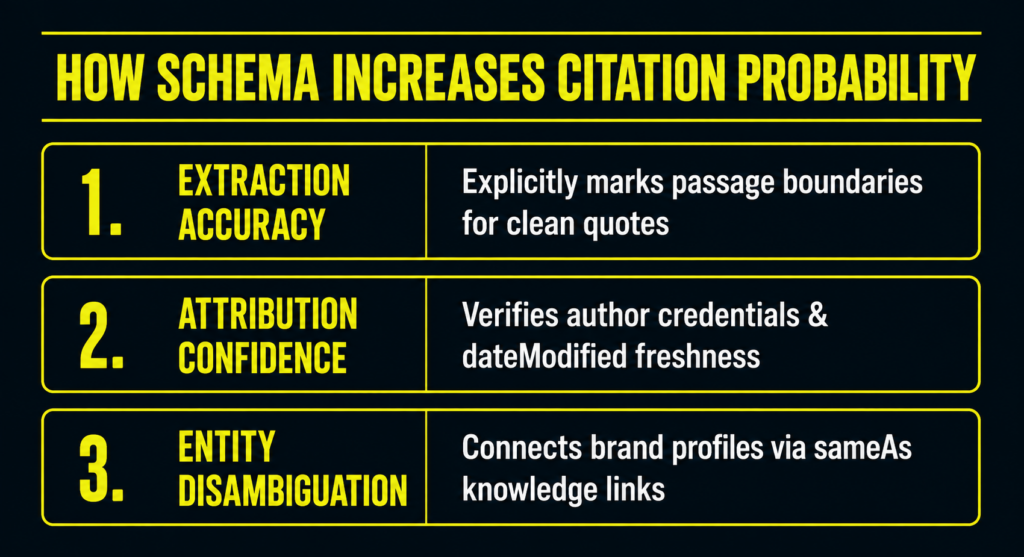
- Extraction Accuracy: Marking up FAQ pairs or article summaries defines explicit passage boundaries [²]. The RAG pipeline can extract a 40-to-60-word passage without misinterpreting surrounding sidebar text or navigation links [³].
- Attribution Confidence: AI engines weigh content source credibility before displaying inline links. Article schema that identifies a credentialed Person author and an updated dateModified timestamp satisfies freshness and authority validation checks [²].
- Entity Disambiguation: Using sameAs arrays within Organization schema connects your website directly to recognized Knowledge Graph entities [¹] [²]. This ensures that off-site brand mentions earned through PR and AI Visibility campaigns accurately strengthen your brand’s core domain authority.
5 Common Schema Mistakes That Destroy Citations
- Mistake 1: Marking Up Hidden Content: Including FAQ pairs or product attributes in JSON-LD that do not appear visibly on the rendered page violates search guidelines and risks manual action penalties [¹] [²].
- Mistake 2: Mixing Multiple Syntax Formats: Combining JSON-LD script blocks with inline Microdata creates conflicting entity nodes that confuse machine parsers [²].
- Mistake 3: Deploying Schema Without Technical Validation: Syntax errors, missing required properties, or invalid ISO date formats cause search engines to ignore structured data blocks entirely [²].
- Mistake 4: Treating Structured Data as a One-Time Install: Failing to update dateModified or product availability tags leads to stale markup that contradicts page content [²].
- Mistake 5: Expecting Schema to Replace Quality Content: Schema markup communicates content meaning; it cannot manufacture value for thin, unverified, or low-quality text [¹] [²].
An 8-Step Structured Data Implementation Roadmap
Follow this technical workflow to deploy standards-based JSON-LD across your website architecture.
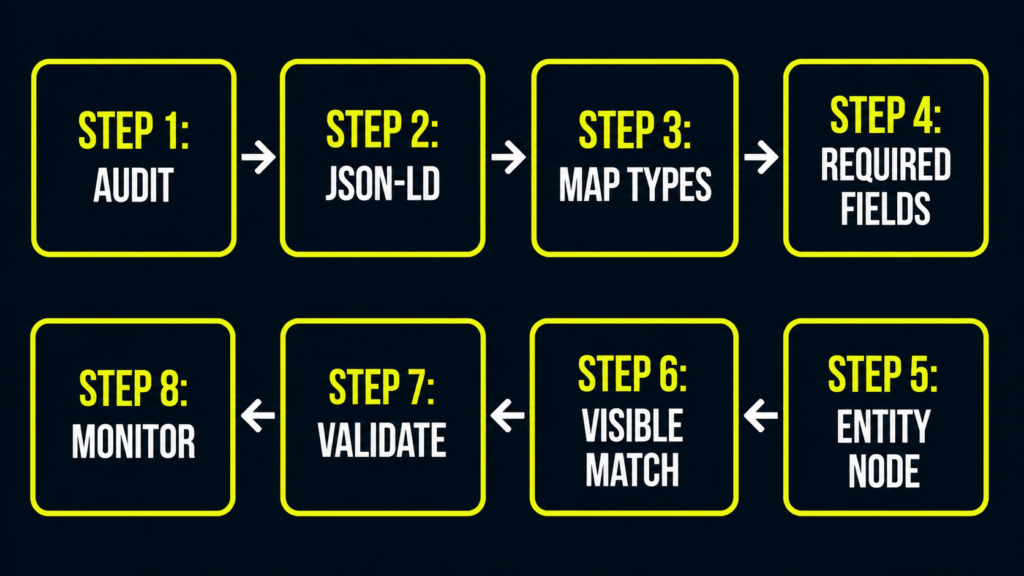
1. Audit Existing Schema Implementation
Crawl your domain using analytics tools to identify legacy Microdata, syntax errors, missing fields, or conflicting JSON-LD blocks [²].2. Standardize Exclusively on JSON-LD
Consolidate all structured data into clean JSON-LD script blocks placed within the page <head> or main template files [²].3. Map Schema Types to Page Templates
Assign explicit Schema.org types to target page templates:- Blog Posts & Guides: Article + Person + Organization
- Product Pages: Product + Offer + AggregateRating
- FAQ Sections: FAQPage
- Tutorials & Instructions: HowTo
4. Populate All Required and Recommended Properties
Ensure required fields are fully populated with accurate values:- Article: headline, image, datePublished, dateModified, author, publisher [²].
- Product: name, image, description, sku, offers (price, priceCurrency, availability) [²].
5. Build a Unified Organization Entity Node
Define your Organization schema centrally. Include legal business name, URL, official logo, contact endpoints, and authoritative sameAs profile links (Wikipedia, Crunchbase, LinkedIn, Google Business Profile) [²]. Reference this entity ID sitewide [²].6. Verify Alignment with Visible On-Page Text
Confirm that every statement contained within JSON-LD scripts strictly matches text visible to human visitors [¹] [²].7. Validate Markup Pre- and Post-Deployment
Test all template outputs using two primary validation tools prior to shipping code:- Schema.org Validator: Verifies syntax correctness against official Schema.org standards [²].
- Google Rich Results Test: Identifies platform-specific errors or missing required properties [²].
8. Establish Ongoing Schema Governance
Monitor structured data reports in Google Search Console and Bing Webmaster Tools monthly to identify syntax errors introduced during CMS updates [²]. To pair clean technical markup with direct-answer content structures, explore our guide on Answer Engine Optimization (AEO) for Perplexity, Gemini, and Copilot.Partner with National Positions for Enterprise GEO
Deploying valid, machine-readable structured data across enterprise websites requires technical analytics engineering, schema validation, and strategic content alignment.
National Positions provides complete Generative Engine Optimization solutions:
- 22+ Years of Search Engine Leadership: Managing search analytics and technical SEO for over 300 e-commerce and B2B brands.
- Google Premier Partner Leadership: Recognized in the top tier of performance marketing agencies worldwide.
- The PACE Framework: Our methodology (Plan, Analyze, Convert, Expand) grounds technical schema strategies in verified business revenue.
- First-Party Attribution via AdBeacon: Our proprietary first-party attribution platform, AdBeacon, tracks multi-touch discovery across organic, paid, and AI-driven channels.
Ready to audit your structured data and maximize your AI search visibility? Book a structured data and AI search audit with our team to evaluate your technical setup and build a platform-specific GEO strategy.
Frequently Asked Questions
Does structured data guarantee my website will be cited in Google AI Overviews?
No. Google explicitly states that structured data does not guarantee inclusion or citation in AI Overviews [¹]. Schema markup improves machine readability and entity understanding, but passage relevance, E-E-A-T authority, and content freshness remain primary selection criteria [¹] [²].
What is the difference between JSON-LD, Microdata, and RDFa?
They are three distinct syntax formats for expressing Schema.org vocabulary [²]. JSON-LD lives in an independent script block, making it easier to implement and maintain than Microdata or RDFa, which inject attributes directly into HTML elements [²]. Google explicitly prefers JSON-LD [²].
Can invalid or mismatched schema cause search engine penalties?
Yes. Marking up content that is not visible on the page or providing misleading structured data violates search webmaster guidelines and can trigger manual action penalties [¹] [²]. Broken or invalid syntax will not incur a penalty, but it causes search engines to ignore the markup [²].
Which schema types should e-commerce brands prioritize first?
E-commerce brands should prioritize Product (with nested Offer and Review properties) and Organization schema [²]. This combination provides AI engines with the structured data required to display accurate product details, pricing, and availability during shopping research queries [²].
How frequently should structured data markup be audited?
Audit structured data quarterly and immediately following CMS updates, site migrations, or template redesigns [²]. Routine audits ensure syntax remains valid and dateModified properties accurately reflect content updates [²].
Do Perplexity, Gemini, and Copilot all process the same schema vocabulary?
Yes. All major search and AI answer engines utilize the shared Schema.org standard developed collaboratively by Google, Microsoft, Yahoo, and Yandex [²] [³]. Implementing standard JSON-LD schema ensures compatibility across all major generative engines [²].
Sources & References
- Google Search Central, “Documentation on AI Features, Helpful Content, and Structured Data Guidelines,” Technical Documentation [¹].
- Schema.org Disclosures & Technical Audits, “Structured Data Implementation Standards, JSON-LD Specifications, and RAG Extraction Rules,” Technical Webmaster Guidelines [²].
- BrightEdge & AI Analytics Research, “Structured Data in the Generative Search Era: Citation Volatility and Entity Disambiguation,” Industry Search Reports [³].
- Semrush & Measured Disclosures, “Impact of JSON-LD Schema on Generative Summary Appearances,” Digital Marketing Research [⁴].
Related Deep-Dive Guides
- Cross-Platform GEO: Read The Complete Guide to AI Search Visibility (GEO) for a complete 90-day visibility roadmap.
- Answer Engine Mechanics: Read Answer Engine Optimization (AEO) for Perplexity, Gemini, and Copilot to optimize content for RAG extraction.
- OpenAI Optimization: Read The ChatGPT Search Playbook to capture citations across OpenAI and Bing search networks.