Executive Summary: Traditional organic rank tracking measures position in a static list of blue links, failing to capture presence inside AI-synthesized responses. Measuring true AI Search Visibility requires tracking four core metrics: Citation Frequency across buyer prompt sets, Share of AI Voice relative to competitors, AI Referral Traffic isolated in GA4, and Branded Search Lift [¹] [²]. Combining automated prompt trackers, first-party referral analytics, and scheduled manual spot checks provides a complete measurement scorecard [³].
Key Takeaways
- Traditional Rank Tracking Blind Spots: Standard SERP rank trackers cannot measure zero-click AI Overview appearances, conversational brand mentions, or dynamic prompt-sampling variations [¹] [²].
- The 4 Core Metrics: Complete visibility requires tracking Citation Frequency, Share of AI Voice, AI Referral Traffic, and Branded Search Volume Lift [³] [⁴].
- Isolating AI Traffic in GA4: Sessions from chatgpt.com, perplexity.ai, copilot.microsoft.com, and gemini.google.com can be isolated using custom channel groupings to measure real conversion value [⁴].
- Pre-Qualified Conversion Value: Visitors arriving via direct AI citation links demonstrate higher purchase intent, as the AI engine pre-qualifies their research before they click [³][⁴].
- The Branded Search Halo Effect: Zero-click AI citations frequently drive users to search for your brand name directly on traditional search engines, creating measurable branded query lift [²] [⁵].
Why Traditional Rank Tracking Misses AI Answers
Traditional search engine optimization (SEO) tools were engineered to track static rank positions (1–10) on a page of blue links [¹]. Generative answer engines—such as SearchGPT, Perplexity, Google AI Overviews, Gemini, and Microsoft Copilot—replace static link lists with dynamic, synthesized responses [¹] [²].
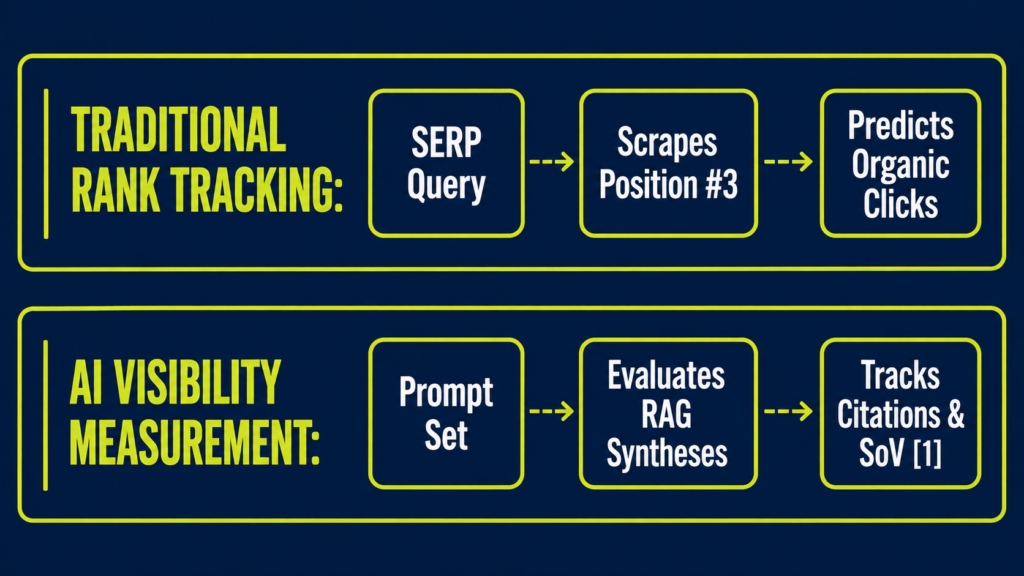
Traditional Rank Tracking vs. AI Visibility Measurement
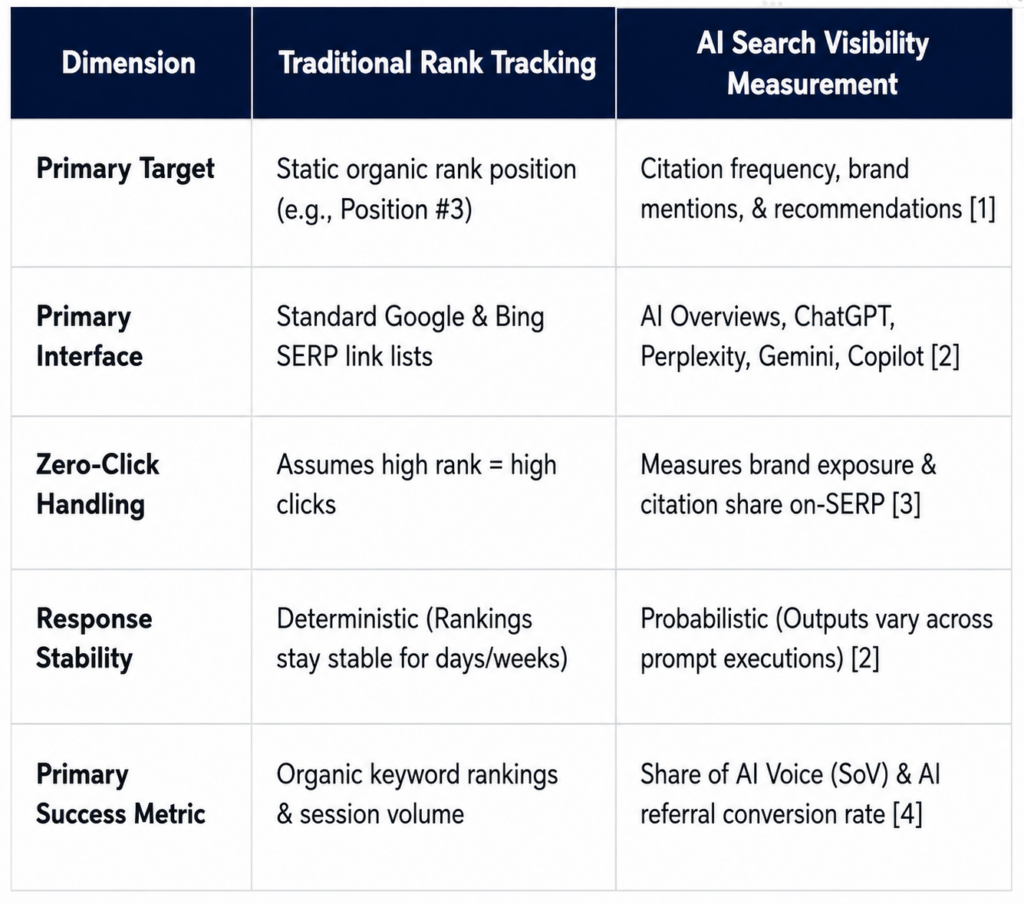
The 3 Specific Blind Spots of Legacy Tracking:
- Unmeasured Brand Mentions: Legacy rank trackers measure URL positions, completely ignoring whether an AI answer describes, recommends, or mentions your brand without a direct hyperlink [¹].
- Zero-Click Traffic Erasure: AI Overviews resolve informational prompts directly on the SERP [³]. A site can retain organic position #2 while losing 40% of its traffic to zero-click AI summaries [³].
- Probabilistic Response Volatility: LLMs generate answers probabilistically [²]. A single daily rank scrape cannot capture the citation rate across multiple user prompt executions [²].
For a full strategic roadmap on earning citations across generative engines, read our companion guide, How to Get Cited by AI: Building LLM Authority & E-E-A-T Signals.
The 4 Core AI Visibility Metrics to Track
To evaluate whether your Generative Engine Optimization (GEO) strategy is driving commercial value, monitor four core metrics [³] [⁴].
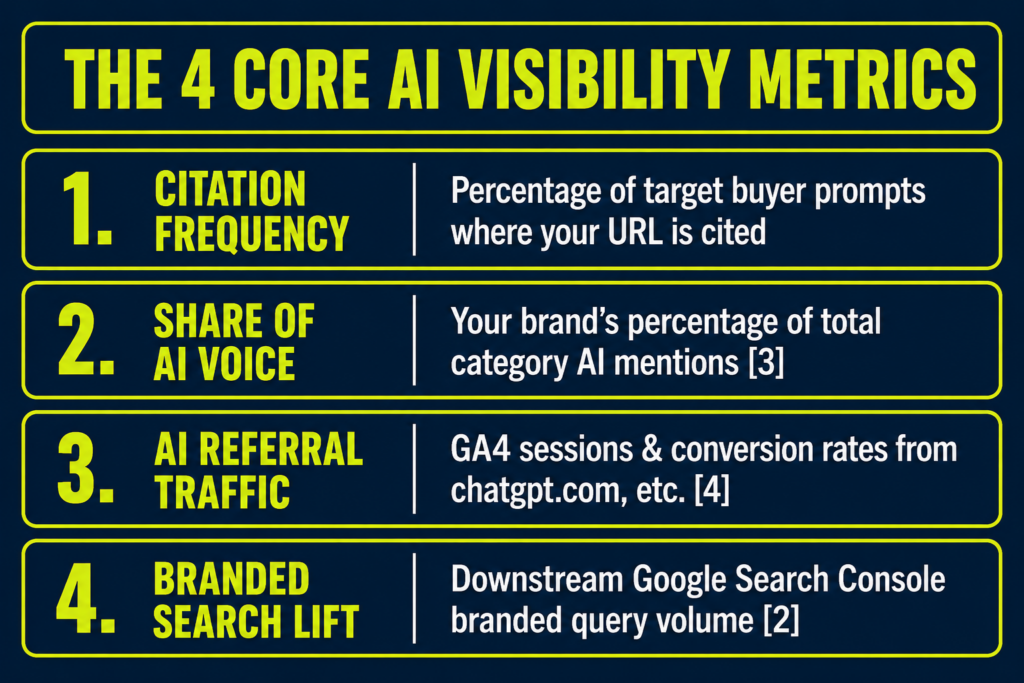
1. Citation Frequency
Citation Frequency measures how often an AI engine references your URLs or brand name across a defined set of target customer prompts [¹] [³].
- Tracking Logic: Evaluate prompts across ChatGPT, Perplexity, Gemini, Copilot, and Google AI Overviews. Categorize citations into three types: Linked Source (footnote link), Textual Mention (brand named without link), and Product Recommendation (brand explicitly recommended) [³].
2. Share of AI Voice (SoV)
Share of AI Voice quantifies your brand’s presence relative to direct category competitors across AI-generated answers [³].
- Strategic Value: Share of AI Voice reveals true competitive positioning. If your absolute citation count increases by 10% but a competitor’s increases by 40%, your total Share of AI Voice has declined.
3. AI Referral Traffic and Conversion Rate
AI referral traffic measures direct website sessions arriving from AI platforms (e.g., chatgpt.com, perplexity.ai, gemini.google.com, copilot.microsoft.com) [⁴].
The 4 Core AI Visibility Metrics
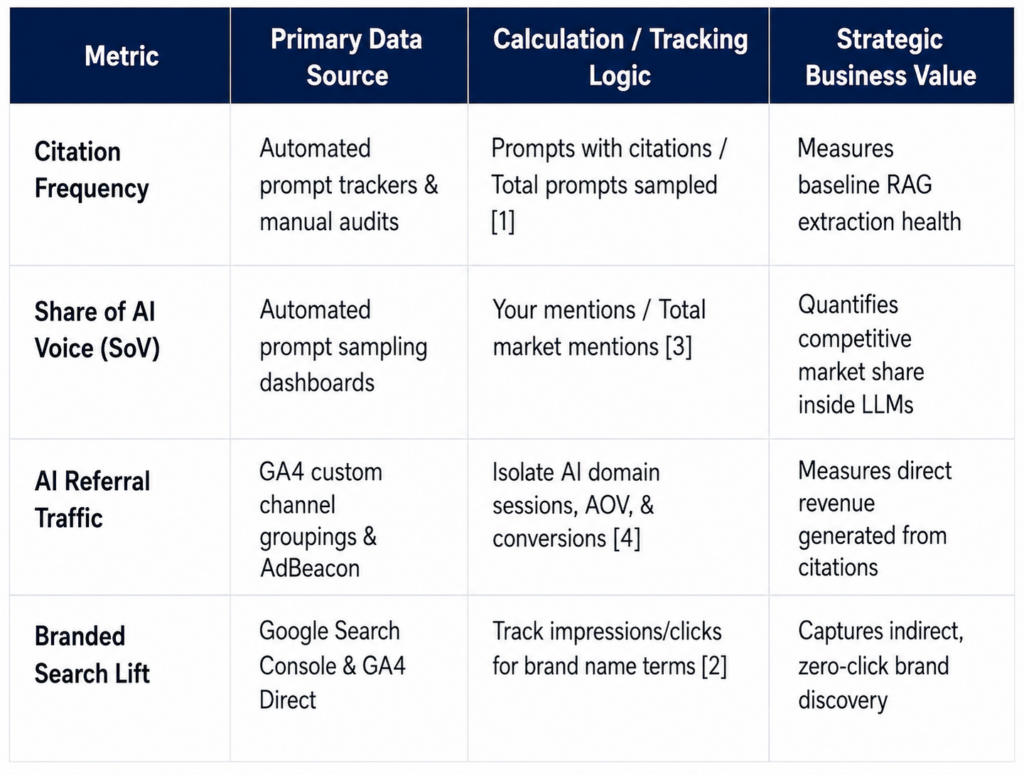
4. Branded Search Volume Lift
Many users read a brand recommendation inside an AI answer, close the chat tab, and search for the brand directly on Google [²]. Monitoring branded impression and click volume in Google Search Console captures the halo effect of zero-click AI citations [²] [⁵].
Connecting fuzzy top-of-funnel AI discovery touchpoints to direct orders is why we developed our first-party attribution platform, AdBeacon, giving marketing teams clear revenue visibility across all search channels.
Tooling Stack: Automated Trackers vs. Manual Spot Checks
No single software captures complete visibility across all generative engines. Building a accurate scorecard requires a hybrid tracking stack [¹] [³].
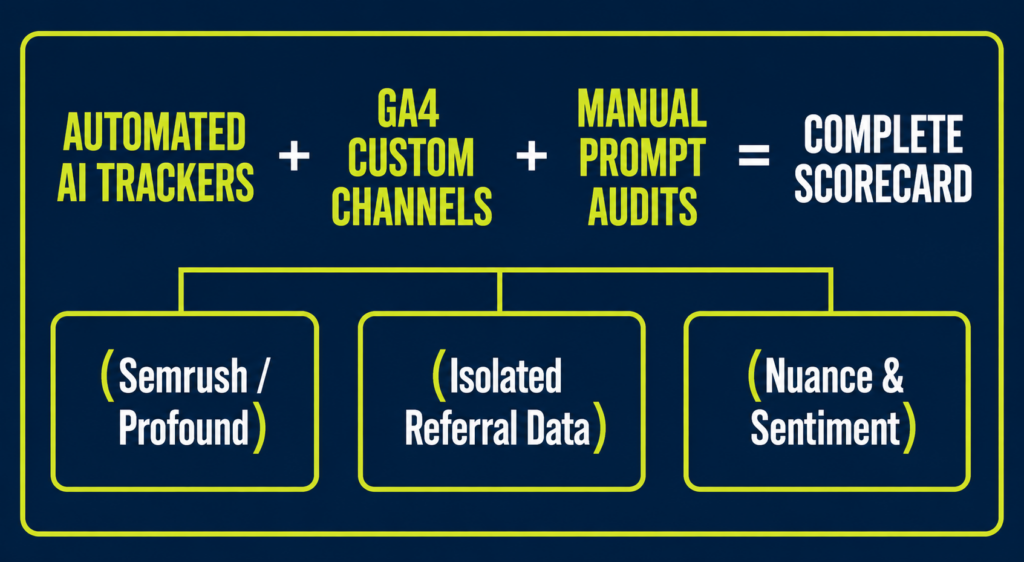
- Automated AI Visibility Platforms (Semrush, Ahrefs, BrightEdge, Profound): Automate recurring prompt execution across multiple LLMs, tracking citation frequency, AI Overview occurrences, and competitive Share of Voice at scale [³].
- Google Search Console & GA4: Search Console tracks impressions and CTR discrepancies on AI Overview queries. GA4 isolates direct referral sessions via custom regex channel filters [⁴].
- Monthly Manual Spot-Checking: Manually query 20 to 30 core buyer prompts in clean, unpersonalized browser sessions once per month. Manual spot-checking reveals crucial qualitative details that automated tools miss: recommendation framing, brand sentiment, and competitive context [³].
5 Measurement Pitfalls to Eliminate Immediately
- Leading Executive Reports with Keyword Rankings: Reporting traditional organic rank positions in a zero-click AI environment misrepresents actual search performance [¹] [³].
- Treating a Single Prompt Run as Definitive Data: LLMs generate answers probabilistically. A single prompt test is an anecdote; recurring sampling yields actionable data [²].
- Ignoring AI Referral Traffic Due to Low Initial Volume: AI referral traffic is low-volume but carries high purchase intent [⁴]. Failing to set up GA4 tracking leaves teams blind to growing referral trends.
- Obsessing Over Raw Citation Counts Without Competitive Context: Increasing raw citation count provides little value if competitors are expanding their Share of AI Voice at a faster rate [³].
- Postponing Measurement Until a “Perfect” Tool Emerges: Waiting for a single software solution leaves your brand flying blind. Combine Search Console, GA4, and manual prompt testing today [¹] [³].
A 6-Step Reporting Cadence You Will Actually Maintain
Fancy dashboards die from neglect. Deploy this repeatable 6-step reporting framework—aligned with our PACE methodology (Plan, Analyze, Convert, Expand)—to maintain clear operational visibility.
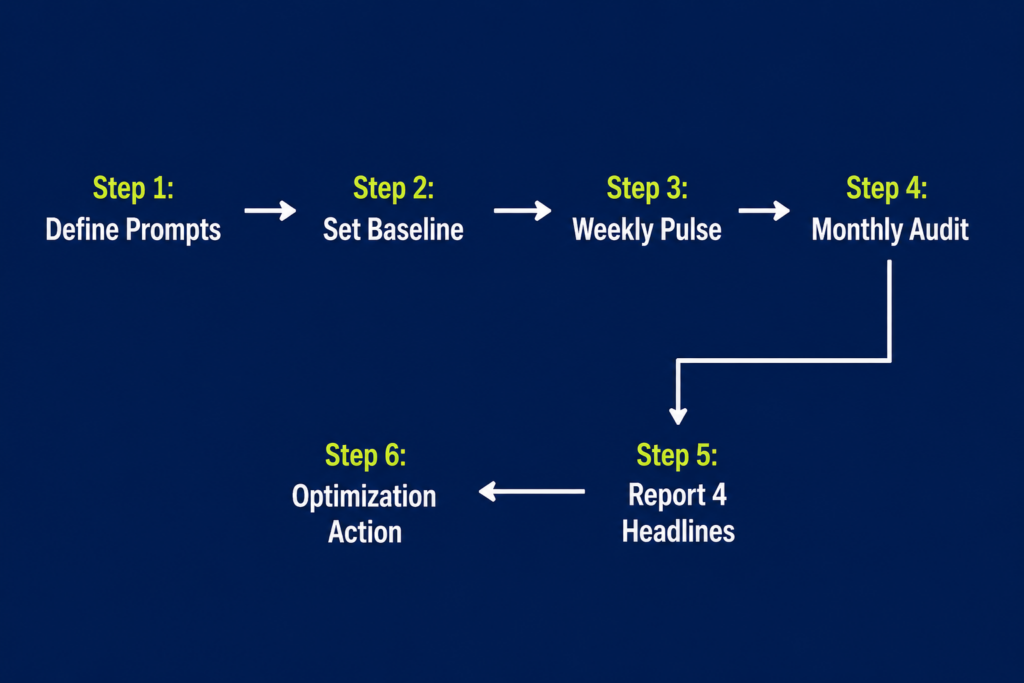
Step 1: Define Your Target Buyer Prompt Set (Plan)
Compile 30 to 50 questions real customers ask throughout their buying journey, ranging from top-of-funnel research (“What are the top non-toxic cookware brands?”) to bottom-of-funnel comparisons (“Brand X vs Brand Y review”).
Step 2: Establish Your Month-Zero Baseline (Analyze)
Run your prompt set across ChatGPT, Perplexity, Gemini, Copilot, and Google AI Overviews. Record initial Citation Frequency, Share of AI Voice, and brand recommendation status [³].
Step 3: Execute a Weekly 5-Minute Analytics Pulse
Review your GA4 AI referral traffic segment and Search Console branded search impressions weekly to spot sudden spikes or drops [²] [⁴].
Step 4: Perform a Comprehensive Monthly Audit
Re-run your full prompt set monthly using automated tools supplemented by manual spot-checks. Record changes in citation links, competitor positioning, and brand sentiment [³].
Step 5: Report on the 4 Headline Metrics
Present the same four metrics in every monthly report: Citation Frequency, Share of AI Voice, AI Referral Sessions & Conversion Rate, and Branded Search Lift [³] [⁴].
Step 6: Convert Data Into Tactical Optimization Actions (Convert & Expand)
- Flat Share of Voice: Indicates a need for increased digital PR, off-site co-citations, and updated entity metadata [⁵].
- Low AI Referral Conversions: Indicates a need for conversion rate optimization on landing pages to convert warm AI traffic.
If mapping this measurement framework to your product catalog requires dedicated bandwidth, our specialized AI Search Optimization team provides end-to-end implementation for e-commerce and B2B brands.
Partner with National Positions for Data-Driven GEO
Measuring and expanding your visibility across ChatGPT, Perplexity, Google AI Overviews, and Copilot requires technical analytics engineering, digital PR, and first-party attribution tracking.
National Positions delivers complete Generative Engine Optimization solutions:
- 22+ Years of Growth Engineering: Managing search and performance analytics for over 300 e-commerce and B2B brands.
- Google Premier Partner Leadership: Recognized in the top tier of performance marketing agencies globally.
- The PACE Framework: Our methodology (Plan, Analyze, Convert, Expand) grounds AI search strategies in verified revenue metrics.
- First-Party Attribution via AdBeacon: Our proprietary AdBeacon platform measures traffic, attribution, and conversion impact across paid, organic, and AI-driven channels.
Ready to measure what actually matters in AI search? Book a free AI Search Visibility audit with our team to baseline your citations, Share of Voice, and AI referral traffic.
Frequently Asked Questions
How can I isolate traffic from ChatGPT and Perplexity in Google Analytics 4?
In GA4, build a custom channel grouping filtering for referral sources including chatgpt.com, perplexity.ai, gemini.google.com, and copilot.microsoft.com [⁴]. Combine GA4 with first-party attribution software to prevent AI referral traffic from being miscategorized as direct traffic.
What is the operational difference between Citation Frequency and Share of AI Voice?
Citation Frequency measures how often AI engines cite your brand across your target prompts in absolute numbers [¹] [³]. Share of AI Voice measures your brand’s percentage of total mentions relative to all competitors within those same responses [³].
How frequently should an e-commerce brand audit its AI search visibility?
Perform a light weekly check on GA4 AI referral traffic and Search Console branded impressions, followed by a comprehensive monthly prompt audit to track Citation Frequency and Share of AI Voice [³] [⁴].
Can AI search visibility be measured without paid software tools?
Yes. You can establish a baseline manually using a prompt spreadsheet, clean browser sessions, Google Search Console, and custom GA4 referral filters [³] [⁴]. Paid tools accelerate tracking at scale, but manual testing remains essential for evaluating qualitative brand framing [³].
Why is branded search volume lift considered an indicator of AI search visibility?
Many zero-click AI responses mention or recommend a brand without providing an outbound link [²]. Users frequently read the recommendation, close the AI chat, and search for the brand directly on Google [²]. Monitoring branded impression growth captures this indirect discovery [²] [⁵].
Sources & References
- Medium “Information Extraction Quality, RAG Retrieval Benchmarks, and LLM Citation Mechanics,” Technical Search Analytics Disclosures [¹].
- Similarweb, “Search Engine User Behaviors, Zero-Click SERP Trends, and AI Referral Analytics,” Search Industry Analytics [²].
- Omnibound, “AI Overview Occurrence Rates, Citation Volatility, and Share of Voice Benchmarks,” Digital Marketing Research [³].
- Google Search Central, “Google Analytics 4 Referral Segmentation, Search Console Performance Metrics, and Webmaster Guidelines,” Technical Documentation [⁴].
- FancyAI, “Off-Site Co-Citation Networks, Subreddit Indexing, and Branded Search Lift,” Search Industry Benchmark Data [⁵].
Related Deep-Dive Guides
- Pillar Strategy: Read The Complete Guide to AI Search Visibility (GEO) for a complete 90-day visibility roadmap.
- Earning Citations: Read How to Get Cited by AI: Building LLM Authority & E-E-A-T Signals to master the trust levers LLMs require.
- OpenAI Optimization: Read The ChatGPT Search Playbook to capture citations across OpenAI and Bing search networks.