Executive Summary: Large Language Models (LLMs) do not select citations based on traditional keyword density or PageRank alone. To get cited by AI answer engines—such as SearchGPT, Perplexity, Google AI Overviews, and Copilot—brands must demonstrate E-E-A-T signals (Experience, Expertise, Authoritativeness, Trustworthiness), maintain consistent sitewide entity metadata, publish un-copyable first-party data, and establish strong off-site co-citations across high-trust data sources [¹] [²].
Key Takeaways
- Verification Over Rank: AI engines prioritize sources they can verify and cross-reference, rather than simply selecting top-ranking blue links [¹] [³].
- E-E-A-T Machine Translation: Google’s E-E-A-T principles map directly onto the trust thresholds LLMs use to prevent hallucinations during Retrieval-Augmented Generation (RAG) [¹] [²].
- Un-Copyable First-Party Data: Publishing original survey benchmarks, proprietary datasets, and first-hand research makes your domain an indispensable primary source [³] [⁴].
- High-Weight Off-Site Mentions: LLM confidence depends heavily on third-party verification across Reddit discussions, Wikipedia entity nodes, and authoritative trade press [⁴] [⁵].
- Entity Disambiguation: Uniform brand details (Name, Category, Product Specs, Executive Bios) across all web properties eliminate model ambiguity, increasing citation selection rates [¹] [³].
Why LLMs Cite Specific Brands (Training vs. RAG Retrieval)
Large Language Models evaluate brand information through two distinct operational layers [²] [³]:
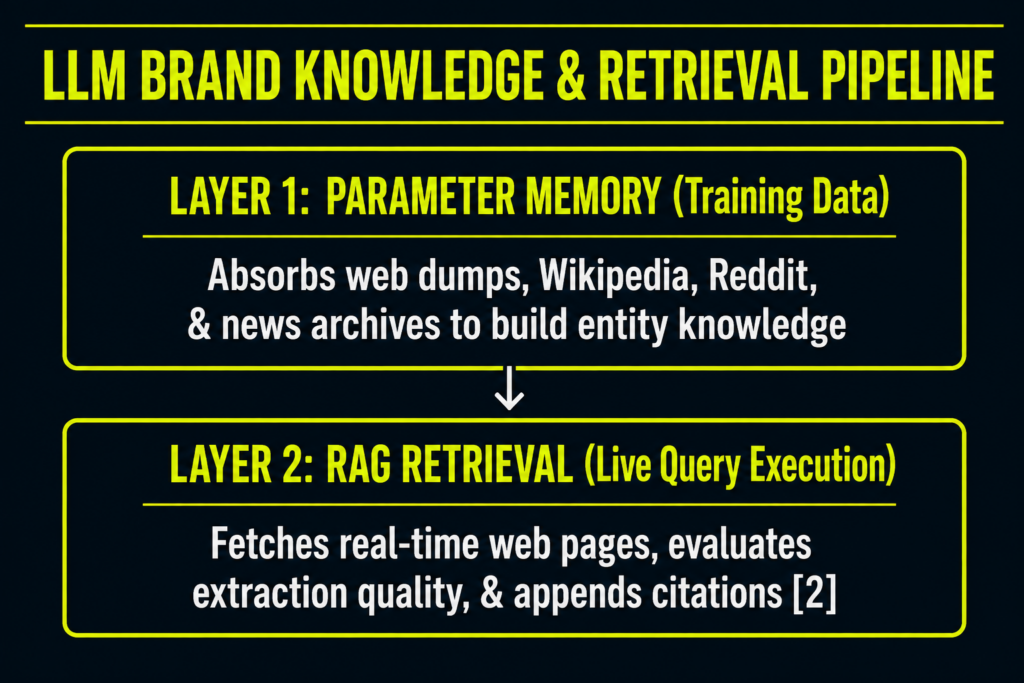
- Parameter Memory (Training Corpus): Models like GPT-4 and Gemini absorb historical snapshots of the web. Brands that appear frequently within trusted contextual nodes become embedded in the model’s permanent knowledge base [³] [⁴].
- Retrieval-Augmented Generation (Live RAG): Engines like Perplexity, Google AI Overviews, and Microsoft Copilot execute real-time searches at query time. They retrieve candidate passages, filter them for factual accuracy, and attach inline citations [²] [³].
Winning visibility requires optimizing for both layers: building long-term entity authority for parameter memory while providing clean, chunkable text for live RAG retrieval [¹] [³].
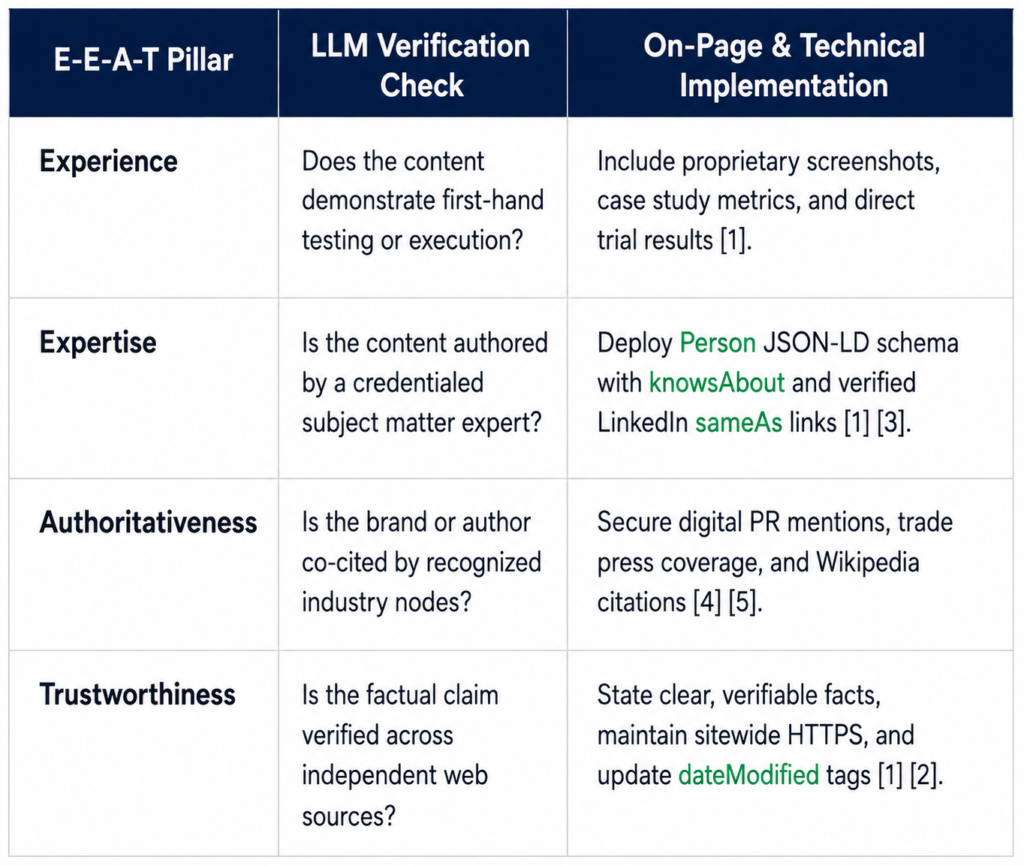
Translating E-E-A-T into Machine-Readable Citation Signals
An LLM’s primary operational constraint during live answer synthesis is minimizing factual errors and hallucinations [²]. Consequently, RAG algorithms heavily weigh verifiable E-E-A-T signals [¹].
E-E-A-T to AI Citation Translation Matrix
First-Party Data vs. Third-Party Mentions
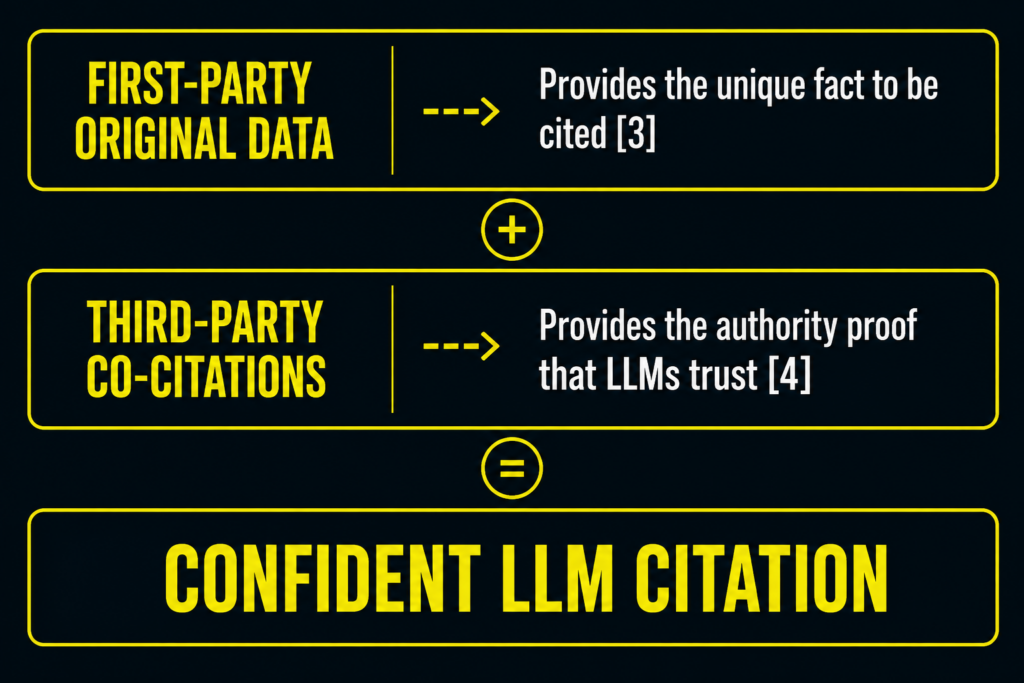
The Power of Un-Copyable First-Party Data
Generic explainer content (e.g., “10 Tips for Email Marketing”) is easily summarized by LLMs without attribution because the model already “knows” those facts from its training corpus [³]. To force an inline citation, you must supply a unique, primary data point that exists nowhere else on the web [³] [⁴]:
- Proprietary industry survey benchmarks
- Anonymized performance data across your customer base
- Named, original frameworks with unique terminology
- First-hand experimental case studies
High-Weight Third-Party Entity Ecosystem
Because LLMs prioritize independent verification, off-site mentions directly dictate whether a model trusts your brand [⁴] [⁵].
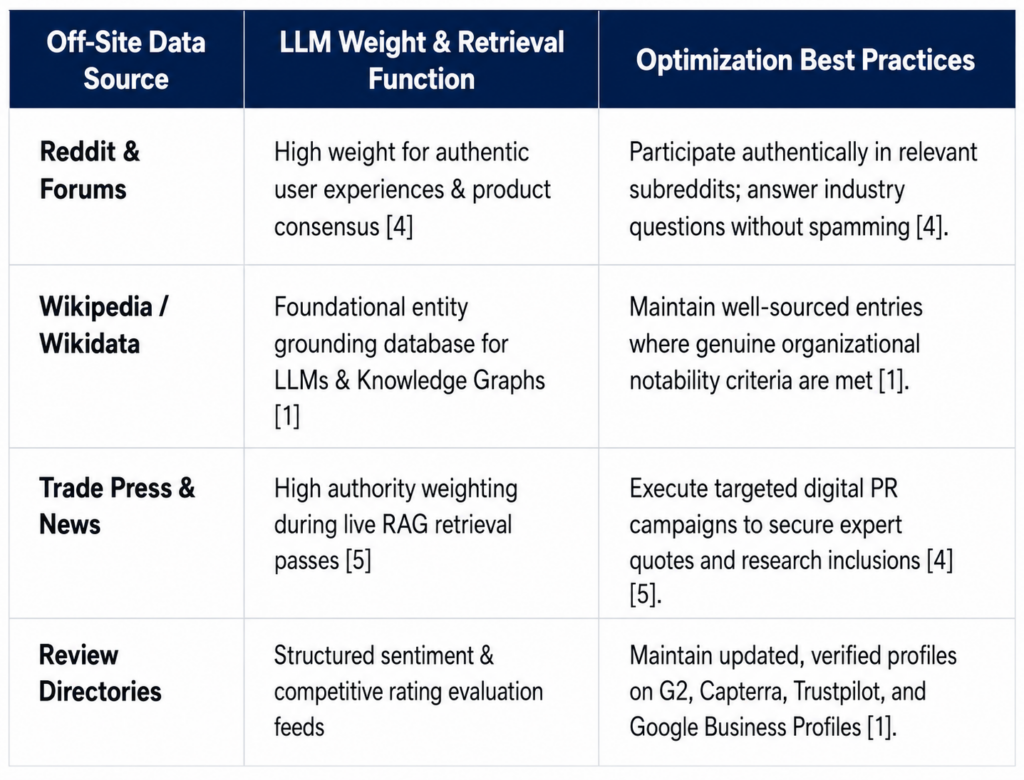
Build strong off-site authority through our specialized PR and AI Visibility programs.
Entity Consistency: Eliminating Machine Ambiguity
LLMs construct internal knowledge graphs representing your brand as a distinct entity [¹]. Conflicting entity attributes create ambiguity, causing algorithms to omit your brand from comparison answers [¹] [³].
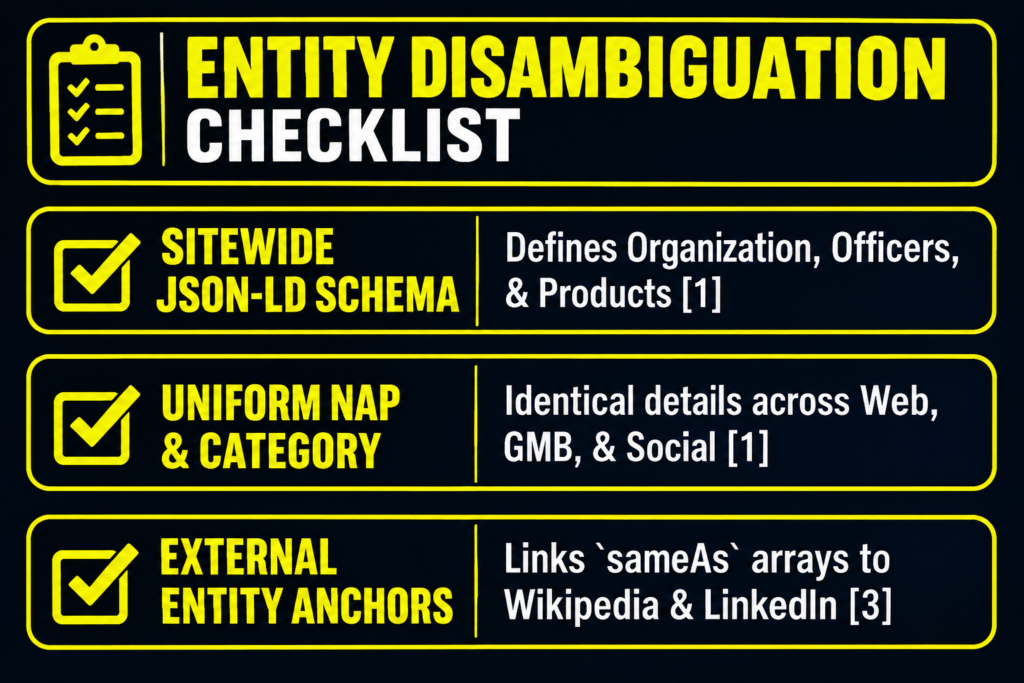
3 Steps to Tighten Entity Alignment:
- Standardize Core Entity Attributes: Ensure your official company name, primary category, address, phone number, and core service descriptions match across your site, social profiles, and industry directories [¹].
- Implement Sitewide Organization Schema: Deploy structured JSON-LD Organization schema featuring sameAs properties linking directly to verified Wikipedia, Wikidata, LinkedIn, and corporate registry entries [¹] [³].
- Optimize the “About” Page: Structure your primary “About Us” page as a clear, factual entity manifest detailing founding history, leadership bios, core software integrations, and official corporate milestones [¹].
Our core SEO team integrates entity disambiguation into every technical optimization blueprint.
5 Obsolete Tactics to Stop Immediately
- Publishing Thin, Generic “Me-Too” Content: Producing high-volume, low-density articles provides no unique factual claims for an LLM to cite [³].
- Hiding or Omitting Author Credentials: Anonymous articles fail E-E-A-T validation, causing RAG algorithms to select accredited competitor pages [¹].
- Attempting Astroturfing or Manufactured Links: Creating fake profiles on Reddit or purchasing spammy link packages damages domain trust and risks automated filter penalties [⁴].
- Treating Business Descriptions as Marketing Jargon: Filling brand profiles with vague phrases like “world-class innovative solutions” deprives LLMs of machine-readable category attributes [¹].
- Assuming Organic Rank Guarantees Citation: Ranking #1 on Google SERPs does not guarantee inclusion in ChatGPT or Perplexity answers if passage-level extraction quality or off-site co-citations are missing [²] [³].
The 7-Step AI Citation Execution Roadmap
Follow this step-by-step roadmap to build machine-readable authority and secure citations across major LLM platforms.
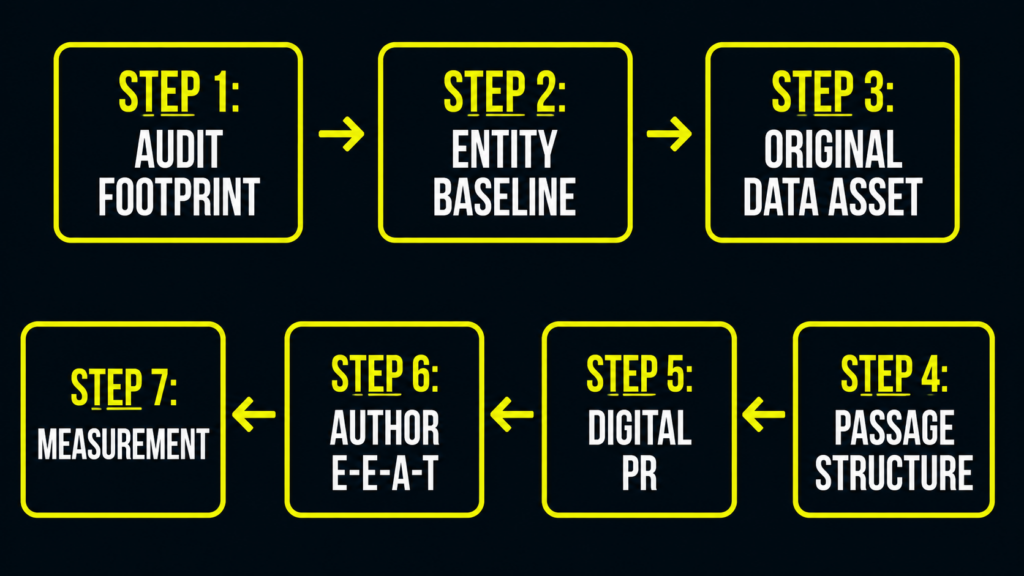
Step 1: Audit Your Current Citation Footprint
Query ChatGPT, Perplexity, Gemini, and Copilot with 20 to 30 core buyer prompts. Record which competitor URLs are cited and identify the exact off-site sources the AI retrieved [²] [³].
Step 2: Standardize Your Entity Foundation
Update your Organization schema, harmonize NAP details across directories, and rewrite your “About Us” page into a clear entity description [¹].
Step 3: Publish One Proprietary Data Asset
Execute an original industry survey, compile internal benchmark metrics, or release a named analytical framework. Place a clear 40-to-60-word summary table near the top of the asset [³] [⁴].
Step 4: Format Content for Passage Extraction
Restructure priority pages to lead with concise, direct answers beneath query-focused H2 subheadings. Implement valid Article and FAQPage JSON-LD schema [¹] [³].
Step 5: Execute Targeted Digital PR
Pitch your original data asset to trade publications, industry journalists, and authoritative blogs to earn brand mentions and co-citations [⁴] [⁵].
Step 6: Fortify Author E-E-A-T Metadata
Add comprehensive author bios, attach Person JSON-LD schema with LinkedIn sameAs links, and secure guest quotes for your internal experts on external industry sites [¹].
Step 7: Measure Citation Share of Voice and Iterate
Track citation frequency, AI referral sessions, and branded search lift monthly. Learn how to track performance in our guide on Measuring AI Search Visibility.
If you need a dedicated partner to execute this strategy across your brand catalog, explore our specialized AI Search Optimization services.
Partner with National Positions for Enterprise GEO
Earning consistent citations across ChatGPT, Perplexity, Google AI Overviews, and Copilot requires integrated analytics engineering, digital PR, and structured entity management.
National Positions provides complete Generative Engine Optimization solutions:
- 22+ Years of Growth Leadership: Managing search analytics and digital strategies for over 300 e-commerce and B2B brands.
- Google Premier Partner Leadership: Recognized in the top tier of performance marketing agencies globally.
- The PACE Framework: Our methodology (Plan, Analyze, Convert, Expand) grounds AI search strategies in verified revenue metrics.
- First-Party Attribution via AdBeacon: Our proprietary AdBeacon platform measures traffic, attribution, and conversion impact across paid, organic, and AI-driven channels.
Ready to audit your brand’s AI search authority? Book a free AI Search Visibility audit with our team to evaluate your current citation baseline and build a platform-specific GEO strategy.
Frequently Asked Questions
How long does it take to start getting cited by AI search engines?
Live RAG engines like Perplexity and Google AI Overviews can index and cite updated, high-authority pages within 30 to 60 days [²] [³]. Building entity authority for parameter memory training sets (e.g., base ChatGPT models) typically takes 6 to 12 months of consistent off-site mentions and digital PR [³] [⁴].
Are traditional backlinks still required to get cited by AI?
Yes, but their role has evolved. LLMs evaluate backlinks as co-citation authority proof [⁴] [⁵]. A contextual brand mention in an authoritative trade publication carries higher citation weight than numerous low-quality directory links [⁴].
Can a business pay for organic citations inside ChatGPT or Perplexity?
No. Organic citations inside AI answers cannot be purchased [³]. They must be earned by providing structured, verifiable data, maintaining entity consistency, and securing third-party mentions [¹] [⁴].
Does JSON-LD schema markup directly force an AI citation?
No. Schema markup eliminates machine parsing ambiguity, making it easier for LLM crawlers to extract and credit page facts [¹] [³]. However, passage relevance, E-E-A-T authority, and content freshness remain primary selection criteria [¹] [²].
Why are Reddit and community forums cited so frequently in AI answers?
LLMs prioritize Reddit because it contains high volumes of authentic, peer-reviewed human discussion [⁴]. Active, helpful participation in relevant industry subreddits helps build brand awareness within model training feeds [⁴].
Sources & References
- Google Search Central, “Guidance on Building Helpful, Reliable, People-First Content and E-E-A-T Frameworks,” Technical Webmaster Documentation [¹].
- OpenAI & Perplexity Developer Documentation, “RAG Retrieval Architectures, Live Search Mechanics, and Source Citation Protocols,” Developer Documentation [²].
- Generative Engine Optimization Analytics, “Information Extraction Quality, Entity Disambiguation, and LLM Citation Benchmarks,” Technical Search Analytics Disclosures [³].
- Digital PR & Authority Benchmarks, “Co-Citation Networks, Subreddit Indexing, and LLM Grounding Sources,” Search Industry Benchmark Data [⁴].
- Instant Press, “Impact of Digital PR, Earned Media, and Off-Site Brand Mentions on Generative AI Citations,” Digital Marketing Research [⁵].