Executive Summary: A marketing measurement framework is a multi-layered analytics architecture that connects media spend across all channels directly to revenue and gross profit. By combining platform-level micro metrics, multi-touch attribution (MTA), and macro-level Marketing Mix Modeling (MMM) built on a first-party data foundation, brands can eliminate platform double-counting and allocate ad budgets based on true incremental growth.
Key Takeaways
- Connects Activity to Profit: A modern measurement framework bridges the gap between top-of-funnel clicks and bottom-line P&L profitability.
- Overcomes Fragmentation: Only 36% of marketers report being able to accurately measure ROI [¹], primarily due to data integration silos that affect 48% of teams [¹].
- The 3-Tier Measurement Stack: The most resilient frameworks layer platform analytics (micro view), multi-touch attribution (connective tissue), and Marketing Mix Modeling or incrementality testing (macro truth) [²].
- Efficiency Boost from Attribution: Moving from single-touch (last-click) to multi-touch attribution increases marketing budget efficiency by an average of 22% [²].
- First-Party Data Infrastructure: 80% of marketers now prioritize first-party data over third-party identifiers [³], and first-party-driven campaigns generate up to 50% higher ROI [³].
Why Most Measurement Efforts Fall Apart
Most organizations do not suffer from a lack of data; they suffer from fragmentation. Ad platforms self-report conversions using optimistic attribution windows, web analytics tools isolate online touchpoints, and CRM databases record offline sales without source connection.
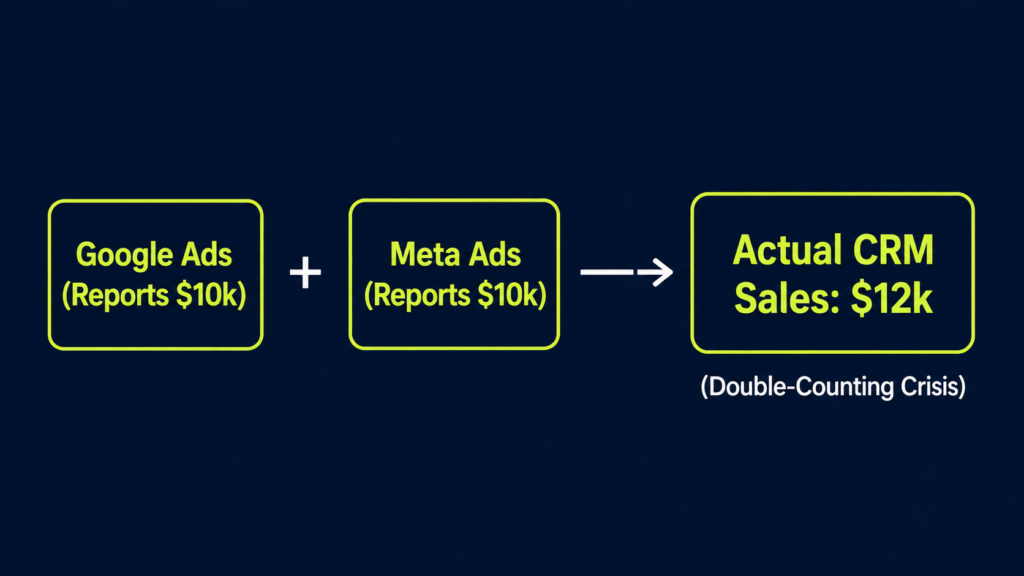
This fragmentation leads to critical measurement failures:
- The Measurement Confidence Gap: Only 36% of marketers feel confident in their ROI tracking [¹], while 47% struggle specifically with multi-touch attribution implementation [¹].
- Data Integration Silos: 48% of marketing teams cite integrated data infrastructure as their primary operational bottleneck [¹].
- Measuring Activity Instead of Profit: Teams rely on abundant, low-friction metrics (clicks, impressions, page views) because they are easy to pull. However, top-of-funnel volume does not defend a budget in front of executive leadership.
Customer acquisition costs (CAC) jumped 40% to 60% across major channels between 2023 and 2025 [⁴]. Relying on platform self-reporting leads directly to misallocated capital. To see how individual metrics feed into this model, read our companion guide on how to prove ad ROI.
The Anatomy of a Modern Marketing Measurement Framework
A complete measurement architecture does not rely on a single tool. It integrates three distinct layers that operate together to provide total visibility.
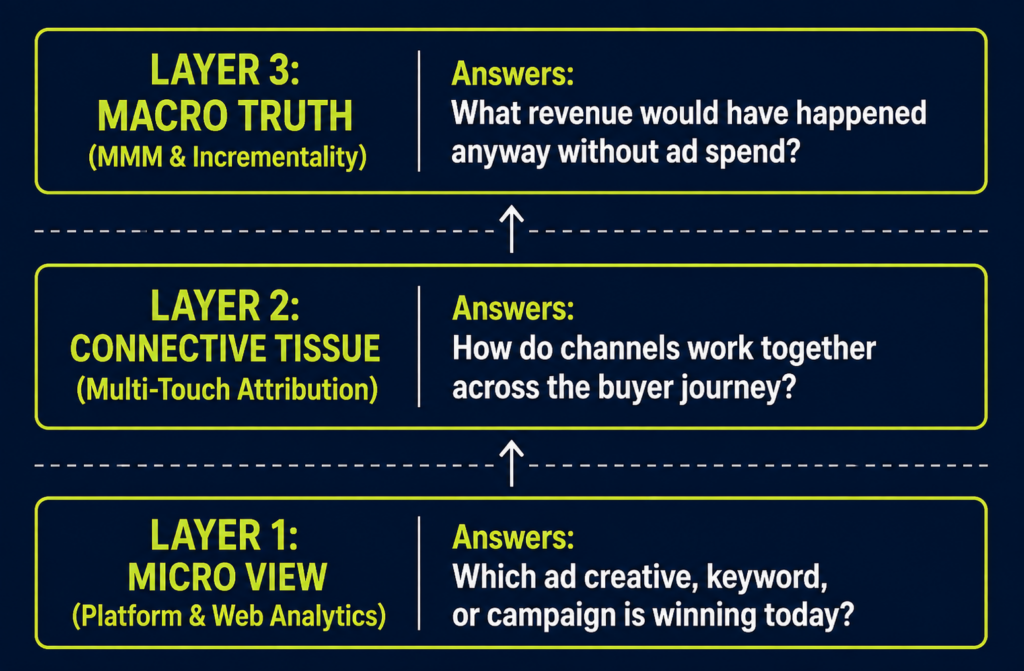
Layer 1: Platform & Web Analytics (The Micro View)
Granular, day-to-day tactical data from Google Ads, Meta Ads Manager, TikTok, and GA4.
- Primary Function: In-channel optimization (creative variations, keyword bids, audience targeting).
- Limitation: Tends to over-credit the final touchpoint and double-count conversions across platforms.
Layer 2: Attribution (The Connective Tissue)
Cross-channel tracking that connects touchpoints across the entire buyer journey into a unified path.
- Primary Function: Evaluates how paid search, paid social, email, and organic touchpoints assist and convert users.
- Limitation: Can be affected by browser tracking restrictions if not supported by a custom server-side infrastructure.
Layer 3: Incrementality & Mix Modeling (The Macro Truth)
Top-down statistical measurement (Marketing Mix Modeling) and causal holdout experiments.
- Primary Function: Validates true baseline revenue lift and informs high-level quarterly budget splits across online and offline channels [²].
- Limitation: Too broad for rapid, daily campaign-level adjustments.
Choosing the Right Attribution Model
Attribution defines how credit for a conversion is distributed across user touchpoints. Selecting an inappropriate model distorts channel value and misdirects marketing spend.
While 57% of organizations utilize formal attribution modeling, 31% to 37% still rely primarily on last-click rules [²]. Shifting to multi-touch modeling yields an average 22% gain in overall budget efficiency [²].
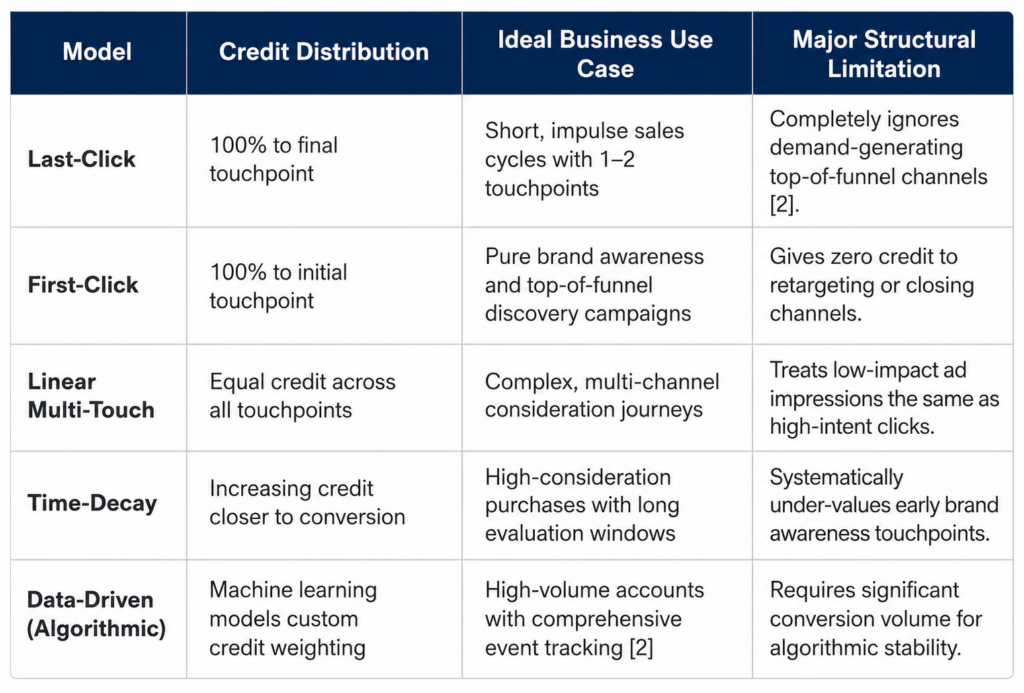
Between 2025 and 2028, an estimated 45% to 55% of enterprise marketing teams will transition to machine-learning attribution models [²] to manage multi-device customer journeys accurately.
Building Your Framework: A 6-Step Measurement Plan
Execute this structured framework to transition from scattered campaign reporting to a unified profit pipeline.
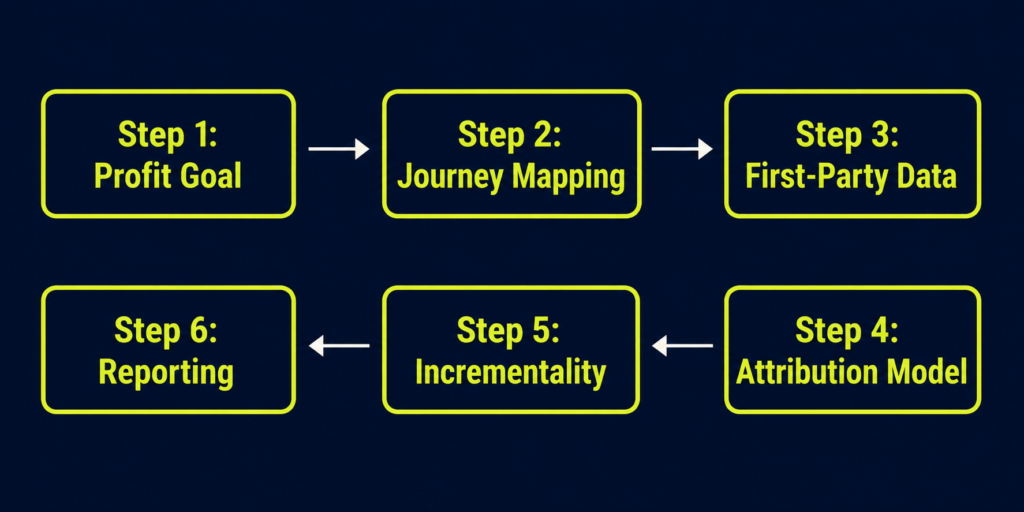
Step 1: Define the Core Profit Outcome
Establish the primary metric that defines success before setting up tracking tools. Anchor the framework in net contribution margin, gross profit, or Customer Lifetime Value (LTV) rather than top-line revenue or ad clicks.
Step 2: Map the Complete Customer Journey
Document every digital and offline touchpoint from initial impression to repeat purchase. Identifying these interactions reveals tracking blind spots across devices and channels.
Step 3: Establish a First-Party Data Foundation
Build your analytics infrastructure on owned data: customer CRM records, transaction logs, and first-party server-side cookies. With 80% of marketers prioritizing first-party data strategies over third-party alternatives [3], server-side collection ensures long-term tracking durability.
Step 4: Deploy a Journey-Appropriate Attribution Model
Select an attribution model that matches your sales cycle length and media mix. Transition away from last-click tracking to ensure top-of-funnel demand drivers receive accurate credit [²].
Step 5: Implement Regular Incrementality Checks
Conduct quarterly geo-lift tests or branded search holdout experiments. Causal holdout testing validates whether ad spend actively drives incremental sales or simply claims credit for existing organic conversions.
Step 6: Establish an Executive Decision Cadence
Structure reporting around actionable business decisions:
- Weekly Cadence: Micro-adjustments (creative swaps, ad set bid adjustments).
- Monthly/Quarterly Cadence: Strategic capital reallocation across media channels based on attribution and incrementality signals.
From Clicks to Profit: Closing the Measurement Gap
Connecting digital clicks directly to gross profit transforms marketing from an expense category into a predictable revenue driver.
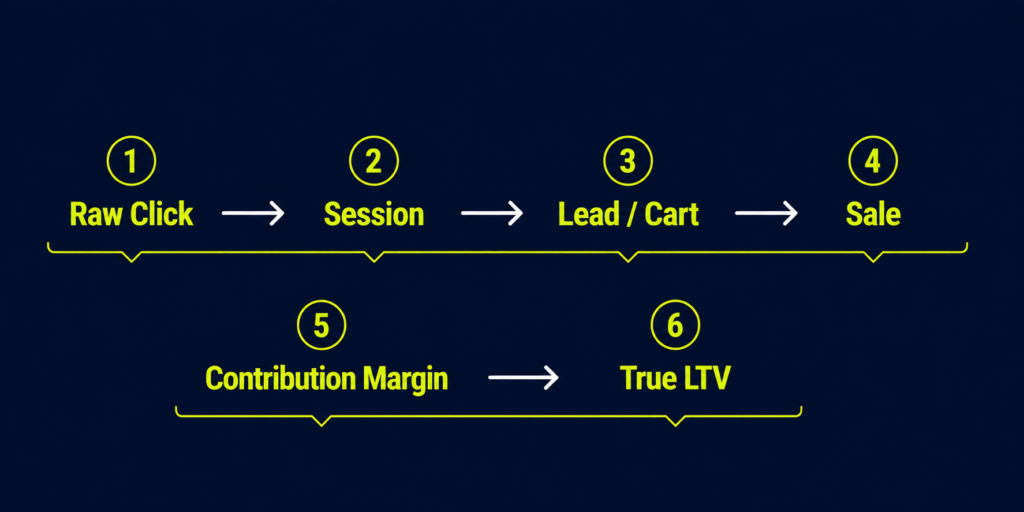
Closing this gap yields direct financial returns:
- Higher Campaign Returns: First-party-data-driven marketing strategies generate up to 50% higher ROI than third-party alternatives [³].
- Executive Decision Influence: 64% of CMOs state that unified attribution directly dictates their annual budget allocations [²].
- Algorithmic Accuracy: Integrating first-party tracking data into ad network machine learning models trains bidding algorithms on high-value customers rather than low-intent clickers.
For brands operating in privacy-restricted environments, implementing a cookieless-ready setup provides the server-side infrastructure necessary to maintain this data flow.
The Technology That Makes a Framework Work
Executing a multi-tiered framework requires technology capable of consolidating spend from every ad network with backend CRM and sales data.
Data silos remain a major operational hurdle:
- Data Integration Friction: 88% of marketers struggle to unify performance data across disparate channels and platforms [²].
- Platform Self-Reporting Discrepancies: Individual ad network dashboards operate in isolation, frequently double-counting the same conversion and overstating total program performance.
Unified first-party attribution software resolves data discrepancies by deduplicating conversions, stitching touchpoints on an owned subdomain, and feeding accurate purchase events back to analytics dashboards.
Partner with National Positions
Designing a measurement framework on paper is straightforward. Making it work across real accounts, real data, and real budgets is where most efforts stall, and it’s where National Positions has spent more than 22 years. As a Google Premier Partner serving over 300 clients with a 97 percent client retention rate, we’ve built frameworks that survive the messy reality of multi-channel marketing rather than looking tidy in a slide.
Our PACE methodology—Plan, Analyze, Convert, and Expand—maps directly onto the framework this post describes. We plan by defining the profit outcomes your measurement must serve, analyze performance through connected first-party data instead of siloed platform reports, convert those insights into reallocated budget, and expand what the data proves is working. At the center sits first-party attribution platform, AdBeacon, which stitches ad spend to real customer revenue so your framework runs on truth rather than platform-reported guesses. It’s the connective tissue that turns three theoretical layers into one working system.
Book a Free Measurement Framework Consultation
Wondering where your current measurement breaks down between the click and the profit? We’ll map it with you. Book a free consultation and our team will review how your data flows today, pinpoint the silos and blind spots costing you clarity, and show you how a first-party framework connects every touchpoint to revenue. Start the conversation and we’ll take it from there.
Frequently Asked Questions
What is a marketing measurement framework?
A marketing measurement framework is an integrated system that connects marketing activities across all channels to business revenue and profit. It stacks three core layers: platform analytics (micro view), multi-touch attribution (connective tissue), and Marketing Mix Modeling or incrementality testing (macro truth) [²].
How does a measurement framework differ from an attribution model?
An attribution model is a single calculation rule within the framework that assigns credit to specific user touchpoints. A marketing measurement framework is the broader operational architecture that encompasses data pipelines, profit definitions, attribution models, incrementality holdouts, and executive decision cadences.
Which attribution model is best for multi-channel digital marketing?
Data-driven (algorithmic) attribution is ideal for multi-channel accounts with high conversion volumes [²]. For brands with longer sales cycles that lack the data volume for algorithmic modeling, linear or time-decay multi-touch models offer a significant upgrade over single-touch last-click rules [²].
Why is first-party data essential for modern measurement frameworks?
With third-party cookie deprecation and mobile privacy restrictions limiting pixel tracking, first-party data provides a reliable, compliant foundation owned directly by the business [³]. First-party data strategies can drive up to 50% higher ROI compared to third-party dependent models [³].
How long does it take to deploy a functional measurement framework?
A foundational measurement framework can be implemented within a single quarter by mapping customer journeys, setting up server-side data collection, deploying custom attribution rules, and establishing a regular reporting and reallocation cadence.
Sources & References
- Firework, “Marketing ROI Statistics: 30+ Stats to Boost Your Strategy in 2025,” Firework Insights.
- Hyperone, “Marketing Attribution Statistics (Multi-Touch, Cross-Channel, AI),” Hyperone Analytics.
- TechRT, “First-Party Data Statistics 2026: Key Trends and Growth Insights,” TechRT Data Reports.
- Phoenix Strategy Group, “CAC Benchmarks by Channel for 2025,” Phoenix Strategy Group Research.