A CTV advertising agency will tell you television is finally measurable. That is half true, and the half that is not true is where most ecommerce budgets get wasted.
Connected TV is a real channel with real incremental value. It is also the easiest place in digital media to spend six figures and produce a dashboard that proves nothing. The difference comes down to whether your agency understands measurement or just has access to inventory.
Here is when CTV earns a slot in an ecommerce budget, how the measurement genuinely works, and the specific things that separate a competent partner from a reseller with a rate card.
The audience is there, which is not the same as the channel being right for you
Streaming reached 48.6 percent of total TV watch time in May 2026, against 20.4 percent for cable and 19.2 percent for broadcast. Ad supported viewing still makes up the bulk of television, with streaming taking a record 46.6 percent share of ad supported TV in Q1 2026 while ad supported TV held near 73 percent of overall viewing.
Advertisers have followed. IAB projects CTV reaching $28.2 billion in 2026, up 12 percent from $25.3 billion in 2025, while its broader outlook forecasts CTV growth of 13.8 percent against a 1.7 percent decline for linear TV.
Forecasts for this channel vary by definition. eMarketer sizes 2026 CTV ad spending at $37.95 billion, up 14.5 percent. An agency that quotes one number as settled fact without explaining what it includes is telling you something about how it handles data generally.
When connected TV is worth it for an ecommerce brand
CTV is an upper funnel channel that can be measured with lower funnel rigor. It is not a replacement for search or a cheaper Meta.
It tends to pay off when at least three of these are true:
- You are already spending enough on search and social that incremental dollars there are getting expensive
- Your average order value supports a longer consideration window, roughly $75 and up
- Your product benefits from demonstration or ambience that a static image cannot carry
- You have a defined audience beyond "people who buy things like ours"
- You can commit a test budget for eight to twelve weeks without needing weekly ROAS reads
- You have first party customer data clean enough to build suppression and lookalike audiences
It usually does not pay off with a small catalog on tight margins, a total paid media budget under roughly $30,000 a month, or an organization that needs a same week answer on every dollar.
CTV also rewards brands that already have search demand to capture. The ad creates the interest. Something else closes it.
How CTV measurement actually works
This is where most agency conversations go soft. Be precise here.
Nobody clicks a television ad. Every CTV outcome metric is therefore an inference, built by connecting an ad exposure on one device to a conversion somewhere else. The major platforms are explicit about what that looks like.
Amazon describes its streaming TV measurement as offering household level insights, reach and frequency reporting, video completion rates, cross device attribution, and brand lift studies, with third party verification through partners including Kantar and Nielsen Total Ad Ratings. Note the phrase "household level." That is the real unit of measurement, not the individual.
Roku's published measurement material describes automatic content recognition using opted in viewing data, a data pipeline built to feed marketing mix models, clean rooms for audience matching without direct data exchange, and retail attribution partnerships with Walmart, DoorDash, and Kroger Precision Marketing, which brings purchase data from roughly 60 million households. Roku calls incrementality testing the gold standard in test and learn advertising optimization.
The method matters. Roku documents a ghost ad approach where its buying platform deliberately declines to bid on a slice of eligible impressions to build a holdout control group, then compares conversion rates between the exposed and held out groups. Roku states plainly that incrementality "accounts for customers who would have converted even if they had not seen your ad."
That is the whole argument. A pixel based attribution report hands CTV credit for purchases that would have happened regardless. A holdout does not.
The industry is moving this direction. eMarketer's 2026 CTV outlook describes a shift from multi touch attribution toward media mix modeling, while noting most teams still lack proper CTV integration in those frameworks. If you want CTV to be measured honestly alongside your other channels, media mix modeling is the framework that makes the comparison fair.
What CTV measurement cannot reliably do: tell you which individual person in a household saw the ad, give you a trustworthy same day ROAS, or produce a last click number comparable to branded search. Any agency promising those is describing something the platforms do not claim.
What separates a competent CTV advertising agency from an inventory reseller
Transparency in this channel is genuinely poor, and the industry's own data says so. IAB found that even in the most trusted purchase paths, only 57 percent of buyers had high confidence in inventory transparency for publisher direct insertion orders and programmatic guaranteed deals. Preferred deals came in at 47 percent, private marketplaces 45 percent, commerce and retail media networks 41 percent, and open exchange real time bidding 33 percent.
Among buyers with low confidence in the open exchange, the reasons were fraud and invalid traffic at 56 percent, inability to verify the publisher or content source at 48 percent, and uncertainty about placement at 44 percent.
Buyers are voting with money on what they consider worth paying for. The same IAB report shows willingness to pay premiums for brand safety and suitability verification at 41 percent and advanced measurement and attribution at 39 percent, while only 31 percent will pay extra for fraud detection because they expect it built in.
Use this on your next agency call.
| What to ask | Reseller answer | Real CTV partner answer |
|---|---|---|
| Can I see a full placement report by app and publisher? | "We report by network or by deal ID." | Yes, app level, every flight, unprompted. |
| How do you prove incrementality? | "We use view through conversions." | Designs a geo holdout or platform level control group before launch. |
| What is your markup on media? | Avoids the question. | States the fee, separate from media, in writing. |
| Whose seat is the DSP on? | "Ours, don't worry about it." | Explains the seat, and whether you can retain the data if you leave. |
| What is the view through window? | A long one, quietly. | A defended window, with the reasoning, tested against a holdout. |
| How does CTV appear in our overall measurement? | Its own dashboard. | Integrated into MMM or a cross channel model. |
| What percentage of spend goes to open exchange? | Unclear. | A specific number, with a reason. |
Notice that three of those seven questions are about measurement design rather than inventory. That ratio is roughly right.
If you want to see how we structure programmatic CTV campaigns, including holdout design before the first impression runs, start there.
National Positions is a Google Premier Partner with 22 years in business, more than 10,000 clients served, and $500 million in revenue generated for clients.
What a first CTV test should look like
Run a geo holdout. Pick matched markets, run CTV in half, hold the other half out, and compare total revenue rather than platform reported conversions. Keep other channels steady across both groups.
Give it eight to twelve weeks. CTV bought on a four week window and judged on last click will always look bad, which is one reason the channel gets abandoned prematurely.
Cap frequency and enforce it. Then ask for the app level placement report in week one, not at the end of the flight. What comes back tells you more than any case study.
FAQ
How much does CTV advertising cost for an ecommerce brand?
CPMs are the wrong first question. A valid incrementality test needs enough reach in each test market to move a measurable amount of revenue, which for most ecommerce brands means a real monthly commitment over at least two months, not a $5,000 trial. Ask what minimum budget makes the agency's measurement approach statistically valid, and be skeptical if they say there is no minimum.
Can you actually track sales from CTV ads?
You can track outcomes, but not the way you track search. Platforms connect a household level ad exposure to a later conversion, which Amazon describes as cross device attribution. That is a modeled connection, not a click path. The trustworthy version is a holdout test comparing exposed and unexposed groups.
Is CTV better than Meta or Google for ecommerce?
It is a different job. Search captures demand that already exists. CTV creates demand the other channels then convert, which is why brands that cut search while scaling CTV usually see both numbers get worse. Judge CTV on incremental total revenue, against what another dollar in your existing channels would have returned.
What Does “Tracking AI Search Visibility” Actually Mean?
Tracking AI search visibility is the systematic process of monitoring how often, in what context, and with what financial return your brand appears within generative search engines.
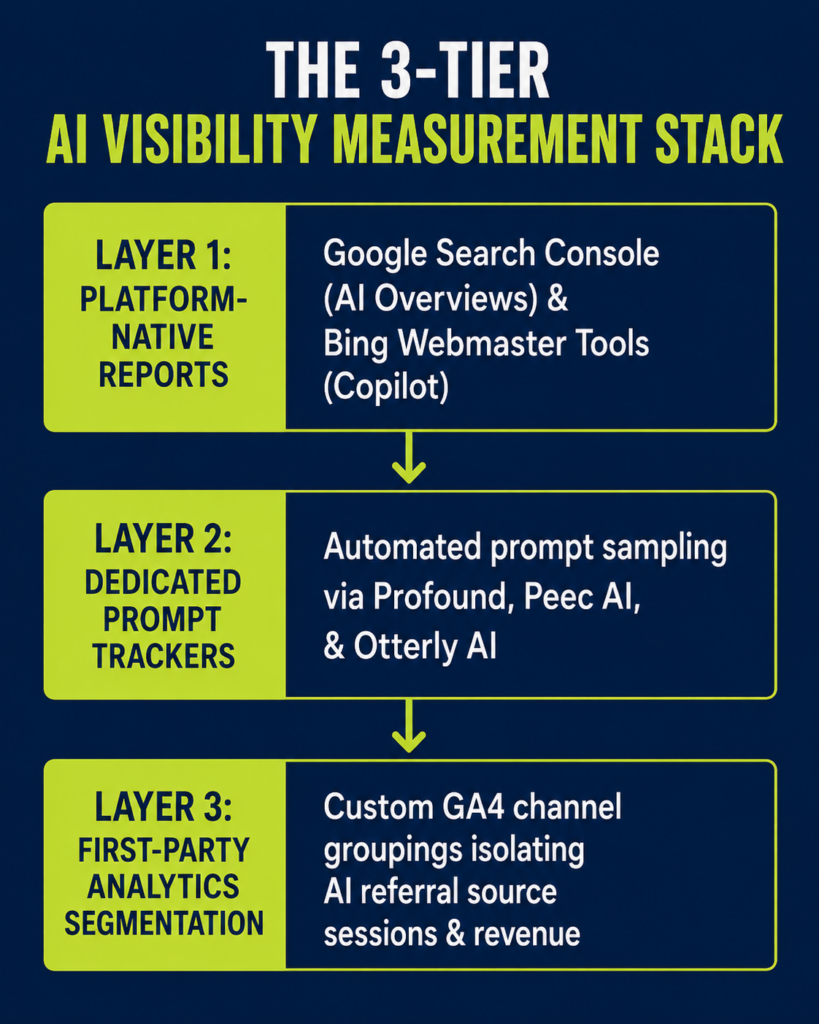
A complete measurement program answers three sequential questions:
- Brand Presence: Is your brand mentioned in generative answers for target customer prompts?
- Attribution & Citations: Is the mention backed by an explicit hyperlink or brand citation?
- Downstream Conversion: Are AI-driven referrals visiting your site and converting into revenue?
To establish baseline prompt-testing habits before building an automated tracking pipeline, read our guide on AI search visibility fundamentals.
The 7 AI Search Surfaces to Track
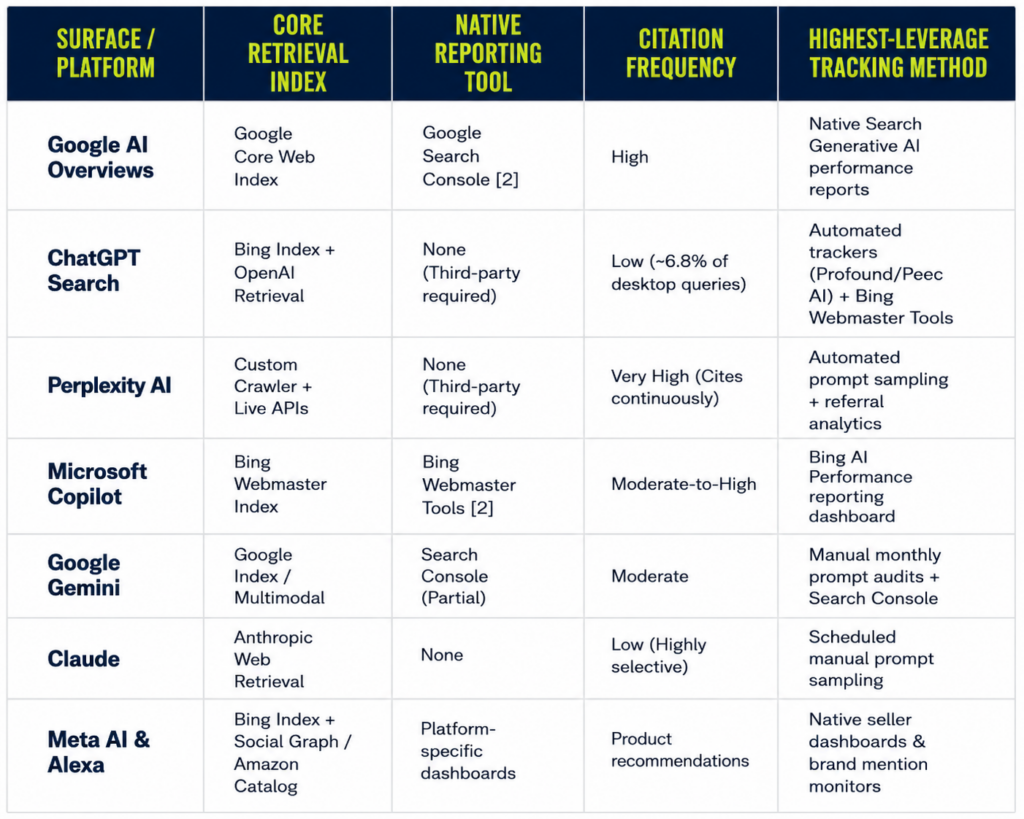
Each major AI engine utilizes different indices, citation models, and analytics access.
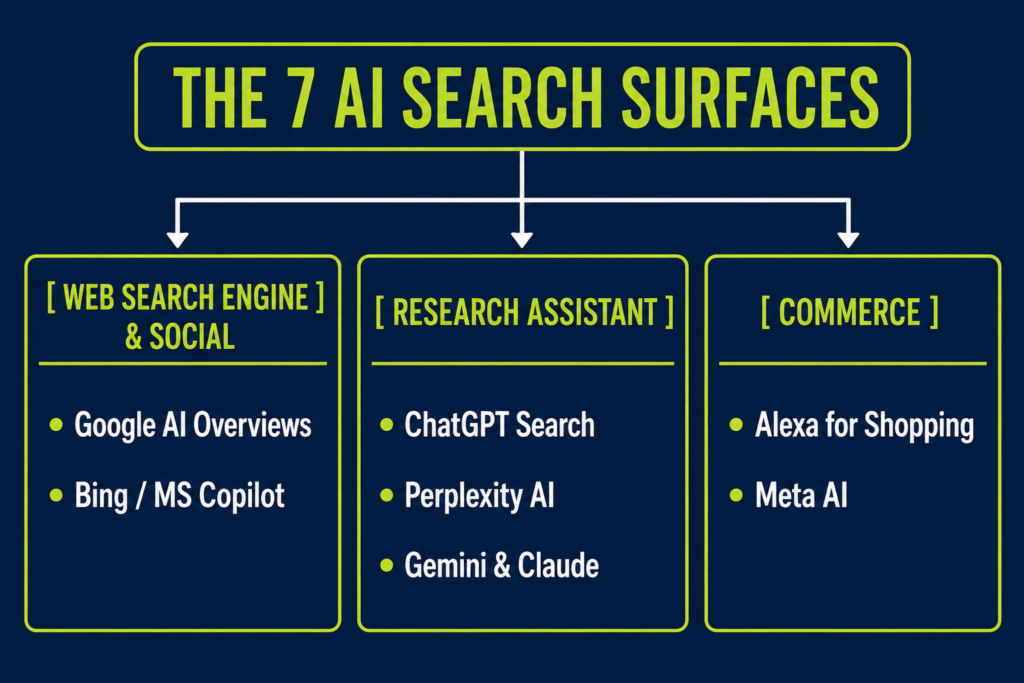
1. Google AI Overviews & AI Mode
The highest-volume surface in search. Google supplies native tracking through Google Search Console performance reports [²].
2. ChatGPT Search
Functioning as a primary research and shopping engine, ChatGPT relies heavily on Bing’s search index for live web queries. Review The ChatGPT Search Playbook to understand how Bing indexing dictates ChatGPT citations.
3. Perplexity AI
The most citation-dense platform, making it highly transparent for tracking source links and verifying information accuracy.
4. Microsoft Copilot
Runs on Bing’s web index and integrates natively into Windows, Edge, and Microsoft 365, serving a high volume of enterprise and B2B users.
5. Google Gemini
Embedded across Android, Google Workspace, and Google Search interfaces. While citation mechanics remain less transparent than AI Overviews, tracking Gemini share of voice is critical for total Google ecosystem coverage.
6. Claude (Anthropic)
Features no public advertising layer or native brand reporting. Claude requires manual prompt sampling to evaluate presence among technical and professional user bases.
7. Amazon Alexa for Shopping & Meta AI
Context-specific discovery surfaces operating within commerce and social networks. Explore our tactical guides on Alexa for Shopping optimization and Meta AI’s quiet turn into a search engine.
7 AI Search Surfaces Comparison Matrix
How to Track Google AI Overviews and AI Mode
In June 2026, Google introduced dedicated Search Generative AI performance reports inside Google Search Console [²]. This report isolates queries where your URL appeared as a source inside an AI Overview or AI Mode response from standard organic listings.
How to Analyze Search Console AI Data:
- Account for Impression Definitions: An impression registers whenever your page is cited as a source inside a synthesized answer, even if the user does not scroll to view the link card. Expect click-through rates (CTR) on AI Overviews to run lower than standard top-3 organic blue links.
- Identify Zero-Click Exposure: Filter AI performance data against your core product and transactional terms. High AI impressions coupled with low CTR indicate where zero-click search behavior is concentrating across your catalog.
- Cross-Reference with Bing Webmaster Tools: Bing’s AI Performance reports track Copilot citations while providing diagnostic visibility into the index that feeds ChatGPT’s search layer.
Evaluating AI Visibility Tracking Tools: Point Solutions vs. SEO Suites
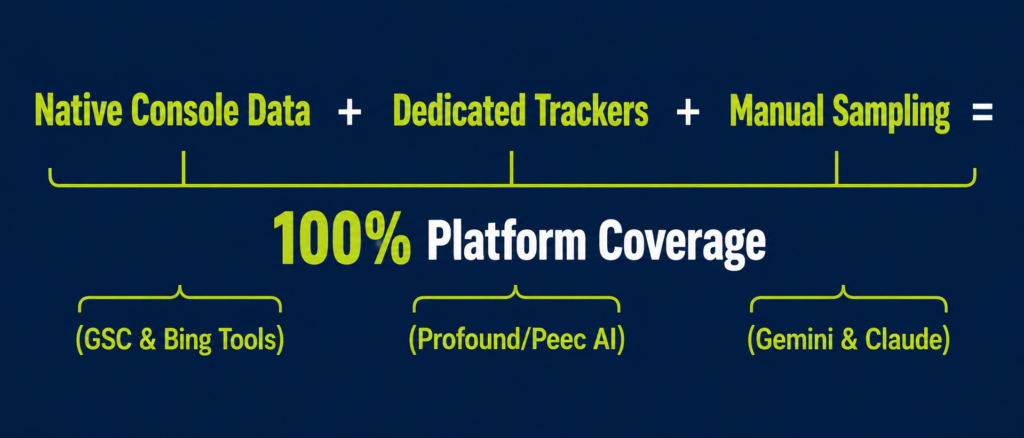
Because no single software covers all seven platforms, tracking visibility requires a hybrid tool stack.
1. Dedicated AI Visibility Trackers (Profound, Peec AI, Otterly AI)
- How They Work: Automatically run prompt sets across ChatGPT, Perplexity, Gemini, and Copilot on a recurring schedule to record brand mentions, link citations, and competitive share of voice.
- Key Methodology Note: Generative engines use probabilistic sampling, meaning identical prompts can return different cited sources across executions. Enterprise trackers run each prompt multiple times to output a statistical Citation Rate (%) rather than a single pass/fail result.
2. Enterprise SEO Suites (Semrush, Ahrefs Brand Radar)
- How They Work: Extend existing keyword and backlink tracking to monitor brand mentions across AI outputs.
- Trade-Off: Convenient single-dashboard tracking, but often feature lower prompt sampling capacity and slower platform coverage updates than dedicated point solutions.
3. Manual Prompt Sampling
- Best Use Case: Essential for Claude and Gemini, where third-party API tracking remains limited. Manually run 20 to 30 core buyer questions monthly and record mention rates in a central database.
Isolating AI Referral Traffic in GA4 Analytics
Standard Google Analytics 4 (GA4) properties route incoming traffic from AI engines into broad channels like Organic Search, Referral, or Unassigned. Isolating this traffic requires custom channel groupings.
Recommended Custom Channel Grouping Setup:
Create a custom channel definition named AI Search Referrals filtering by Session Source using standard regex matching:
Code snippet

Key Measurement Nuances:
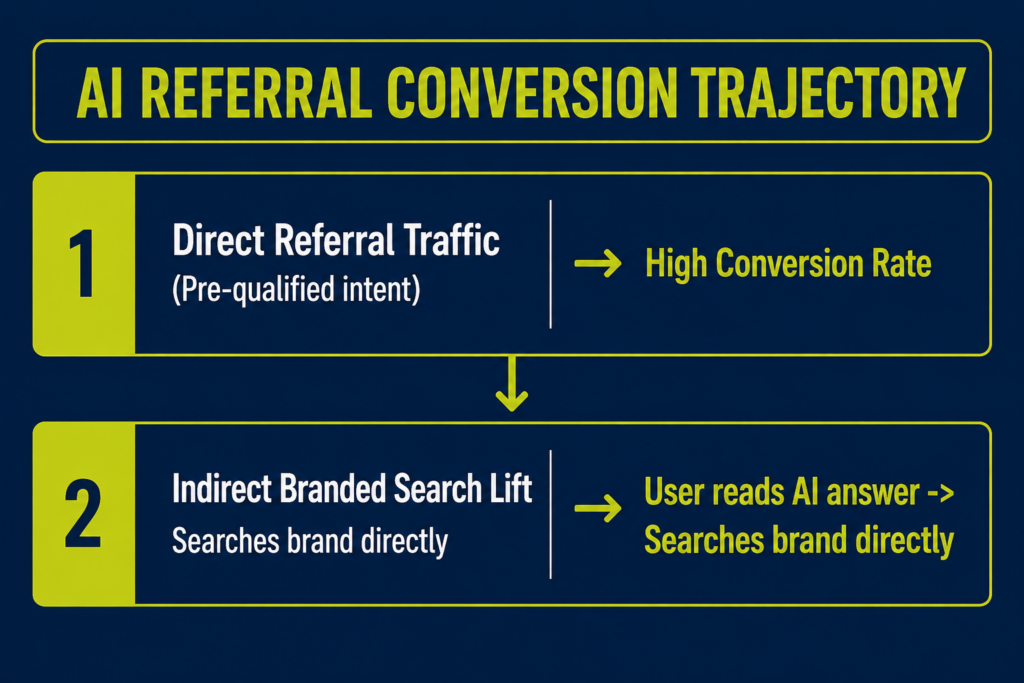
- The Dark Social Effect (Indirect Search Lift): A significant portion of AI discovery does not result in a direct citation click. Users often read an AI recommendation, close the chat window, and search for the recommended brand name directly. Monitor Branded Search Volume alongside direct AI referral sessions.
- High-Intent Conversion Rates: Industry data indicates that visitors arriving via direct AI citations convert at higher rates than average organic search traffic [[1]]. Users who click an AI citation have already digested a synthesized answer and enter the funnel with higher buying intent.
Connecting fuzzy AI discovery touchpoints to direct orders is why we developed our first-party attribution platform, AdBeacon, giving marketing teams accurate source attribution without relying on spreadsheet estimates.
The Monthly AI Search Scoreboard Framework
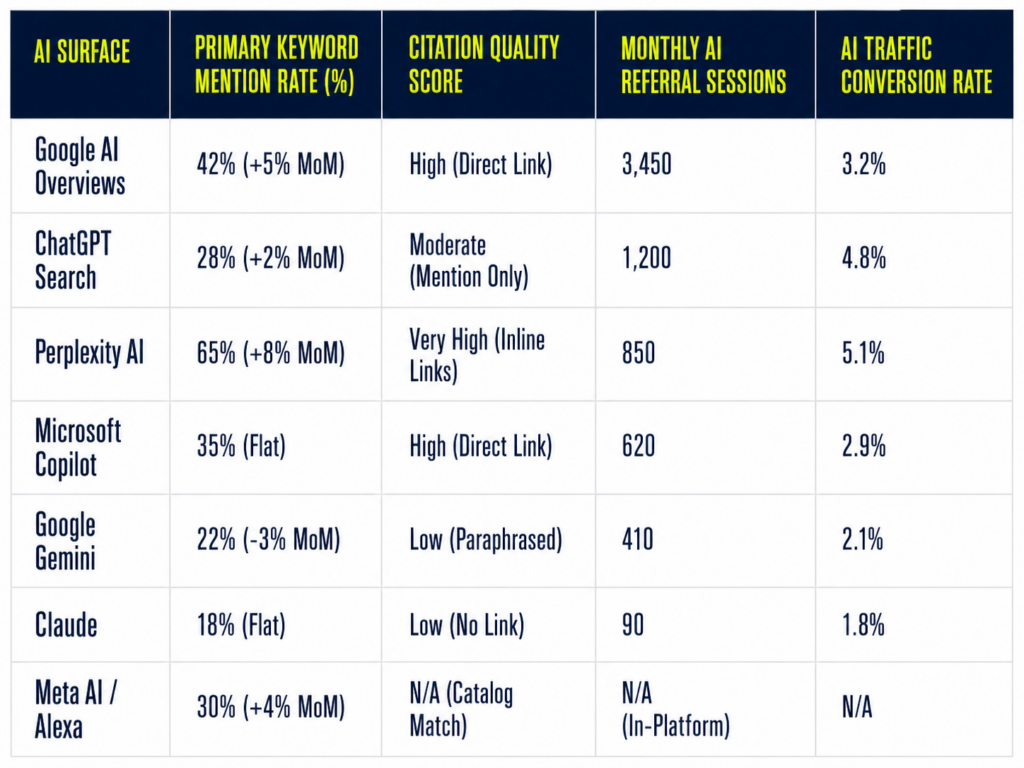
Avoid complex 12-tab dashboards. Instead, build a clean, single-page monthly scoreboard that tracks performance across all seven surfaces.
Executive AI Visibility Scoreboard Format
5 Common Measurement Pitfalls to Avoid
- Waiting for “Perfect” Unified Measurement: Postponing tracking until a single tool monitors all seven platforms leaves your brand blind to shifting customer discovery patterns. Directional data beats no data.
- Relying Solely on a Single Tool: No single platform provides complete coverage across all generative engines. Combine search console data, point-solution trackers, and manual sampling.
- Overreacting to Short-Term Citation Shifts: Generative models are probabilistic. A single day’s citation drop often reflects sampling variance rather than lost visibility. Evaluate performance trends over monthly or quarterly windows.
- Ignoring Traffic-Sparse Engines: Low referral traffic on platforms like Claude or Gemini does not justify ignoring them. Content structured to earn citations on one engine improves machine readability across all LLMs.
- Equating AI Impressions with Conversions: Appearing inside an AI Overview answer represents brand exposure, not a sale. Report impressions and converted sessions on separate line items.
Your 30-Day AI Visibility Tracking Implementation Plan
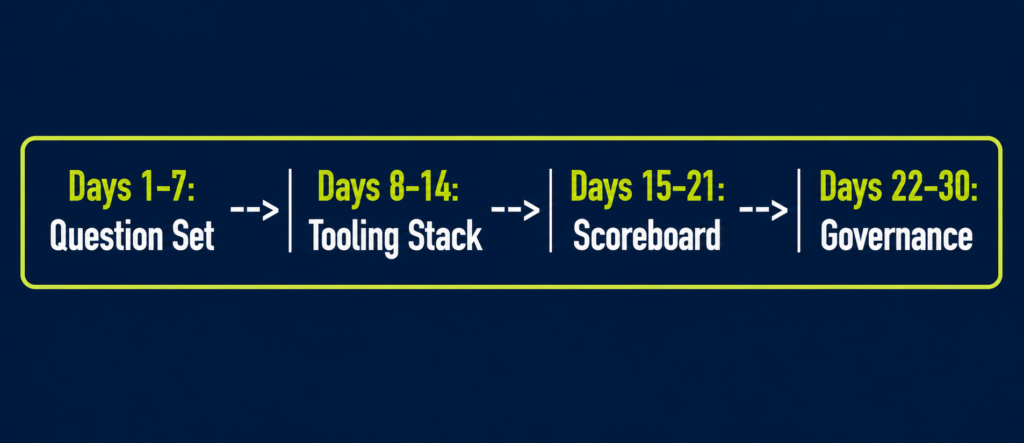
Days 1 to 7: Build Query Sets & Analytics Filters
- Compile 30 to 50 high-intent questions your buyers ask prior to purchasing.
- Verify domain ownership in Google Search Console and Bing Webmaster Tools.
- Build the custom AI Referral regex filter in GA4 to isolate incoming chat traffic.
Days 8 to 14: Select Your Tooling Stack & Run Baseline Tests
- Implement a dedicated point-solution tracker (e.g., Profound, Peec AI) for ChatGPT, Perplexity, and Copilot.
- Run manual prompt tests across Gemini and Claude, recording initial mention rates.
- Export baseline AI performance data from Google Search Console and Bing Webmaster Tools.
Days 15 to 21: Construct the Monthly Scoreboard
- Consolidate your tracking sources into a single monthly scoreboard.
- Distribute baseline figures to marketing leadership and executive stakeholders.
Days 22 to 30: Establish Ongoing Reporting Cadence
- Assign clear internal ownership for monthly scoreboard updates.
- Schedule a monthly performance review to reallocate content and optimization resources toward underperforming platforms.
If your team requires expert support to build and maintain this measurement infrastructure, our specialized AI Search Optimization program provides comprehensive tracking and optimization across all major AI platforms.
Partner with National Positions
Establishing clear visibility across seven evolving AI search platforms requires advanced analytics engineering, continuous prompt sampling, and data integration expertise.
National Positions delivers complete measurement solutions for growing brands:
- 22+ Years of Growth Analytics: Managing and optimizing search performance for over 300 e-commerce and SMB brands.
- Google Premier Partner Leadership: Recognized in the top tier of performance agencies worldwide.
- The PACE Framework: Our integrated strategy (Plan, Analyze, Convert, Expand) grounds every campaign in verified revenue metrics.
- Proprietary Attribution Infrastructure: Our first-party attribution platform, AdBeacon, bypasses platform self-reporting to link AI citations and multi-touch discovery directly to sales revenue.
Book a Consultation to Audit Your AI Visibility
Ready to evaluate your true share of voice across ChatGPT, Perplexity, Google AI Overviews, and Copilot? Book a call with National Positions to receive a comprehensive AI search audit and build a custom visibility scoreboard for your brand.
Frequently Asked Questions
Is there a single tool that tracks AI search visibility across all platforms?
No. Complete coverage requires a hybrid tracking stack: Google Search Console and Bing Webmaster Tools for native search data [²], point-solution trackers (Profound, Peec AI) for ChatGPT and Perplexity, and manual sampling for Claude and Gemini.
What is the difference between an AI Overview impression and an actual click?
An impression registers whenever your page is included as a source inside an AI-generated answer, regardless of whether the user scrolls to view or click the link. A click represents a user actively navigating from the AI citation to your website.
How can I verify whether ChatGPT or Perplexity traffic is converting?
Build a custom channel grouping in GA4 filtering for referral sources like chatgpt.com or perplexity.ai. Compare conversion rates and Average Order Value (AOV) for this segment against your overall organic site averages [¹].
Should my brand track platforms that currently drive low referral volume, like Claude?
Yes. The structural optimization signals required to earn citations on platforms like Claude (clean entity data, well-structured content, verifiable authority) enhance machine readability across all LLM platforms.
How often should an e-commerce brand update its AI visibility scoreboard?
Monthly. Updating weekly leads to overreacting to probabilistic sampling noise, while quarterly updates are too slow to keep pace with algorithmic changes across AI search platforms.
Are Google Search Console’s native AI performance reports accurate?
Yes, Google Search Console AI reports provide directionally accurate data for tracking impressions and clicks within AI Overviews [²]. Use it as a trailing metric evaluated over multi-week windows.
Sources & References
- Adobe Digital Insights, “E-commerce AI-Referred Traffic Growth & Conversion Benchmarks,” Retail Analytics Report (2026).
- Microsoft Webmaster Documentation, “Search Generative AI & Bing AI Performance Reporting Frameworks,” Bing Technical Documentation (Updated June 2026).
Related Guides & Next Steps
Continue building your generative search optimization strategy with our platform-specific playbooks:
- Master ChatGPT Retrieval: Read The ChatGPT Search Playbook to optimize for Bing index dependencies and OpenAI search features.
- E-Commerce Voice Search: Read Alexa for Shopping Optimization to adapt your Amazon product catalog for AI voice shopping.
- Social Discovery: Read Meta AI’s Quiet Turn into a Search Engine to optimize content for social AI assistants.