Executive Summary: Zero-click search occurs when a user query is resolved directly on the search engine results page (SERP) or inside an AI interface—via Google AI Overviews, featured snippets, knowledge panels, or conversational AI agents—without the user clicking through to an external website [¹] [²]. Capturing commercial value in a zero-click environment requires shifting from top-of-funnel organic traffic volume to Generative Engine Optimization (GEO): earning inline passage citations, building brand entity memory, and optimizing high-intent lower-funnel click paths [³].
Key Takeaways
- The SERP as the Destination: Zero-click search turns the search engine results page into the final destination rather than a gateway, resolving user intent before an outbound click occurs [¹] [²].
- Accelerated by AI Engines: The rapid deployment of Google AI Overviews, ChatGPT Search, Perplexity, and Microsoft Copilot has expanded zero-click behavior from simple facts to complex informational research [³] [⁴].
- Shift in Value Capture: Value in zero-click search is captured through three primary mechanisms: earning inline AI citations, building brand entity recall, and converting high-intent commercial traffic lower in the funnel [²] [⁵].
- Passage Extraction Formatting: Winning zero-click placement requires structuring web pages for machine extraction: 40-to-60-word direct answer blocks, query-focused subheadings, and structured JSON-LD schema [³].
- New Measurement Scorecard: Traditional organic session tracking fails to measure zero-click impact. Brands must track Share of AI Voice, prompt citation rates, branded search volume lift, and AI referral conversions [²].
What Does Zero-Click Search Actually Mean Now?
Zero-click search is a search engine interaction where the user’s information need is satisfied directly on the results page or within an AI interface, resulting in zero outbound traffic to a third-party website [¹] [²].
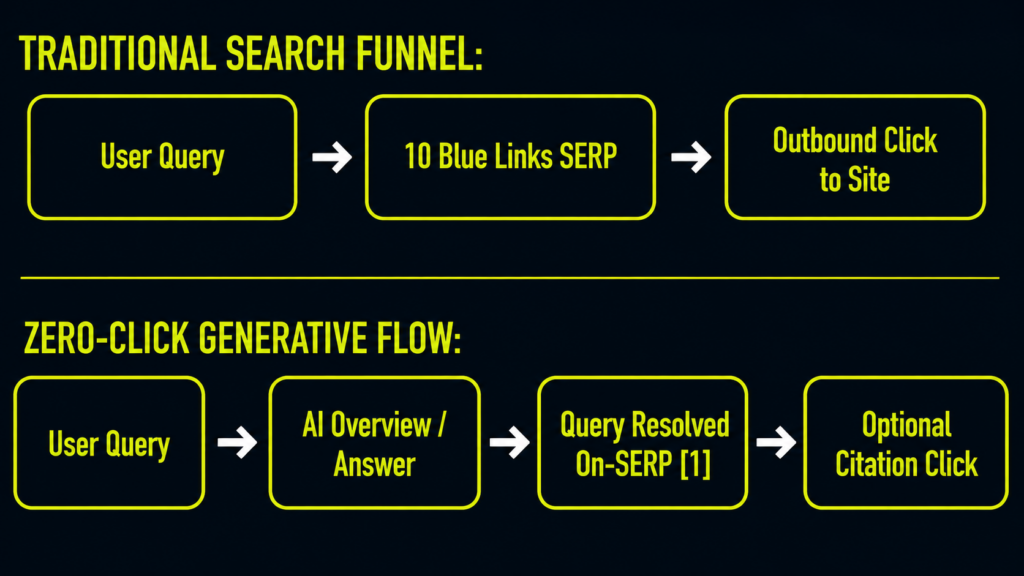
Historically, zero-click searches were confined to simple transactional widgets—such as weather updates, sports scores, currency conversions, or instant definitions [²]. Today, zero-click behavior covers complex, multi-part informational queries [³]. Generative answer engines summarize multi-source answers directly at the top of the SERP, satisfying user intent instantly [¹] [⁴].
Zero-click search is not a failure of your marketing funnel; it is the new top of your funnel [²]. When an AI engine displays an answer on the SERP, an impression occurs [³]. The primary strategic objective is ensuring your brand entity is cited as the authoritative source behind that answer [³] [⁵].
To understand how generative engines evaluate and attribute web sources, read our pillar guide, The Complete Guide to AI Search Visibility (GEO).
Why AI Accelerated Zero-Click Behavior
Three structural shifts have accelerated zero-click search behavior across consumer and enterprise markets [³] [⁴]:
- SERP Real Estate Reallocation: Google AI Overviews occupy the prime screen real estate above traditional organic blue links [¹] [³]. For informational queries, users obtain complete answers before scrolling down the page [²].
- Off-SERP Discovery Surfaces: Conversational tools like ChatGPT, Perplexity, and Microsoft Copilot handle millions of daily research queries off Google entirely [⁴] [⁵]. These engines synthesize direct answers, offering citations only as secondary reference links [⁵].
- High Answer Sufficiency: Generative AI summaries provide sufficient depth for broad informational queries, eliminating the need for users to open multiple web tabs [¹] [²].
Traditional SERP vs. Generative Zero-Click SERP
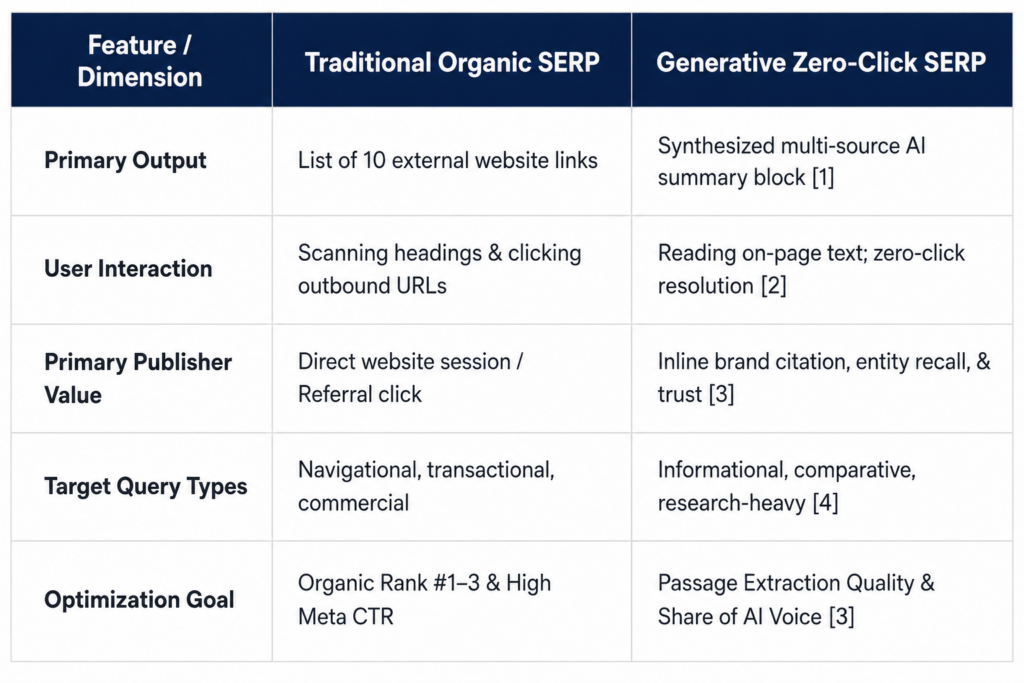
For a deep dive into the operational differences between ranking and getting cited, read GEO vs SEO: What Changes When AI Answers the Query.
5 Common Habits to Stop Immediately
- Stop Treating Every Lost Click as a Lost Customer: Top-of-funnel informational queries frequently carry low immediate commercial intent. Losing un-targeted informational clicks to an AI summary frees up resources to focus on revenue-generating touchpoints [²].
- Stop Over-Investing in Thin “Definition” Content: Publishing basic “what is” articles designed solely for informational click volume yields diminishing returns, as AI Overviews summarize basic definitions automatically [¹] [³].
- Stop Neglecting Branded Search Experience: When users see your brand cited inside an AI Overview, they frequently launch a direct, branded search later in their buying journey [²] [⁵]. Weak branded landing pages waste this high-intent awareness.
- Stop Measuring Search Success Solely on Total Organic Sessions: As zero-click resolution expands, total informational site sessions decrease industry-wide [¹] [²]. Evaluating marketing health strictly on traffic volume masks growth in brand authority and conversion efficiency.
- Stop Treating Product Detail Pages (PDPs) as Afterthoughts: The traffic that does click through a zero-click SERP carries significantly higher commercial intent [²] [³]. Unoptimized landing pages or weak calls-to-action waste pre-qualified visitors.
The 3 Levers to Capture Value from Zero-Click Search
To capture commercial value when outbound clicks decline, execute across three core operational levers [²] [³] [⁵].
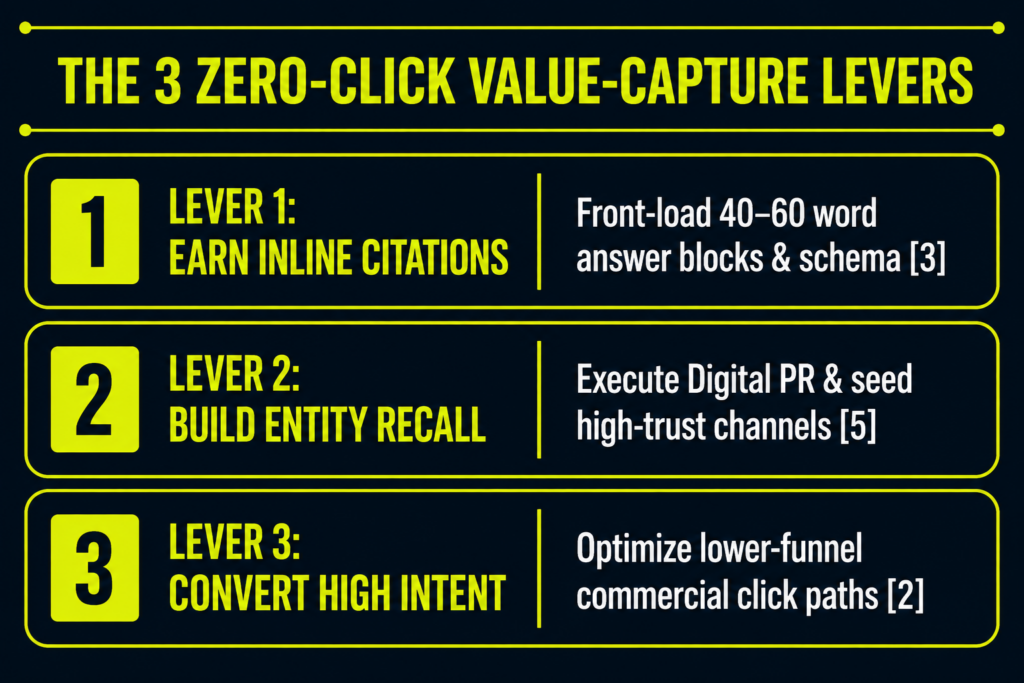
Lever 1: Be the Cited Source
If an AI model synthesizes an answer on the SERP, ensure your brand is credited as the underlying source [¹] [³]:
- Position a direct, 40-to-60-word answer block at the beginning of major content sections [³].
- Format information using clean HTML subheadings (H2, H3), structured tables, and bulleted lists.
- Implement structured JSON-LD schema (FAQPage, Article, Product) to facilitate automated machine extraction [³].
Our specialized AI Search Optimization service structures on-page architecture to maximize passage extraction across Google AI Overviews, ChatGPT, and Perplexity.
Lever 2: Build Brand Recognition and Entity Demand
Zero-click search rewards brands with strong entity authority [²] [⁵]. When your business is cited consistently across AI outputs and authoritative publications, it builds brand memory that drives direct, branded search queries down the line [²] [⁵].
Through our targeted PR and AI Visibility programs, we seed brand mentions and co-citations across the news outlets, trade publications, and community databases that AI models rely on for entity verification [⁵].
Lever 3: Capture Demand Lower in the Funnel
Allow AI summaries to satisfy broad informational prompts, and focus content efforts on high-intent commercial queries where users actively seek outbound links: product comparisons, “best X for Y” buyer guides, pricing breakdowns, and branded terms [²] [³].
Once high-intent users arrive on your site, applying rigorous Conversion Rate Optimization ensures that pre-qualified, warm traffic converts directly into pipeline revenue.
The 6-Step Zero-Click Execution Roadmap
Follow this 6-step implementation pipeline—aligned with our PACE methodology (Plan, Analyze, Convert, Expand)—to transition from click-dependent reporting to zero-click value capture.
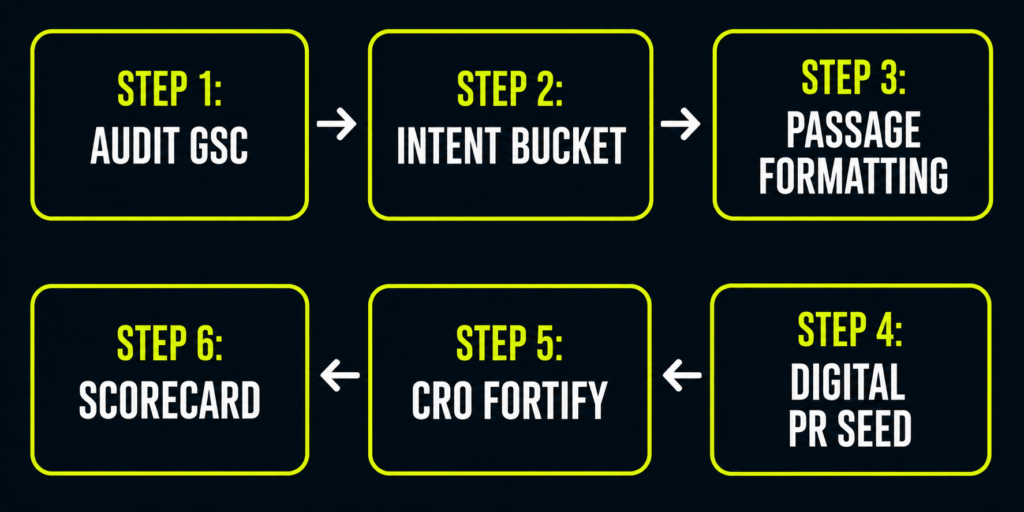
Step 1: Audit Impression-to-Click Discrepancies (Plan & Analyze)
Open Google Search Console and isolate queries exhibiting high impression volume coupled with declining click-through rates. Cross-reference these terms against live SERPs to identify queries where Google AI Overviews answer the prompt directly [¹] [³].
Step 2: Segment Content Infrastructure by Search Intent
Categorize your site’s URLs into three functional buckets:
- Informational (Zero-Click Risk): Optimize for passage extraction and brand citation [³].
- Commercial / Comparison (Click-Eligible): Refine side-by-side spec tables and buyer guides to capture active researchers [³].
- Transactional / Branded (High-Conversion Value): Fortify on-page UX and conversion paths.
Step 3: Restructure Priority Pages for Machine Extraction (Convert)
Format top commercial and informational pages for RAG extraction. Insert concise direct-answer blocks below query-focused headings, clear wall-of-text paragraphs into scannable lists, and deploy valid JSON-LD schema markup [³].
Step 4: Seed Authority Across Off-Site Entity Hubs (Expand)
Execute digital PR outreach to earn brand mentions in authoritative trade media, industry blogs, and community forums (such as Reddit and Wikidata) [⁵]. AI models crawl these platforms continuously to establish entity authority [⁴] [⁵].
Step 5: Fortify High-Intent Conversion Touchpoints
Optimize product detail pages, pricing guides, and landing pages. Test headline positioning, form length, social proof callouts, and checkout friction to maximize revenue from incoming referral traffic.
Step 6: Deploy a Modern AI Search Scorecard
Replace pure session tracking with a multi-metric dashboard:
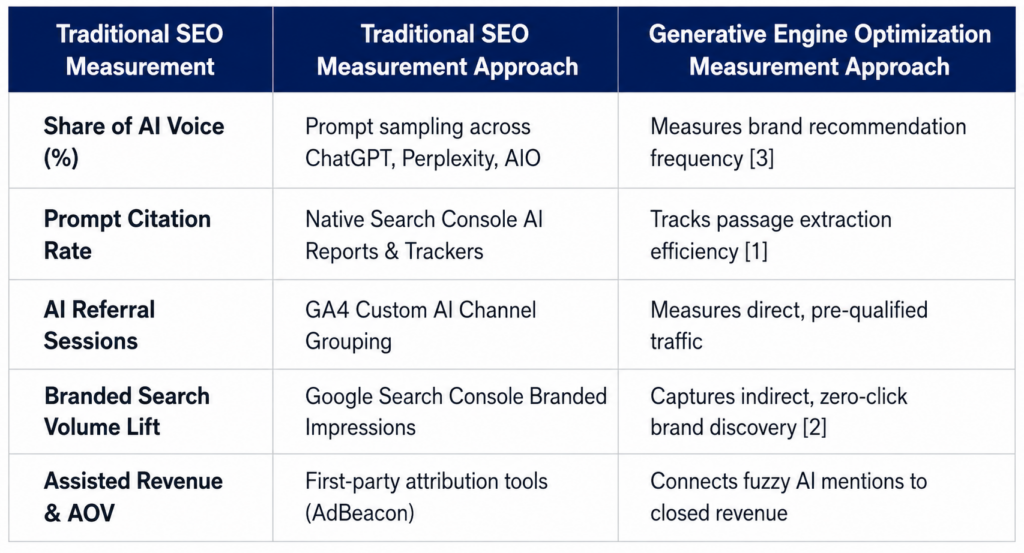
Our proprietary first-party attribution platform, AdBeacon, connects fuzzy top-of-funnel AI discovery moments directly to backend sales data, eliminating spreadsheet guesswork.
Partner with National Positions for Advanced GEO
Navigating zero-click search environments requires integrated analytics engineering, digital PR, technical SEO, and conversion optimization.
National Positions provides complete Generative Engine Optimization solutions:
- 22+ Years of Performance Engineering: Managing search and performance analytics for over 300 e-commerce and B2B brands.
- Google Premier Partner Leadership: Recognized in the top tier of performance marketing agencies globally.
- The PACE Framework: Our methodology (Plan, Analyze, Convert, Expand) grounds AI search strategies in verified revenue metrics.
- First-Party Attribution via AdBeacon: Our proprietary AdBeacon platform measures traffic, attribution, and conversion impact across paid, organic, and AI-driven channels.
Ready to audit your brand’s zero-click visibility and protect your search revenue? Book a zero-click visibility and conversion audit with our team to evaluate your current baseline and build a platform-specific growth strategy.
Frequently Asked Questions
Is zero-click search harmful to digital businesses?
Not if your strategy adapts to capture value from citations and brand authority [²]. While zero-click behavior reduces overall session volume for broad informational queries, it increases brand exposure via AI Overview citations and drives higher-intent, warmer traffic to lower-funnel commercial pages [²] [³].
What percentage of Google search queries resolve without a click?
Industry research indicates a significant and growing proportion of web searches resolve directly on the SERP without an outbound click [¹] [²]. This trend is particularly pronounced for informational, definitional, and comparative search prompts [³] [⁴].
Should businesses block AI crawlers to force users to visit their websites?
No. Blocking search or AI crawlers removes your domain from search indexes entirely, forfeiting both organic blue-link rankings and zero-click AI citations [¹] [³]. Earning brand citations within AI summaries provides far greater commercial value than complete invisibility.
How can a business track brand mentions inside zero-click AI responses?
Monitor brand mentions by running monthly prompt sampling audits across Google AI Overviews, ChatGPT, Perplexity, and Copilot [³] [⁵]. Additionally, monitor Search Console for increases in branded search volume, which often signals downstream lift from zero-click AI citations [²].
Do zero-click search interactions lead to actual sales conversions?
Yes. Users who interact with an AI summary before clicking through to a website enter the funnel pre-qualified [²] [³]. They have already digested foundational facts and arrive on commercial landing pages prepared to evaluate pricing and complete purchases [²].
How should e-commerce brands adapt to zero-click search trends?
E-commerce brands should structure product data, size guides, and comparison tables for passage extraction within AI Overviews [³]. Simultaneously, fortify Product Detail Pages (PDPs) with conversion rate optimization to ensure incoming traffic converts efficiently [²].
Sources & References
- Google Search Central, “Guidance on AI Overviews, Search Features, and Web Indexing,” Technical Webmaster Documentation [1].
- Pew Research Center & Similarweb, “Digital Search Behaviors and the Expansion of Zero-Click SERP Interactions,” Search Industry Analytics [2].
- Semrush, “Passage Extraction Quality, Information Density, and Citation Mechanics in RAG Engines,” Industry Technical Reports [3].
- Semrush & BrightEdge Disclosures, “AI Overview SERP Real Estate Impact and Organic Click-Through Rate Benchmarks,” Digital Marketing Research [4].
- Thinklytics, “Off-Site Co-Citations, Subreddit Indexing, and LLM Grounding Architectures,” Search Industry Benchmark Data [5].