Executive Summary: SEO optimizes web content to earn clicks from a ranked list of blue links on search engine result pages (SERPs). Generative Engine Optimization (GEO) optimizes content to get cited, quoted, or recommended inside AI-generated answers across SearchGPT, Perplexity, Google AI Overviews, Gemini, and Copilot. GEO does not replace traditional SEO; it builds upon technical crawlability and E-E-A-T foundations to capture zero-click and AI-mediated search discovery [¹] [²].
Key Takeaways
- Shift in End Goal: Traditional SEO earns website clicks; GEO earns inline citations, brand mentions, and category recommendations inside AI responses [²] [³].
- Shared Foundations: Technical crawlability, fast page speeds, site authority, and topical depth remain mandatory prerequisites for both SEO and GEO [¹].
- Passage-Level Extraction: LLMs extract discrete text blocks. A concise, self-contained 40-to-60-word passage wins citations faster than a lengthy, unstructured 2,500-word article [²] [⁴].
- Entity Authority Matters: LLMs weigh brand mentions, digital PR coverage, and third-party corroboration across Reddit, Wikipedia, and trade press to verify source trust [²] [⁵].
- Dual-Surface Execution: High-performing growth strategies maintain traditional SEO to capture commercial blue-link traffic while layering GEO tactics to win zero-click AI answers [³].
What Is the Actual Difference Between GEO and SEO?
Search Engine Optimization (SEO) is the discipline of structuring web pages to rank in search engine results pages, persuading human searchers to click an outbound link [¹].
Generative Engine Optimization (GEO) is the process of structuring content, brand entity signals, and off-site authority so that large language models (LLMs) extract, cite, and recommend your business inside synthesized AI responses [²] [³].
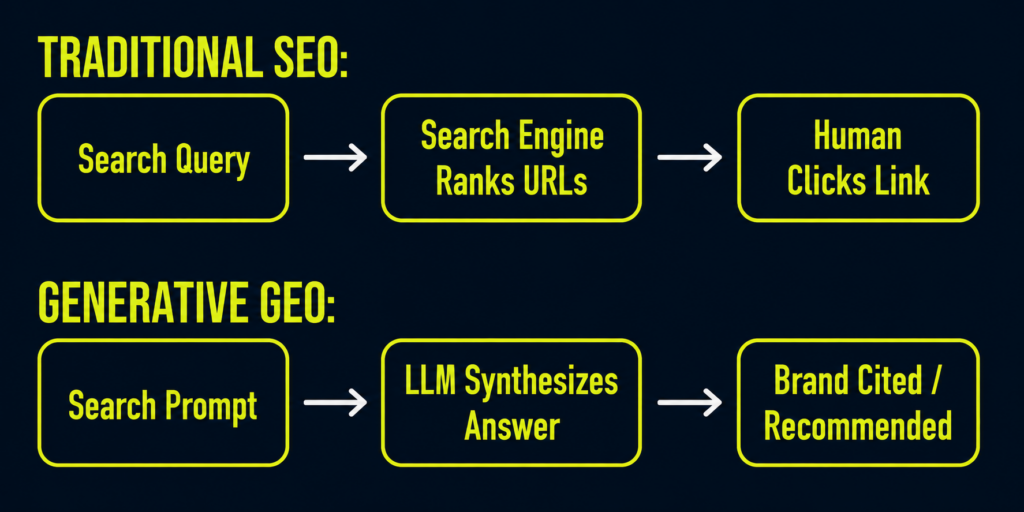
Because generative answer engines (such as Google AI Overviews) ground their responses in underlying web indexes, traditional ranking factors directly feed the AI retrieval pipeline [¹] [⁴]. GEO is not an alternative to SEO; it is a specialized evolution that assumes an AI model reads and processes your content before a human ever views the page [²].
For a full breakdown of cross-platform AI search mechanics, explore our pillar guide, The Complete Guide to AI Search Visibility (GEO).
SEO vs. GEO: Comparison Matrix
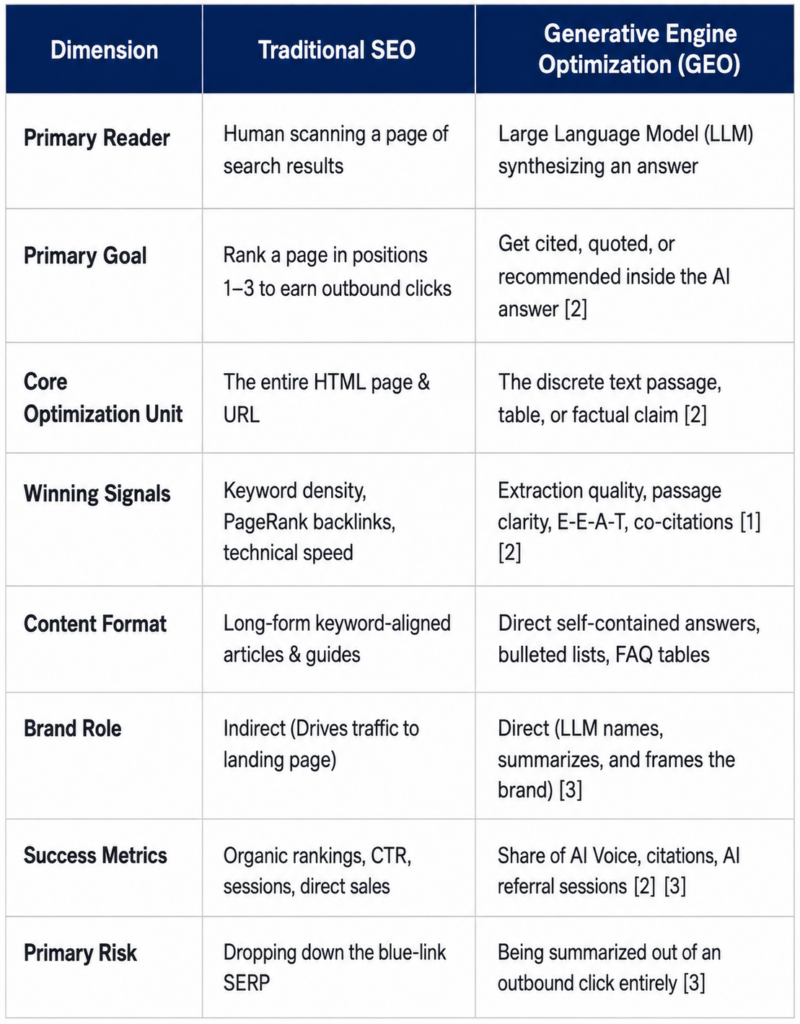
How Ranking Signals Shift from SEO to GEO
While technical crawlability and indexation remain mandatory across both disciplines [¹], GEO shifts optimization focus toward four specific machine-readability signals [²] [⁴]:
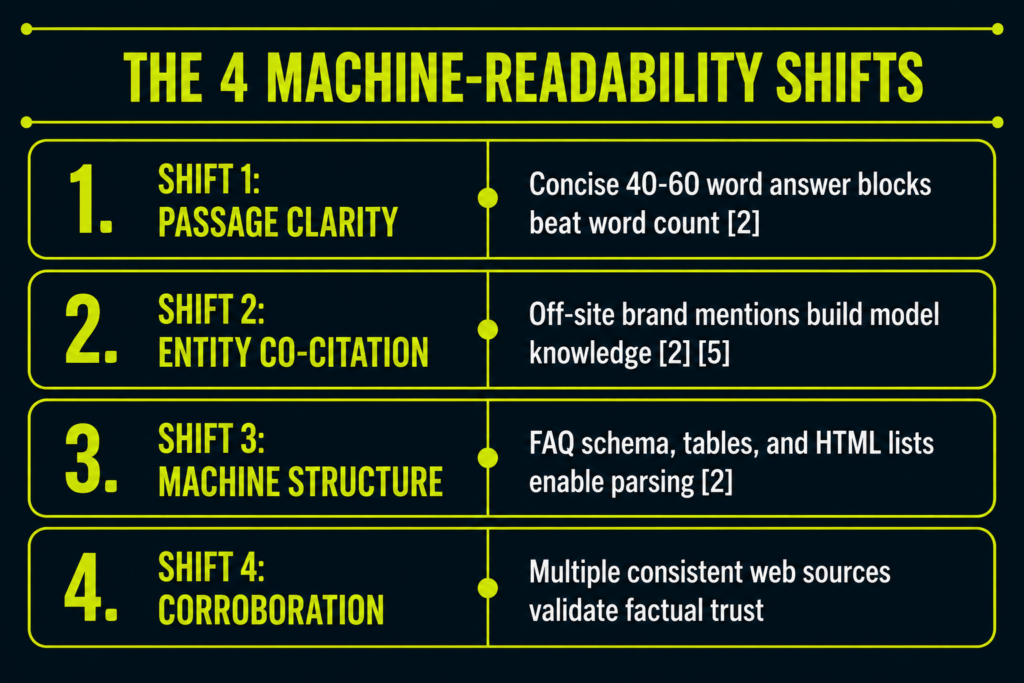
Passage-Level Extraction: LLMs process text in sentence-level chunks. Placing a concise, self-contained 40-to-60-word answer immediately below a query-focused heading ensures the passage can be lifted and cited cleanly [²].
- Entity Co-Citations and Off-Site PR: LLMs verify brand authority by analyzing mentions across external publications, press releases, and digital forums [⁵]. Integrating PR and AI Visibility strategies builds the off-site footprint models require.
- Machine-Readable Structure: HTML tables, bulleted lists, and structured JSON-LD schema eliminate parsing ambiguity for AI crawlers [²].
- Factual Corroboration: AI models prioritize claims that are confirmed across multiple reputable web properties, penalizing unverified or isolated assertions [⁴].
What Stays the Same (The Shared Search Foundation)
Eliminating traditional SEO in favor of standalone AI tactics creates a fragile search footprint. GEO requires solid technical SEO fundamentals to function [¹]:
- Crawlability and Indexation: If search bots cannot crawl or index your site, LLMs cannot retrieve your content for live search synthesis [¹].
- Google E-E-A-T Guidelines: Experience, Expertise, Authoritativeness, and Trustworthiness remain foundational signals for both organic rank and LLM citation selection [¹].
- User Intent Matching: Content must directly resolve the underlying search query [¹].
- Topical Authority: Shallow, low-quality content is filtered out by search algorithms and generative models alike [²].
4 Outdated SEO Habits to Stop Immediately
- Burying Answers Under 2,500-Word Intros: Forcing readers to scroll through long introductions before answering a query causes LLMs to extract answers from concise competitor pages [²].
- Relying Exclusively on Head-Keyword Search Volume: Traditional keyword tools miss conversational, long-tail search prompts executed inside ChatGPT and Perplexity [²].
- Treating Digital PR as Optional: Neglecting off-site press coverage deprives AI models of the co-citation signals required to verify brand authority [⁵].
- Measuring Success Purely by Organic Rank Position: Focusing solely on traditional SERP rankings ignores whether your brand appears in AI Overviews or zero-click AI responses [³].
A Framework for Where to Invest: SEO, GEO, or Both
Optimizing for modern search requires allocating resources based on query intent and audience behavior.
Search Query Allocation Matrix
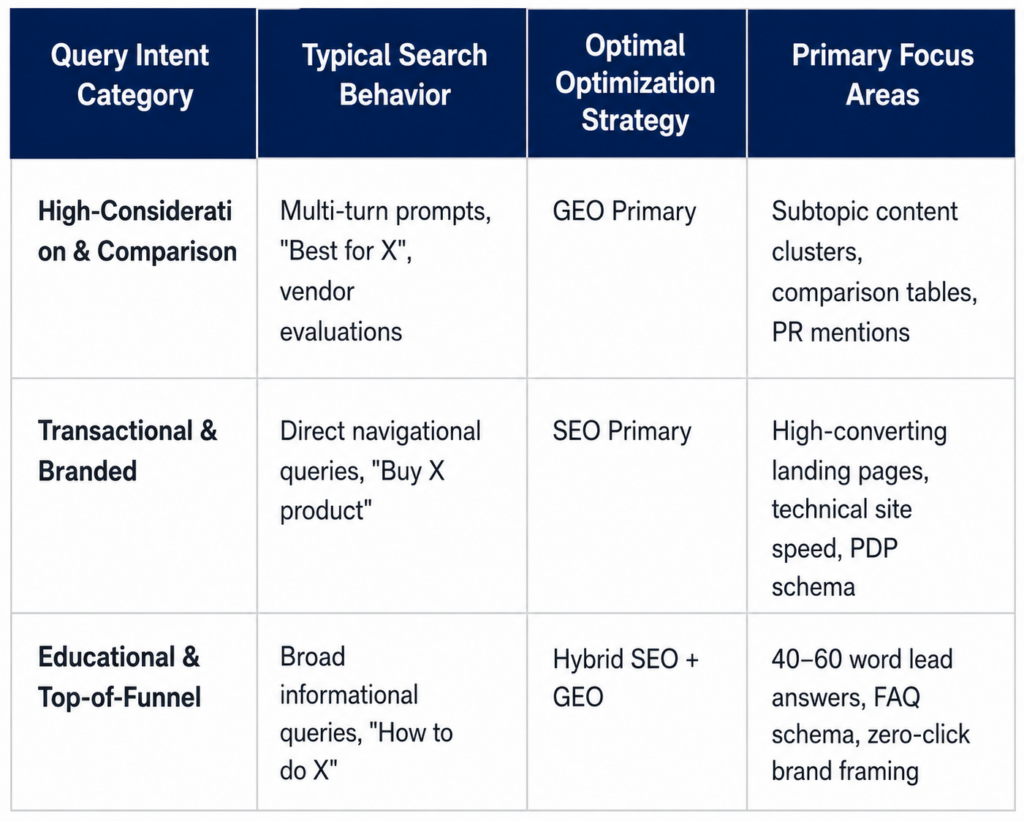
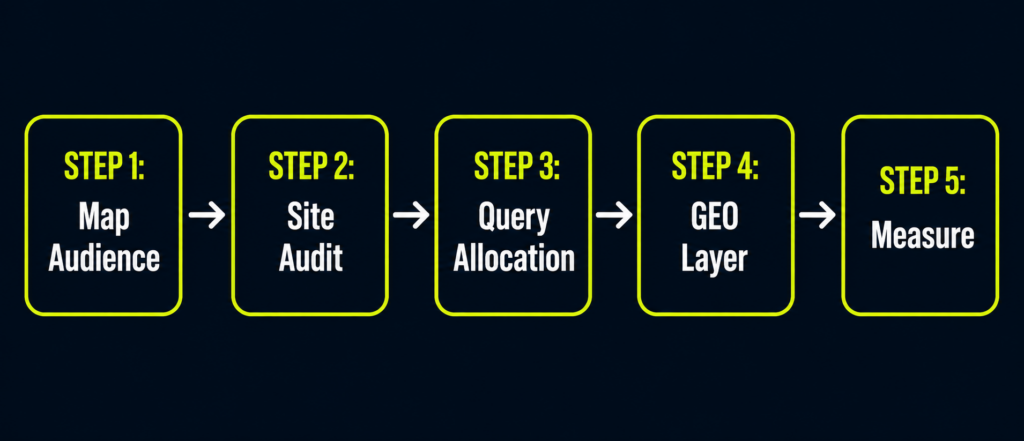
5-Step Action Plan to Deploy an Integrated GEO + SEO Strategy
Deploy this 5-step roadmap—aligned with our PACE methodology (Plan, Analyze, Convert, Expand)—to maximize total search visibility.
Step 1: Audit Current AI Presence (Plan & Analyze)
Query ChatGPT, Google AI Overviews, Perplexity, and Gemini with 20 to 30 core customer prompts. Record brand inclusion rates, competitor citations, and factual accuracy [²].
Step 2: Audit Site Technical Health (SEO Foundation)
Resolve crawling errors, validate XML sitemaps, improve page load speeds, and verify indexation in both Google Search Console and Bing Webmaster Tools [¹]. Explore our core SEO work to resolve underlying technical bottlenecks.
Step 3: Restructure Landing Pages for Extraction (Convert)
Restructure priority commercial landing pages to place concise 40-to-60-word answers directly beneath query-focused headings [²]. Implement FAQPage, Article, and Product JSON-LD schema markup.
Step 4: Expand Off-Site Authority (Expand)
Execute digital PR campaigns to secure brand mentions in authoritative trade publications, news outlets, and industry directories [⁵].
Step 5: Track Multi-Surface Performance
Track traditional organic rankings alongside Share of AI Voice, prompt citation rates, AI referral traffic, and assisted conversions [³]. Our proprietary AdBeacon platform connects fuzzy AI discovery touchpoints directly to closed sales revenue.
If your business needs a dedicated partner to execute an integrated strategy, explore our specialized AI Search Optimization programs.
Partner with National Positions for Data-Driven Growth
Maximizing visibility across traditional search results and generative AI answer engines requires technical analytics engineering, digital PR, and structured content design.
National Positions delivers complete search solutions:
- 22+ Years of Growth Engineering: Managing digital search and performance analytics for over 300 e-commerce and B2B brands.
- Google Premier Partner Leadership: Recognized in the top tier of performance marketing agencies globally.
- The PACE Framework: Our methodology (Plan, Analyze, Convert, Expand) grounds AI search strategies in verified revenue metrics.
- First-Party Attribution via AdBeacon: Our proprietary AdBeacon platform measures traffic, attribution, and conversion impact across paid, organic, and AI-driven channels.
Ready to audit your brand’s search visibility across Google, ChatGPT, and Perplexity? Book a GEO and SEO visibility audit with our team to evaluate your current baseline and build an integrated growth strategy.
Frequently Asked Questions
Is GEO replacing traditional SEO?
No. GEO extends traditional SEO [²]. Generative AI answer engines rely on traditional web crawlers to discover and index source material [¹]. Maintaining strong technical SEO and domain authority forms the mandatory foundation upon which GEO operates.
Do I need to create separate content for GEO and SEO?
No. High-quality content can serve both human readers and AI crawlers when structured correctly [²]. Place direct 40-to-60-word answer blocks beneath clear headings, format data in HTML tables, and implement schema markup to satisfy both search channels.
How can a business measure GEO performance?
Track prompt citation rates across ChatGPT, Perplexity, Gemini, and Google AI Overviews, monitor brand mentions in trade media, analyze incoming AI referral traffic in GA4, and evaluate branded search volume lift [²] [³].
Does GEO drive website traffic if answers are resolved without clicks?
Yes. While zero-click AI answers resolve simple informational prompts directly on the SERP [³], inline citations in commercial comparison queries drive pre-qualified, high-intent traffic [²]. Furthermore, brand mentions inside AI answers build long-term category awareness [³]. Read our post on zero-click search strategy to capture value from unclicked AI answers.
Which industry verticals should prioritize GEO first?
Industries with high-consideration purchase funnels—including e-commerce, B2B SaaS, financial services, healthcare, and professional services—see significant AI answer influence during buyer research phases [²] [³].
Sources & References
- Google Search Central, “Guidance on AI Overviews, Web Indexing, and the E-E-A-T Framework,” Technical Webmaster Documentation [¹].
- Medium, “Information Extraction Quality, Passage Chunking, and Citation Mechanics in Large Language Models,” Academic & Search Analytics Disclosures [²].
- Ziptie Dev, “Future of Search: AI Answer Adoption, Zero-Click Behavior, and Organic Traffic Trends,” Digital Marketing Benchmark Reports [³].
- Search Engine Land, “Structuring Web Content for LLM Parsing and RAG Retrieval Pipelines,” Technical SEO Reports [⁴].
- Semrush Analytics, “Co-Citation Networks, Digital PR Impact, and Entity Building in Generative AI Search,” Search Industry Benchmark Data [⁵].