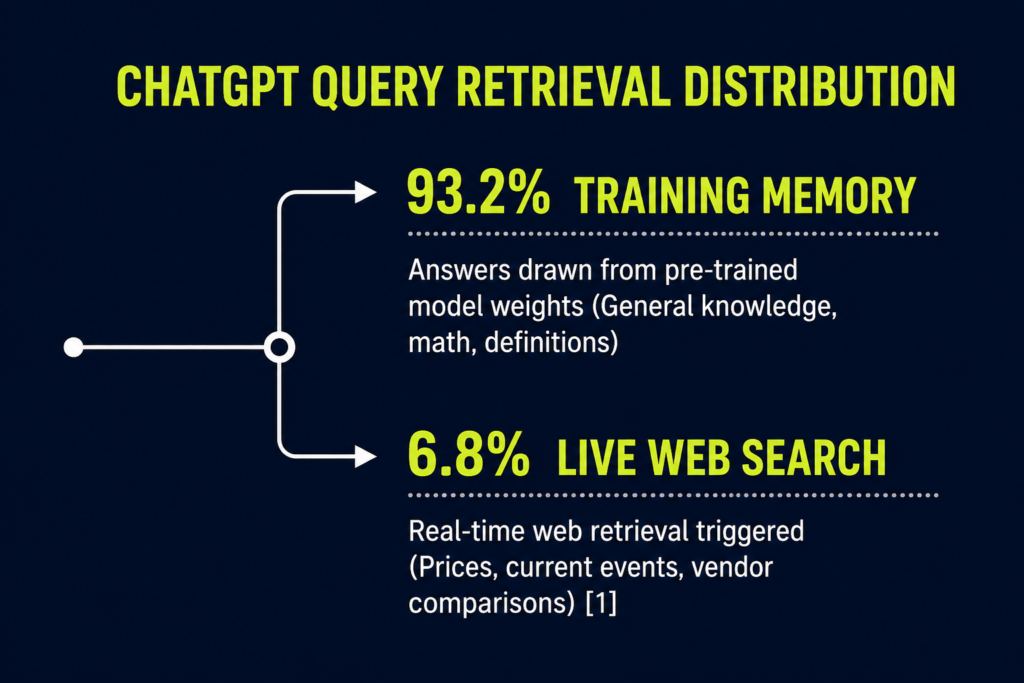
Executive Summary: Optimizing for ChatGPT search visibility requires recognizing that only 6.8% of U.S. desktop queries trigger live web citations [¹]. For queries requiring live web retrieval, ChatGPT relies heavily on Bing’s web index, demonstrating an 87% overlap with top Bing search results [²]. Earning live citations requires verifying domains in Bing Webmaster Tools, permitting OAI-SearchBot in robots.txt, and placing concise 40–60 word direct answers at the top of content sections [³].
Key Takeaways
- The 6.8% Reality: ChatGPT answers 93.2% of prompts using pre-trained memory [¹]. Live citations occur only when queries require current facts, pricing, or specific entity details [¹].
- Bing Index Alignment: ChatGPT’s live web search relies on Bing’s search index rather than Google [²]. Ranking #1 on Google provides zero citation advantage if a page is unindexed on Bing [²].
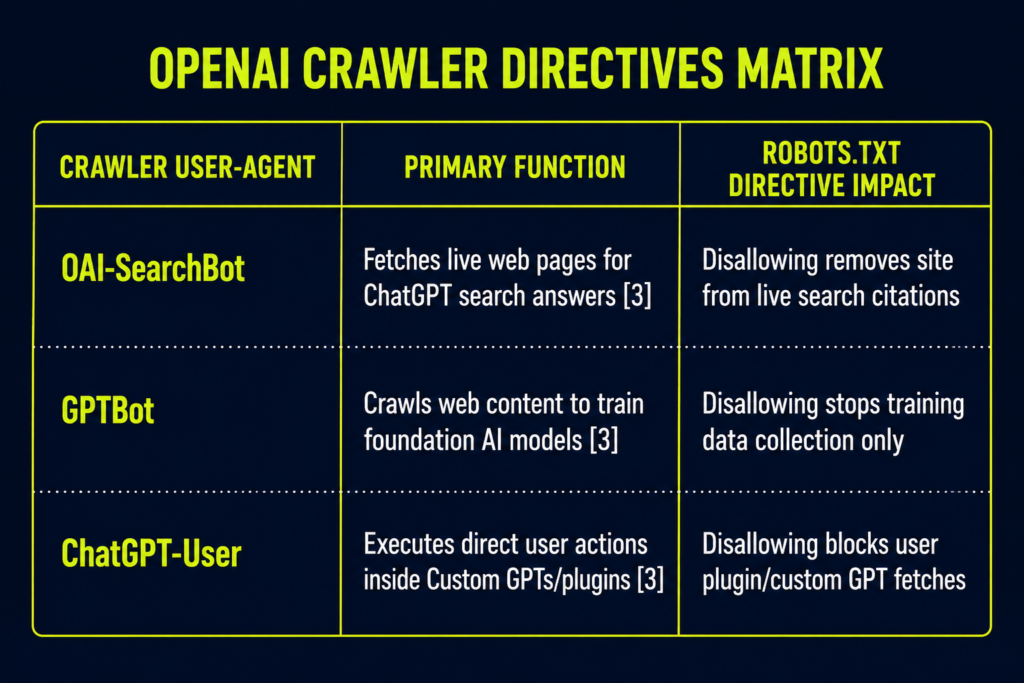
- The Dual-Crawler Distinction: GPTBot crawls content to train AI foundation models, while OAI-SearchBot fetches live web pages for search citations [³]. Blocking GPTBot for privacy does not disable OAI-SearchBot [³].
- llms.txt Limitations: The llms.txt file format is used primarily for developer agent SDKs and provides no direct ranking advantage within consumer ChatGPT search [³].
- Direct-Answer Structuring: To earn citations during real-time retrieval passes, key factual claims must be stated clearly within the first 40 to 60 words of a page section [³].
What Does the 6.8% Citation Rate Actually Mean?
Data indicates that only 6.8% of U.S. desktop queries on ChatGPT result in a live web citation [¹]. While overall citation frequency increased significantly over prior-year baselines, the vast majority of user prompts continue to be answered directly from internal model parameters [¹].
The Two Strategic Optimization Track Layers:
- The 93.2% Parameter Layer (Brand Entity Building): Influenced over long time horizons through Wikipedia inclusions, Reddit discussions, digital PR, and broad web mentions that enter model training sets [²].
- The 6.8% Live Citation Layer (Technical GEO): Influenced directly through Bing indexation, OAI-SearchBot access, structured schema markup, and concise content formatting [³].
Does ChatGPT Search Still Run on Bing’s Index?
Yes. When ChatGPT determines a prompt requires live web data, its search retrieval layer queries Bing’s web index [²]. Comparative citation studies show an 87% match rate between sources cited inside ChatGPT search answers and top organic listings on Bing [²].
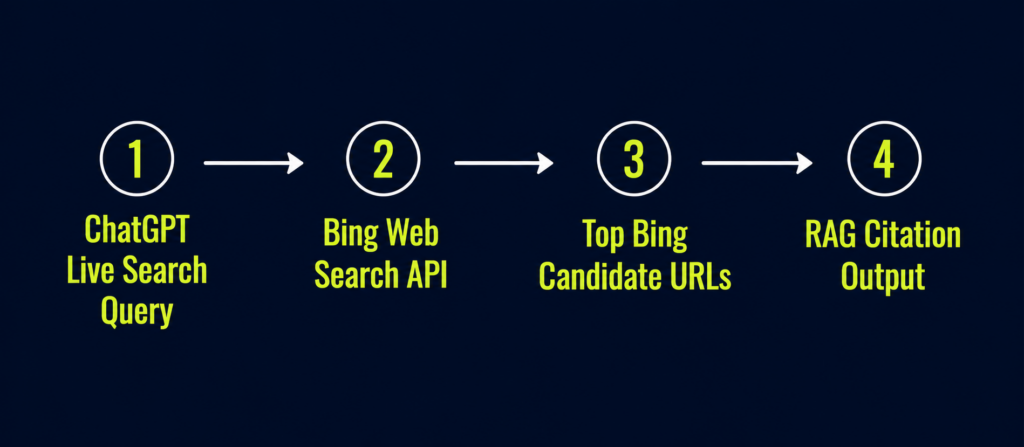
A brand can hold top organic positions on Google, but if Bing has not properly crawled or indexed its domain, that brand remains invisible to ChatGPT’s real-time citation system [²].
Step 1: Claim and Configure Bing Webmaster Tools
Verifying domain health in Bing Webmaster Tools is the primary requirement for ChatGPT live search visibility [²].
Implementation Protocol:
- Domain Verification: Import domain verification directly from Google Search Console into Bing Webmaster Tools to expedite setup.
- Sitemap Submission: Explicitly submit XML sitemaps to Bing. Do not assume Bing discovers sitemaps automatically.
- URL Inspection & Request Indexing: Use Bing’s URL Inspection tool to manually request indexation for critical commercial pages (category hubs, pricing guides, comparison pages, FAQ sections).
- Crawl Lag Monitoring: Check Bing’s Site Explorer monthly to ensure publication velocity matches Bing’s crawl frequency.
What Is the Difference Between GPTBot, OAI-SearchBot, and ChatGPT-User?
OpenAI deploys three distinct crawlers, each controlled by separate user-agent directives in robots.txt [³]. Confusing these crawlers can lead to accidentally blocking live search citations while attempting to manage model training access [³].
Recommended robots.txt Configuration:
To opt out of AI foundation model training while remaining eligible for ChatGPT live search citations, configure your robots.txt file as follows:
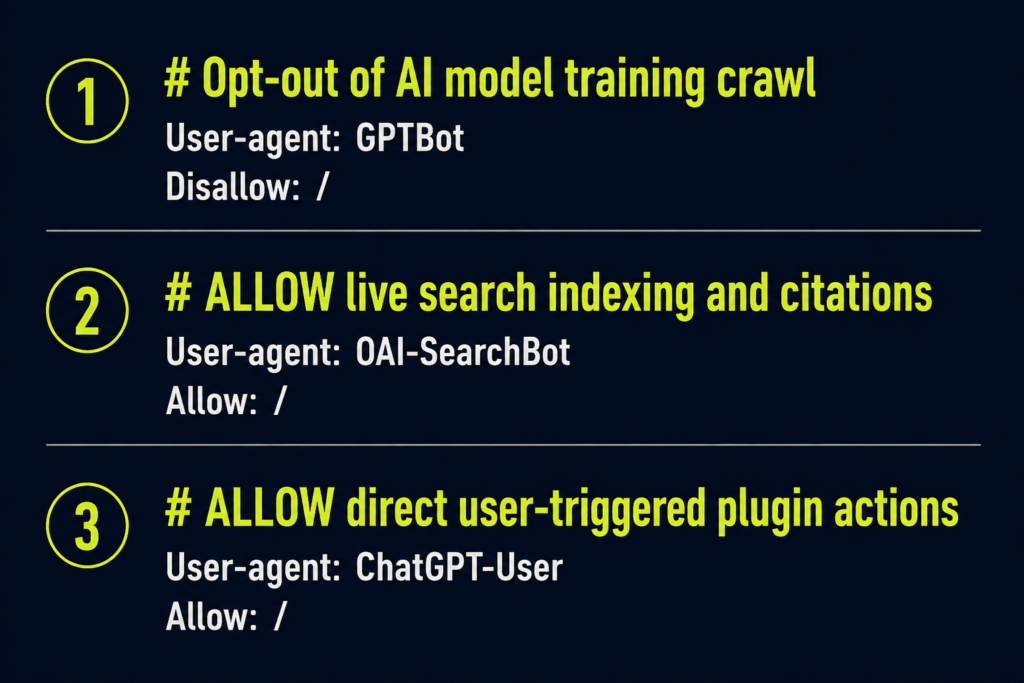
Note: Allow up to 24 hours for OpenAI systems to process robots.txt updates [³]. Verify firewall IP rules against OpenAI’s published searchbot.json endpoint to ensure server-level security plugins do not block crawler requests.
Evaluating llms.txt vs. Core Ranking Factors
The llms.txt proposal outlines a markdown-formatted directory intended to help AI crawlers parse key site URLs. While useful for developer documentation and specialized AI agent SDKs [³], major search platforms confirm it does not serve as a primary search ranking factor [³].
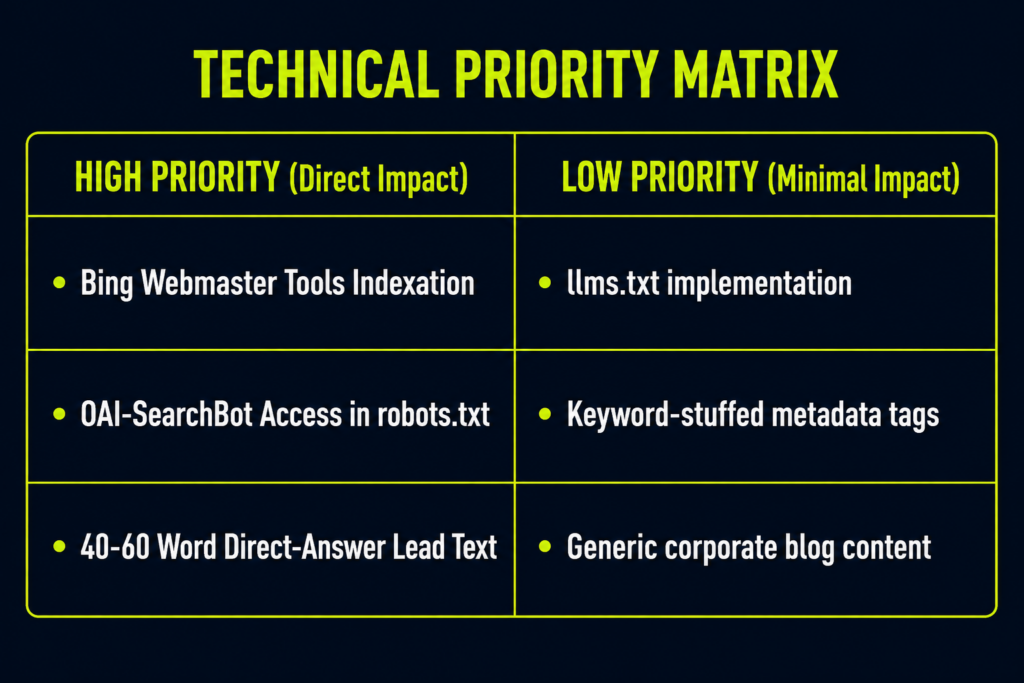
Focus engineering resources on core technical prerequisites: verifying Bing Webmaster Tools indexation, managing OAI-SearchBot rules, and structuring HTML content for clean machine extraction [³].
How to Format Content for AI Machine Extraction
When OAI-SearchBot fetches a page, the underlying model must extract a clean, unambiguous statement in real time [³].
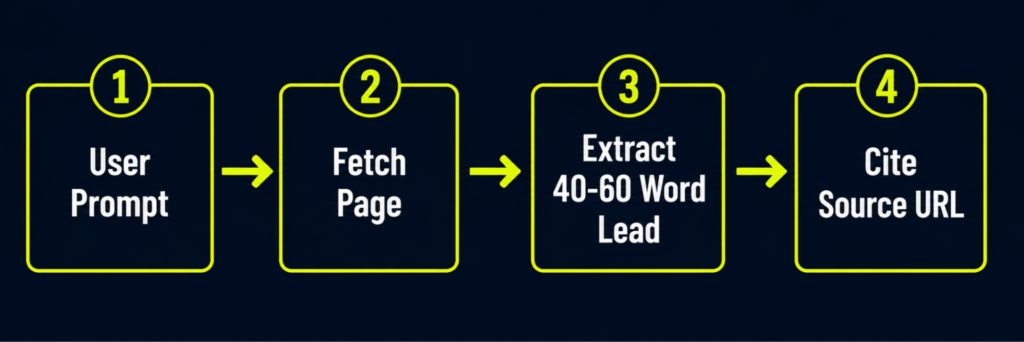
4 Formatting Rules for Citation Extraction:
- Lead with a 40–60 Word Direct Answer: Place a concise, standalone summary answering the core prompt within the first two sentences of a section [³].
- Use Query-Based Headings: Use H2 and H3 subheadings that match actual user search queries (e.g., <H2>What is the return policy for Enterprise Tier subscriptions?</H2>).
- Ensure Section Self-Sufficiency: Format every content section so it remains factually complete if extracted out of context [³].
- Publish Original First-Party Data: Include unique metrics, proprietary survey results, or specific customer case studies. Models cite original data sources rather than generic topic summaries [²].
ChatGPT Atlas and Agentic Browsing Integration
OpenAI introduced ChatGPT Atlas as a standalone macOS browser in late 2025 before consolidating its agentic capabilities directly into the ChatGPT desktop application, browser extensions, and cloud-based agent environments [³].
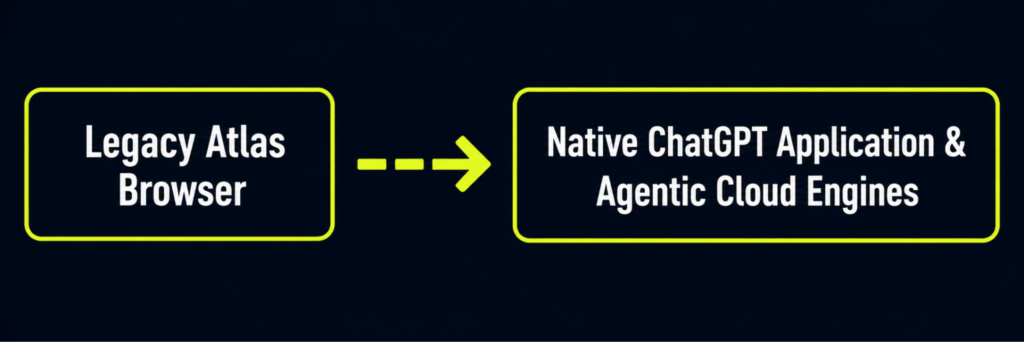
Rather than operating as a separate browser, agentic browsing capabilities (adding items to cart, checking stock availability, comparing pricing across tabs) are built directly into ChatGPT’s primary desktop interface [³]. Ensuring product pages feature clean schema markup and structured spec tables enables both human users and AI agents to process transactions effectively.
5 Misconceptions That Waste AI Search Budgets
- Tracking ChatGPT Visibility Like Google Rankings: ChatGPT outputs dynamic, synthesized answers rather than static SERP rank positions. Measure citation frequency and share-of-voice across target prompt sets instead.
- Assuming Google Ranking Guarantees ChatGPT Citations: Google rankings have no direct impact on ChatGPT retrieval, which relies on Bing’s search index [²].
- Prioritizing llms.txt Over robots.txt Directives: Implementing llms.txt while blocking OAI-SearchBot leaves a domain invisible to live search features [³].
- Publishing Generic Explainer Content: Summarizing widely known facts yields low citation rates, as models answer general queries using internal memory [¹].
- Treating Live Search Citations as the Only Visibility Goal: Live citations account for 6.8% of queries [¹]. Long-term brand visibility also requires building entity authority across training sources (Reddit, Wikipedia, industry news) [²].
The 30-Day ChatGPT Optimization Pipeline
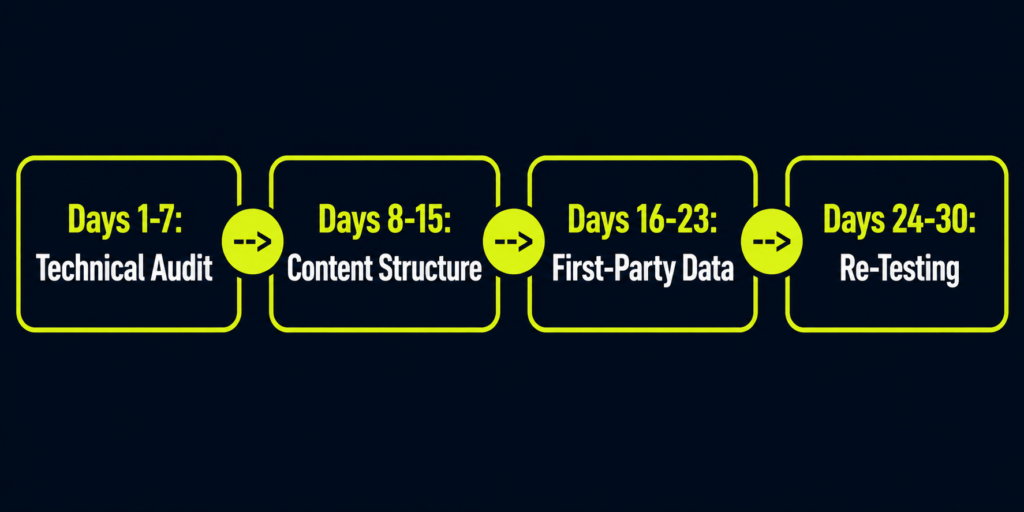
Days 1 to 7: Complete Technical Crawler Audit
- Inspect robots.txt to ensure OAI-SearchBot and ChatGPT-User are explicitly allowed [³].
- Verify domain ownership in Bing Webmaster Tools and submit XML sitemaps [²].
- Use Bing’s URL Inspection tool to confirm indexation across your top 25 revenue-generating pages [²].
- Manually test 15 to 20 core buyer prompts in ChatGPT to establish baseline citation rates [¹].
Days 8 to 15: Restructure Commercial Pages for Extraction
- Rewrite lead paragraphs across top landing pages to deliver direct 40–60 word answers [³].
- Convert generic section headers into query-based H2 and H3 subheadings.
- Implement FAQPage and Product JSON-LD schema markup.
Days 16 to 23: Inject Proprietary First-Party Data
- Add unique statistics, pricing breakdowns, or customer research metrics to priority pages [²].
- Request page re-indexing in both Bing Webmaster Tools and Google Search Console.
Days 24 to 30: Re-Test Prompts and Set Up Monitoring
- Re-run baseline buyer prompts in ChatGPT and evaluate citation inclusion changes [¹].
- Establish a monthly prompt-testing schedule to track citation trends as Bing indexing and OpenAI search parameters update.
For brands seeking expert execution, our specialized AI Search Optimization team manages crawler auditing, Bing indexation, and generative content structuring.
Partner with National Positions for Advanced GEO
Navigating AI search optimization across ChatGPT, Google AI Overviews, Perplexity, and Copilot requires dedicated analytics engineering and cross-platform technical execution.
National Positions delivers comprehensive Generative Engine Optimization solutions:
- 22+ Years of Search Engine Leadership: Optimizing performance marketing strategies for over 300 e-commerce and B2B brands.
- Google Premier Partner Expertise: Advanced analytics capabilities aligned with modern measurement standards.
- The PACE Framework: Our methodology (Plan, Analyze, Convert, Expand) grounds AI search strategies in verified revenue metrics.
- First-Party Attribution via AdBeacon: Our proprietary first-party attribution platform, AdBeacon, tracks multi-touch discovery across organic, paid, and AI-driven channels.
Ready to audit your site’s visibility across ChatGPT and Bing search networks? Book a consult with our team to evaluate your crawler configurations and build a platform-specific GEO strategy.
Frequently Asked Questions
Does ChatGPT use Google or Bing for live search results?
ChatGPT’s live search functionality relies on Bing’s search index [²]. Research demonstrates an 87% overlap between ChatGPT live citations and top organic results on Bing [²].
What is the difference between GPTBot and OAI-SearchBot?
GPTBot crawls web content to train OpenAI foundation models [³]. OAI-SearchBot fetches live web pages to generate search citations within ChatGPT [³]. Blocking GPTBot prevents model training access without disabling live search citations.
Should my website implement an llms.txt file?
llms.txt is an optional directory format used primarily for developer agent SDKs [³]. It does not provide a direct ranking advantage within consumer ChatGPT search. Focus engineering efforts on robots.txt configuration and Bing indexation [³].
Why do most ChatGPT answers lack citation links?
Approximately 93.2% of ChatGPT prompts are answered using pre-trained model memory [¹]. Live citations appear only when a query requires current facts, real-time pricing, or specific entity details [¹].
How can I verify whether ChatGPT can crawl my website?
Check robots.txt to confirm OAI-SearchBot is allowed [³]. Then inspect Bing Webmaster Tools to verify that your target pages are indexed in Bing’s search database [²].
Sources & References
- Similarweb & TechCrunch, “ChatGPT Citation Rates and Topic Volatility,” Data reported July 27, 2026 covering May 2026 desktop query metrics [¹].
- Everything-PR & Everything AI, “The AI Platform Citation Source Index 2026: The 50 Websites AI Engines Cite Most,” Analysis of Bing index match rates and domain citations [²].
- OpenAI Developer Documentation, “Overview of OpenAI Crawlers: OAI-SearchBot, GPTBot, and ChatGPT-User,” Technical Webmaster Documentation [³].
Related Guides & Next Steps
Continue building your multi-engine search strategy with our platform-specific playbooks:
- Multi-Platform Strategy: Read AI Search Engines Compared to see how ChatGPT compares against Perplexity, Gemini, and Claude.
- Google’s Ecosystem: Read Google AI Mode versus AI Overviews to master Google’s generative search interfaces.
- AI Visibility Analytics: Read How to Track AI Search Visibility Across Platforms to measure brand citations across major AI engines.