Marketing attribution models determine how conversion credit is distributed among the marketing interactions that lead to a sale, lead, or other valuable action. First-touch attribution credits discovery. Last-touch attribution credits the final interaction. Multi-touch models divide credit across the journey, while data-driven attribution uses observed path data to estimate each touchpoint’s contribution.
The model a business chooses can change how paid search, SEO, social media, email, content, and other channels appear to perform. Those results often influence budget decisions. If the model overvalues the final click, a company may increase spending on channels that capture existing demand while reducing investment in the channels that created it.
Attribution provides a useful framework for evaluating marketing performance, but no model captures the complete truth on its own. Reliable measurement also requires clean tracking, first-party data, consistent conversion definitions, and testing that can distinguish correlation from causation.
Key Takeaways
- Marketing attribution assigns conversion credit to channels and touchpoints.
- First-touch and last-touch models are simple but ignore most of the customer journey.
- Rule-based multi-touch models distribute credit according to predetermined percentages.
- Data-driven attribution estimates contribution using converting and non-converting path data.
- Attribution windows, tracking settings, and reporting scopes can change the results.
- B2B companies may need account-level attribution to connect interactions across a buying committee.
- Attribution should be validated with incrementality testing, media mix modeling, or controlled experiments.
What Is a Marketing Attribution Model?
A marketing attribution model is a rule, set of rules, or algorithm that determines which interactions receive credit when someone completes a conversion.
A touchpoint could include:
- Viewing a paid social advertisement
- Clicking a search advertisement
- Reading an organic blog post
- Opening an email
- Attending a webinar
- Calling a business
- Speaking with a salesperson
- Returning through a branded search
- Visiting a store
- Completing a purchase
Attribution modeling turns these interactions into a reporting framework. The resulting report may show how much revenue, pipeline, or conversion credit each channel received.
That makes attribution closely connected to budget allocation. A report that assigns most revenue to branded search and retargeting may encourage a business to invest more heavily in those channels. A model that recognizes earlier interactions may reveal that content, video, social media, or nonbranded search helped create the demand that lower-funnel channels captured.
One Customer Journey, Different Attribution Answers
Consider a business that closes a $10,000 sale after the following five interactions:
- The buyer discovers the company through a LinkedIn advertisement.
- The buyer finds an educational article through organic search.
- The buyer downloads a guide from an email.
- The buyer requests a sales demonstration.
- The buyer returns through a branded search advertisement and converts.
Each attribution model tells a different story about that sale.
First-Touch Attribution
LinkedIn receives the entire $10,000 because it generated the first recorded interaction.
Last-Touch Attribution
Branded paid search receives the entire $10,000 because it was the final interaction before conversion.
Linear Attribution
Each of the five touchpoints receives $2,000 in credit.
Position-Based Attribution
The LinkedIn advertisement and branded paid-search advertisement each receive $4,000. The remaining $2,000 is divided among organic search, email, and the demonstration request.
W-Shaped Attribution
Most of the credit is assigned to three important milestones, such as first interaction, lead creation, and opportunity creation. The remaining credit is shared among the other recorded touchpoints.
Data-Driven Attribution
Credit is calculated from observed journey data. The system evaluates how the presence, timing, and sequence of different interactions relate to conversion probability.
None of these models changes the actual $10,000 in revenue. They change how that revenue is interpreted and distributed in marketing reports.
Single-Touch Attribution Models
Single-touch models assign 100% of the conversion credit to one interaction. They are easy to explain and require relatively little data, but they omit most of the buying journey.
First-Touch Attribution
First-touch attribution gives all credit to the first recorded interaction.
This model can help answer questions such as:
- Which channels introduce new prospects?
- Which campaigns generate initial awareness?
- Which content brings new people into the funnel?
- Where do high-value customer journeys begin?
Its main weakness is that it ignores every interaction after discovery. A prospect may first encounter a company through a social media post but later convert because of product reviews, email nurturing, sales conversations, and retargeting. First-touch reporting credits none of those later influences.
First-touch attribution is most useful as a discovery lens, not as a complete measure of channel performance.
Last-Touch Attribution
Last-touch attribution gives all credit to the final interaction before a conversion.
It can help identify:
- Which channels appear immediately before conversion
- Which campaigns capture ready-to-buy demand
- Which landing pages or offers close sales
- Which calls to action produce immediate responses
The model tends to favor lower-funnel channels such as branded search, affiliate links, direct response email, and retargeting. These interactions may close the conversion, but they may not have created the original interest.
Last Non-Direct Click Attribution
Last non-direct click assigns credit to the most recent identifiable marketing channel instead of a direct return visit.
For example, a person might click an email, leave the website, and return later by typing the URL directly. Last-touch attribution could credit direct traffic. Last non-direct click would preserve the email as the credited source.
This distinction remains relevant in GA4. Session attribution continues to use non-direct last click, while event-scoped reports can use the property’s selected attribution model.[¹]
Rule-Based Multi-Touch Attribution Models
Multi-touch attribution distributes credit across several interactions. Rule-based models use percentages selected in advance instead of calculating contribution from observed outcomes.
Linear Attribution
Linear attribution divides credit equally among all recorded touchpoints.
If a journey contains five interactions, each receives 20% of the conversion credit.
Linear attribution recognizes that multiple interactions contribute to a sale. It can be a reasonable starting point for businesses with longer journeys and limited data. Its main weakness is that it treats every touchpoint as equally influential.
A brief display impression may receive the same credit as a product demonstration or pricing-page visit.
Time-Decay Attribution
Time-decay attribution gives more credit to interactions that occur closer to the conversion.
This model can be useful for:
- Short sales cycles
- Limited-time promotions
- Event registrations
- Product launches
- Retargeting programs
- Campaigns where recent interactions have greater influence
Time decay still favors lower-funnel activity. It can undervalue the advertisement, article, or referral that originally introduced the customer.
Position-Based Attribution
Position-based attribution, often called U-shaped attribution, gives the most credit to the first and last interactions. A common version assigns 40% to the first touchpoint, 40% to the final touchpoint, and divides the remaining 20% among the middle interactions.
This approach recognizes both demand creation and conversion. It can work well for lead-generation companies that place particular importance on initial discovery and final lead submission.
The percentages are still assumptions. A 40-40-20 split may be easy to communicate, but it does not prove that those touchpoints contributed at those exact levels.
W-Shaped Attribution
W-shaped attribution emphasizes three milestones:
- First interaction
- Lead creation
- Opportunity creation
A common structure gives 30% to each milestone and divides the remaining 10% among other touchpoints.
This model is often more appropriate for B2B sales processes because it recognizes the marketing activity that creates awareness, captures a lead, and advances that lead into a qualified opportunity.
It can still overlook interactions that occur after the opportunity is created, including proposals, sales meetings, procurement reviews, and executive approval.
Full-Path Attribution
Full-path attribution extends the W-shaped framework through the final sale. It typically gives substantial credit to:
- First interaction
- Lead creation
- Opportunity creation
- Closed sale
This model can help B2B organizations connect marketing activity to pipeline and revenue. It requires dependable CRM stages and accurate handoffs between marketing and sales.
Custom Attribution
A custom attribution model assigns credit according to a company’s customer journey, priorities, or historical analysis.
A business might give additional weight to:
- Demonstration requests
- In-person consultations
- Qualified phone calls
- Pricing-page visits
- Webinar attendance
- Repeat purchases
- Interactions from senior decision-makers
Custom attribution offers flexibility, but it can also preserve internal biases. A custom rule-based model is not automatically data-driven. Teams should document why each weight was selected and validate the resulting decisions through testing.
What Is Data-Driven Attribution?
Data-driven attribution uses statistical analysis or machine learning to estimate how marketing interactions contribute to conversions.
Instead of applying fixed percentages, the model analyzes path data from converting and non-converting users. Google explains that its data-driven attribution system evaluates how the presence and timing of ad interactions change the estimated probability of a key event. It then assigns fractional credit based on the estimated contribution of each interaction.[²]
Depending on the platform, a data-driven model may consider:
- Converting and non-converting paths
- Interaction sequence
- Time between touchpoint and conversion
- Ad format
- Device
- Channel combinations
- Repeat interactions
- Differences in conversion probability
Data-driven attribution should not be treated as a neutral view of all marketing activity by default. A model inside an advertising platform may have deeper visibility into its own ecosystem than into competing channels, offline activity, or untracked interactions.
It is important to distinguish among:
- Platform-specific data-driven attribution
- Independent cross-channel attribution
- Custom algorithmic attribution
- Account-level B2B attribution
Each model can use a different data set and produce a different answer.
Marketing Attribution Model Comparison
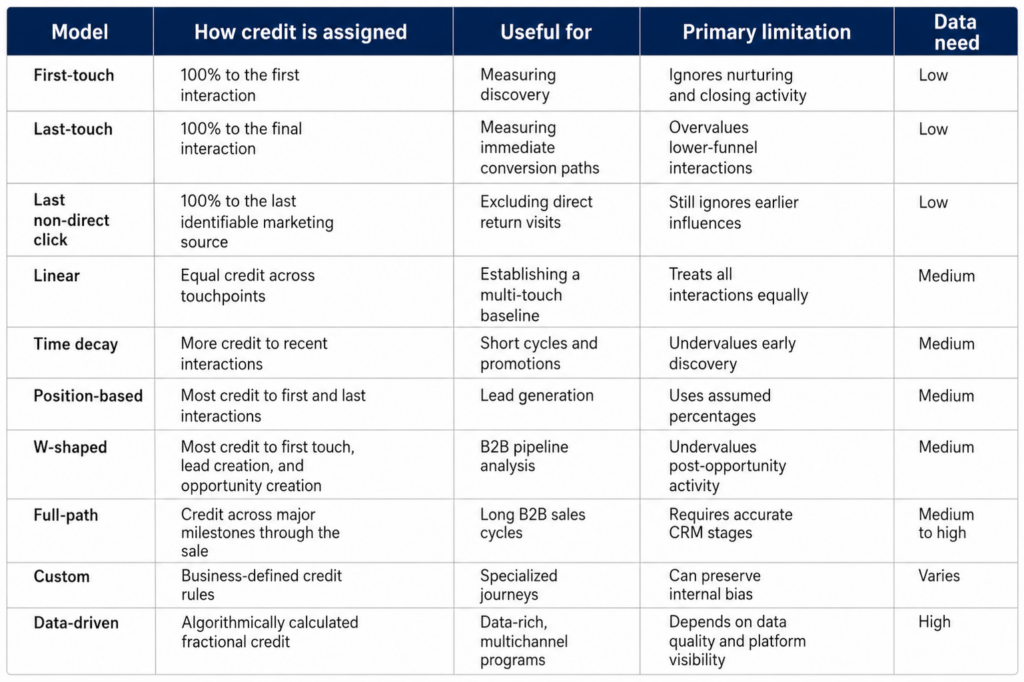
The most advanced model is not always the most useful one. A model must have enough reliable data to produce stable, actionable results.
Which Attribution Model Should a Business Use?
The right starting point depends on the sales cycle, customer journey, data volume, available technology, and business question.
Short-Cycle E-Commerce
Time-decay or data-driven attribution can help evaluate channels near the purchase while still recognizing earlier interactions. Results should be compared against controlled advertising tests and blended business metrics.
Local Lead Generation
Position-based attribution can recognize both discovery and lead submission. Reliable call tracking, CRM integration, and offline outcome data are important because a submitted form or phone call is not always a qualified lead.
Long-Cycle B2B
W-shaped, full-path, or account-level attribution can connect early marketing activity to lead creation, opportunities, and closed revenue. CRM lifecycle stages must be consistently defined.
Content-Led Acquisition
First-touch reporting can identify content that creates discovery, while multi-touch reporting shows how articles, guides, email, and paid media work together. Branded-search and retargeting results should be tested for incrementality.
Subscription Businesses
Data-driven attribution tied to retention and customer lifetime value can provide a better decision framework than attribution based only on the first purchase.
Businesses With Low Conversion Volume
A rule-based model may provide a more stable starting point. Instead of relying on an arbitrary conversion threshold, teams should ask their platform about its eligibility requirements and evaluate how stable the resulting credit allocations are over time.
What Is an Attribution Window?
An attribution window determines how far back a system looks for eligible touchpoints.
A 30-day attribution window gives credit only to qualifying interactions that occurred during the 30 days before conversion. An interaction from 45 days earlier would be excluded, even if it influenced the purchase.
Shorter windows tend to favor recent, lower-funnel interactions. Longer windows capture more of the journey but may include interactions with limited influence.
GA4 allows organizations to configure lookback windows. Acquisition events and other key events may use different settings, and changing the window affects future reporting.[³]
Businesses should document:
- Click-through attribution windows
- View-through attribution windows
- Key-event lookback windows
- Expected sales-cycle length
- Differences among analytics and advertising platforms
- Dates when settings changed
Comparing channels or platforms without aligning these settings can produce misleading conclusions.
Why GA4, Google Ads, Meta, and a CRM May Disagree
Different platforms can report different conversion totals without any single platform being completely broken.
Common reasons include:
- Different attribution models
- Different attribution windows
- Click-through versus view-through credit
- Different time zones
- Event-time versus interaction-time reporting
- Cross-device identity limitations
- Duplicate or missing events
- Consent and browser restrictions
- Different definitions of a conversion
- Offline sales that were never imported
- One sale being claimed by multiple platforms
GA4 also uses different attribution logic for different reporting scopes. Event-scoped reporting uses the selected property model and defaults to data-driven attribution. User-scoped and session-scoped acquisition dimensions use paid-and-organic last-click rules.[¹]
A business should not expect every platform to report identical results. The goal is to understand the cause of each difference and establish a reporting source of truth for business decisions.
The Data Foundation Attribution Requires
An attribution model cannot repair incomplete or inconsistent inputs. Before reallocating budget, audit the systems collecting and connecting customer data.
A practical audit should review:
- Primary and secondary conversion definitions
- UTM and campaign-naming standards
- Cross-domain tracking
- Duplicate-event prevention
- Referral exclusions
- Call tracking
- CRM lifecycle stages
- Lead-source persistence
- Offline conversion imports
- Customer identity resolution
- Consent management
- Server-side event collection
- Revenue and customer-lifetime-value data
- Internal and bot traffic
- Connections among analytics, advertising, CRM, and e-commerce systems
In many attribution audits, the first problem is not the model. Duplicate events, inconsistent UTMs, disconnected CRM records, and mismatched conversion definitions can distort channel credit before the model performs its calculation.
B2B Attribution Must Account for Buying Committees
B2B purchases often involve several people from the same organization.
One employee may discover the company through search. A manager may download a guide. A director may attend a webinar. Procurement may review the proposal, and an executive may approve the purchase.
Contact-level attribution can record these as unrelated journeys. Account-level attribution connects the contacts and their interactions to the same company, opportunity, and revenue outcome.
Effective B2B attribution may require:
- CRM account matching
- Lead-to-account mapping
- Buying-role identification
- Opportunity-stage tracking
- Marketing and sales activity integration
- Multi-contact campaign influence
- Closed-revenue reporting
Without account-level measurement, marketing may receive too little credit for activity that influenced several members of a buying committee.
A Five-Step Framework for Implementing Attribution
1. Define the Business Outcome
Decide what the model should measure. Possible outcomes include purchases, qualified leads, opportunities, closed revenue, profit, repeat orders, or customer lifetime value.
Avoid treating every form submission as equal if lead quality varies significantly.
2. Map the Real Customer Journey
Review a sample of recent customers and identify the channels, devices, contacts, and offline interactions involved. Compare short and long journeys rather than relying only on an average.
3. Audit the Tracking Foundation
Confirm that events fire correctly, campaigns follow consistent naming standards, CRM stages are accurate, and offline outcomes return to the reporting system.
4. Compare Models in Parallel
Run the proposed model alongside the existing model for at least one representative sales cycle. Identify where credit shifts and investigate the reason before changing budgets.
5. Validate and Reassess
Use holdout tests, geographic experiments, audience exclusions, or controlled budget changes to determine if attributed channels produce incremental results. Review the model when the sales process, channel mix, data collection, or platform settings change.
Attribution Does Not Prove Causation
Attribution identifies relationships between touchpoints and conversions. It does not always establish that an interaction caused the conversion.
A branded search advertisement may appear immediately before a sale because the customer had already decided to purchase. Retargeting may receive credit because it reaches people who were already highly likely to convert.
Stronger measurement programs combine several approaches:
- Attribution for journey-level reporting
- Incrementality testing for causal validation
- Media mix modeling for broader channel contribution
- Customer research for motivations attribution cannot observe
- Business metrics such as revenue, profit, and lifetime value
National Positions combines attribution with media mix modeling and incrementality testing to evaluate channel contribution beyond last-click reporting. Its approach includes geographic holdouts, audience holdouts, budget-expansion tests, and scenario modeling.[⁴]
Improve Attribution With National Positions
National Positions helps businesses connect marketing activity to revenue through cleaner tracking, first-party data, cross-channel analysis, and performance-focused campaign management.
AdBeacon, the agency’s proprietary multi-touch attribution platform, provides first-party click-to-conversion journey tracking, campaign-level reporting, attribution insights, and connections to profitability data. It can also compare marketing activity with e-commerce outcomes and support more informed budget allocation.[⁵]
An attribution assessment can help your business:
- Identify conversion-tracking gaps
- Compare GA4, advertising-platform, and CRM reporting
- Review attribution models and lookback windows
- Connect online activity with qualified leads or sales
- Evaluate first-party data collection
- Determine which model fits your sales cycle and data volume
- Build a measurement roadmap for future optimization
If your reporting gives several channels credit for the same sale or leaves you unsure about what is producing revenue, contact National Positions to request an attribution and tracking assessment.
Frequently Asked Questions
What is the best marketing attribution model?
There is no universal best model. The right choice depends on the business question, sales cycle, customer journey, conversion volume, data quality, and available technology. Many businesses benefit from comparing several models and validating major budget decisions through incrementality testing.
What is the difference between first-touch and last-touch attribution?
First-touch attribution gives all conversion credit to the first recorded interaction. Last-touch attribution gives all credit to the final interaction before conversion. Both models are simple, but each ignores most of the customer journey.
What is the difference between last-touch and last non-direct click?
Last-touch can credit a direct visit if it is the final interaction. Last non-direct click ignores direct traffic and gives credit to the most recent identifiable marketing source.
Is GA4 a last-click attribution platform?
GA4 uses different rules according to reporting scope. Event-scoped reports use the property’s selected attribution model, which is data-driven by default. User-scoped and session-scoped acquisition reporting uses paid-and-organic last-click attribution.[¹]
How much data does data-driven attribution require?
Requirements differ by platform, conversion type, channel mix, and journey complexity. Businesses should review the platform’s eligibility requirements and test the stability of its output before using it for major budget decisions.
Can attribution include phone calls and offline sales?
Yes, if phone calls, CRM outcomes, in-store transactions, and other offline events are captured and connected to marketing records. Call-tracking systems, customer identifiers, and offline conversion imports can help connect these outcomes.
What is an attribution window?
An attribution window is the period before conversion during which a touchpoint can receive credit. Changing the window can significantly change which channels appear to perform well.
Why do advertising platforms report more conversions than the business recorded?
Multiple platforms may claim the same conversion. Differences can also result from view-through credit, attribution windows, cross-device modeling, duplicate events, time-zone settings, and conflicting conversion definitions.
Can marketing attribution prove that an advertisement caused a sale?
Attribution alone cannot reliably prove causation. Controlled experiments, holdout groups, and incrementality testing provide stronger evidence that advertising caused additional conversions.
How often should an attribution model be reviewed?
Review the model at least quarterly and after major changes to the sales cycle, channel mix, website, CRM, tracking configuration, privacy controls, or platform settings.