A CRM manages relationships with known leads and customers. A CDP combines customer data from multiple sources to create unified profiles for analysis and marketing activation. A DMP builds anonymous or pseudonymous audience segments primarily for digital advertising.
These platforms can overlap, but they are designed to solve different problems. Some businesses need only a CRM. Others benefit from connecting a CRM to a CDP. DMPs are generally reserved for organizations running large-scale programmatic advertising campaigns.
Choosing the right platform starts with the business problem you need to solve, the data you already collect, and your ability to turn that data into measurable marketing results.
Key Takeaways
- A CRM manages contacts, sales opportunities, customer communications, and service relationships.
- A CDP connects behavioral, transactional, and relationship data to create persistent customer profiles.
- A DMP creates anonymous or pseudonymous audience segments for advertising.
- CDPs and CRMs often work together rather than replacing one another.
- Most small businesses should establish a well-configured CRM before investing in a CDP.
- A business may need better integrations and tracking instead of another platform.
- Platform costs include software, implementation, integrations, data management, and ongoing campaign activation.
What Is the Main Difference Between a CDP, DMP, and CRM?
The primary difference involves the purpose for which each platform collects and organizes data.
A customer relationship management platform, or CRM, helps sales and service teams manage relationships with identifiable people and accounts.
A customer data platform, or CDP, connects data from multiple systems, resolves identities, and makes unified customer profiles available for segmentation, analysis, and marketing activation.
A data management platform, or DMP, organizes anonymous or pseudonymous audience information for advertising, prospecting, and programmatic-media campaigns.
Here is the simplest way to think about the three systems:
- A CRM records what your business knows about a lead or customer relationship.
- A CDP connects what a customer does across channels and systems.
- A DMP helps advertisers reach audience groups without relying on individually identified customer profiles.
What Is a CRM?
CRM stands for customer relationship management. A CRM stores and organizes information about known leads, customers, companies, sales opportunities, and service interactions.
CRM data commonly comes from:
- Contact forms
- Sales calls
- Emails
- Meeting notes
- Live-chat conversations
- Quotes and proposals
- Purchase records
- Support requests
- Account-management activity
Sales, customer-service, and revenue-operations teams commonly use a CRM to track each relationship from the initial inquiry through the sales and retention process.
Common CRM Use Cases
A CRM can help a business:
- Store lead and customer contact information
- Assign leads to sales representatives
- Track opportunities through a sales pipeline
- Schedule calls, emails, and follow-up tasks
- Record customer communications
- Manage service requests
- Forecast potential revenue
- Connect marketing sources with closed sales
- Identify cross-selling and upselling opportunities
Advantages and Limitations of a CRM
A CRM is often the most practical starting point for a small or mid-sized business. It can create a consistent sales process, reduce missed follow-ups, and give teams a shared record of customer interactions.
A CRM may not automatically combine every website visit, advertising interaction, email response, purchase, and offline activity into one profile. Its capabilities depend on the platform, integrations, configuration, and quality of the information entered.
What Is a CDP?
CDP stands for customer data platform. A CDP collects customer information from several systems and creates persistent profiles that other marketing and business tools can use.
A CDP may connect data from:
- Websites
- Mobile applications
- Ecommerce platforms
- Point-of-sale systems
- CRMs
- Email and SMS platforms
- Customer-service tools
- Loyalty programs
- Advertising platforms
- Offline transactions
CDPs primarily rely on first-party data collected through a business’s direct customer relationships. Depending on the platform and configuration, a CDP may also incorporate partner information, third-party enrichment data, or outputs from data clean rooms.
A defining CDP capability is identity resolution. This process matches records from different sources using details such as email addresses, customer IDs, account numbers, transactions, login activity, and device signals. The platform uses those connections to determine which interactions likely belong to the same person, account, or household.[¹]
Common CDP Use Cases
A CDP can help a business:
- Connect customer information held in separate systems
- Build unified customer profiles
- Create detailed audience segments
- Personalize website, email, and advertising experiences
- Coordinate campaigns across multiple channels
- Identify high-value or at-risk customers
- Improve retention and customer-lifetime-value strategies
- Send customer data to analytics and marketing platforms
- Connect anonymous browsing behavior with known profiles when appropriate consent and identifiers are available
What Happens After a CDP Unifies the Data?
Unification is only part of the process. The information must also be activated.
A CDP can send profiles, audiences, and behavioral signals to:
- Email platforms
- SMS platforms
- Advertising accounts
- Website-personalization tools
- Analytics systems
- Customer-service platforms
- Recommendation engines
- Sales systems
For example, an ecommerce business could create an audience of customers who purchased a product six months ago, recently returned to the website, and viewed a related category without buying. That audience could receive a relevant email, see personalized website content, or be included in an advertising campaign.
Advantages and Limitations of a CDP
A CDP can provide better segmentation, more consistent personalization, and greater access to customer information across teams. It is particularly valuable when data is fragmented across ecommerce, advertising, email, website, CRM, and service platforms.
The technology can also be expensive and difficult to operate. A CDP does not automatically correct poor data quality, missing consent records, inconsistent tracking, or unclear campaign goals. Its value depends on sound integrations, reliable identity rules, useful audience strategies, and ongoing activation.
Popular CDP examples include Twilio Segment, Adobe Real-Time CDP, Salesforce Data Cloud, Tealium, and mParticle. Capabilities vary significantly, so the best customer data platform depends on your existing technology, data volume, internal resources, and intended use cases.
What Is a DMP?
DMP stands for data management platform. A DMP collects and organizes anonymous or pseudonymous audience data for advertising and media buying.
DMPs commonly use information from:
- Third-party data providers
- Advertising networks
- Websites
- Cookies
- Device identifiers
- Campaign interactions
- Publisher relationships
- Data partnerships
Although DMPs are strongly associated with third-party data, some can also ingest first-party and second-party information. The data is typically converted into audience segments rather than persistent, individually identified customer profiles.
Common DMP Use Cases
A DMP can support:
- Programmatic advertising
- Anonymous audience segmentation
- Advertising prospecting
- Lookalike modeling
- Media planning
- Audience expansion
- Campaign-frequency management
- Cross-publisher audience analysis
DMP data is often retained for a shorter period than CRM records or CDP profiles. Some platforms and configurations retain audience information for approximately 90 days, although actual retention periods vary.[²]
Are DMPs Becoming Obsolete?
DMPs have a smaller role in many marketing technology stacks, but it is inaccurate to say that they have disappeared.
Browser restrictions, consent requirements, privacy regulations, mobile-platform policies, and advertising-platform changes have reduced access to traditional cross-site signals. These developments have encouraged businesses to invest more heavily in first-party data, identity solutions, clean rooms, contextual advertising, and platform-native audiences.
Google also changed its third-party cookie plans. Chrome continues to give users control over third-party cookies instead of universally eliminating them. Chrome Incognito blocks third-party cookies by default, and Google continues to develop additional tracking protections.[³]
A DMP may still make sense for a large advertiser, publisher, or media organization with substantial programmatic-advertising needs. Most small businesses are unlikely to need a standalone DMP.
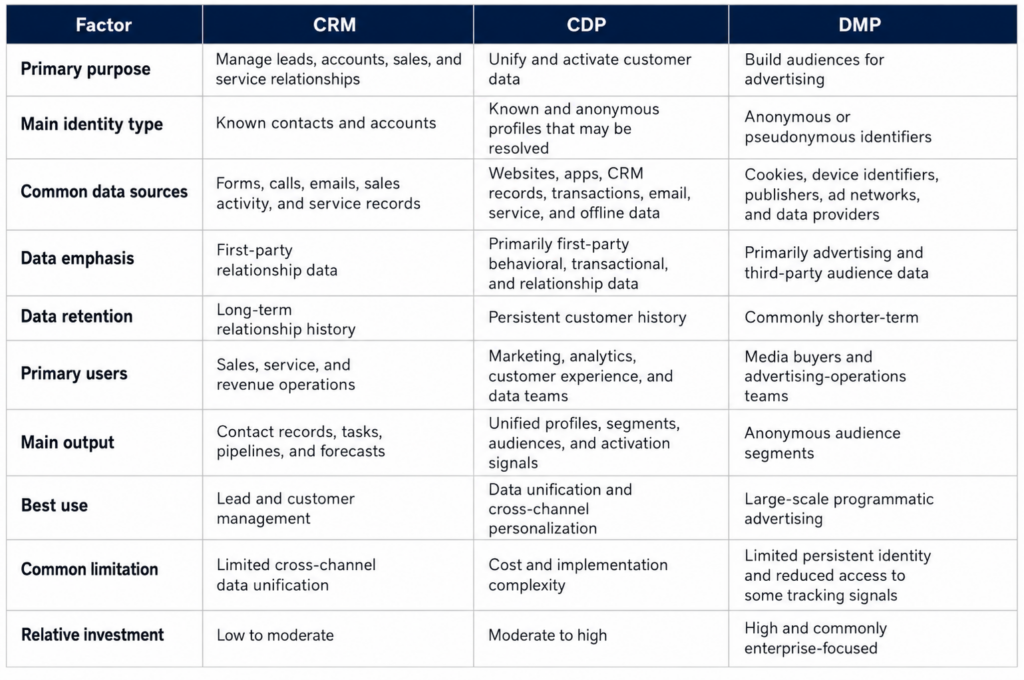
Costs vary by vendor, users, customer profiles, events, data volume, integrations, media activity, and required professional services. Businesses should compare total implementation and operating costs rather than software fees alone.
CDP vs. CRM: Do You Need Both?
Many growing businesses need both a CRM and a CDP because the systems handle different parts of the customer journey.
A CRM is usually the operational record for the sales relationship. It tracks leads, accounts, conversations, opportunities, and follow-up activity.
A CDP can receive information from the CRM and combine it with website behavior, email engagement, purchases, service activity, and other customer signals. It can then send profiles or segments to marketing channels.
Consider an online retailer that uses a CRM to manage customer-service conversations and high-value accounts. Its CDP could combine those records with purchase history, website behavior, loyalty activity, and email engagement. The marketing team could then create campaigns based on broader customer behavior instead of relying only on CRM fields.
A CDP generally complements a CRM rather than replacing it.
CDP vs. DMP: What Separates Them?
A CDP creates persistent customer profiles that can support engagement, personalization, analysis, and retention. A DMP creates audience segments primarily for advertising and commonly relies on anonymous or pseudonymous identifiers.
The two platforms also differ in how long they retain data and how closely the information can be connected to an individual customer.
Choose a CDP when your priority is using owned customer information across several marketing channels. Consider a DMP when the primary need is large-scale audience development for programmatic advertising.
Some organizations may use a CDP with an identity provider, data clean room, demand-side platform, or advertising platform instead of maintaining a traditional standalone DMP.
CRM vs. DMP: Which Problem Are You Solving?
A CRM supports direct relationships with people and accounts your business can identify. A DMP supports anonymous or pseudonymous audience targeting.
A B2B company that needs to track named prospects, proposals, sales calls, and account activity will usually need a CRM.
A major consumer advertiser seeking to build audience segments across publishers may consider a DMP or another advertising-data solution.
These systems serve different teams and rarely substitute for one another.
How CDPs, CRMs, and DMPs Can Work Together
The three platforms may participate in the same marketing ecosystem:
- A prospect visits a website and submits a form.
- The CRM creates a contact record and tracks sales follow-up.
- The CDP combines CRM activity with website visits, purchases, email engagement, and customer-service data.
- The CDP creates audiences based on the unified information.
- Marketing platforms activate those audiences across email, advertising, SMS, and personalized website experiences.
- A DMP may expand anonymous advertising audiences when programmatic-media strategy requires it.
- Conversion and revenue data returns to the appropriate systems for analysis and optimization.
The exact flow depends on the technology stack, consent settings, integrations, and business model.
Which Data Platform Does Your Business Need?
Use your immediate business problem as the starting point.
Choose a CRM If:
- You need to organize contacts and accounts
- Sales representatives are missing follow-ups
- You cannot see where opportunities sit in the pipeline
- Customer communications are spread across inboxes
- You need to connect leads with sales results
- Your company is building its first structured customer database
Consider a CDP If:
- Customer information is fragmented across several systems
- You need cross-channel customer profiles
- Personalization is a defined growth priority
- You have meaningful behavioral and transactional data
- Your team needs more advanced audience segmentation
- You want to coordinate marketing across email, advertising, websites, apps, and offline channels
- Existing integrations cannot support your intended use cases
Consider a DMP If:
- Your organization runs substantial programmatic-advertising campaigns
- Anonymous audience prospecting is a major acquisition strategy
- You work with several publishers or data providers
- You have a dedicated media-buying or advertising-operations team
- Other audience and identity solutions do not meet your requirements
Consider Improving Your Existing Stack If:
- Your CRM is not configured correctly
- Conversion tracking is incomplete
- Customer records contain duplicates
- Teams use inconsistent lifecycle stages
- Marketing and sales platforms do not exchange data
- Consent records are incomplete
- Your team has not defined the campaigns a new platform would support
Many businesses do not need another platform. They need better tracking, integrations, data standards, and operating processes.
Is Your Business Ready for a CDP?
A business may be ready for a CDP when it has:
- Customer information across several active systems
- Enough customer activity to support meaningful segmentation
- Documented personalization or retention use cases
- Defined conversion events
- Reliable first-party data collection
- Consent and governance processes
- Staff or an agency partner to manage implementation
- A plan for activating data through campaigns
- Revenue, acquisition, retention, or efficiency metrics for measuring results
A CDP may be premature if the business collects limited customer data, lacks a working CRM, has unresolved tracking problems, or cannot dedicate resources to ongoing activation.
What Does Platform Implementation Require?
Selecting the software is only one part of the project. Effective implementation may require:
- Mapping every relevant data source
- Standardizing fields and naming conventions
- Removing or managing duplicate records
- Defining identity-resolution rules
- Configuring consent and preference data
- Connecting marketing and sales tools
- Creating audience taxonomies
- Establishing user permissions
- Testing integrations
- Defining conversion events
- Building campaign workflows
- Connecting marketing activity with sales and revenue
- Monitoring data quality over time
These requirements explain why a lower-priced platform can still become expensive and why a feature-rich platform can underperform after a poorly planned implementation.
How National Positions Can Help You Evaluate Your Marketing Stack
Buying a CDP, DMP, or CRM should follow a clear assessment of your customer journey, data sources, campaigns, and measurement gaps.
National Positions can review your CRM, analytics, ecommerce, advertising, email, and first-party data systems to determine what is working and where information is being lost. The assessment may identify a need for a new platform, stronger integrations, cleaner conversion tracking, or better use of tools you already own.
Through its PACE methodology, National Positions approaches marketing technology through four connected stages:
- Plan the customer journey, data requirements, and measurable goals
- Analyze tracking, attribution, audience, and revenue information
- Convert data into campaigns and customer experiences
- Expand strategies based on verified performance
With more than 22 years of digital marketing experience and Google Premier Partner status, National Positions focuses platform decisions on conversion performance and profitable growth rather than feature lists alone.[⁴]
Book a marketing technology consultation with National Positions to evaluate your existing stack, identify data gaps, and create a practical plan for improving marketing activation and measurement.
Frequently Asked Questions
What is the difference between a CDP, DMP, and CRM?
A CRM manages known leads, accounts, sales opportunities, and customer relationships. A CDP unifies information from multiple sources to create persistent customer profiles for analysis and marketing activation. A DMP builds anonymous or pseudonymous audience segments primarily for advertising.
Does a small business need a CDP?
Many small businesses should start with a CRM, reliable analytics, accurate conversion tracking, and connected marketing tools. A CDP becomes more useful when customer data is spread across several systems and the business has defined cross-channel personalization, segmentation, or retention use cases.
Can a CDP replace a CRM?
A CDP usually cannot replace the sales, account-management, task, forecasting, and service workflows of a CRM. The platforms frequently work together, with the CRM supplying relationship data and the CDP connecting it to behavior from other channels.
Can a CRM function as a CDP?
Some modern CRM platforms include customer-data, marketing-automation, and identity features that overlap with CDP capabilities. The deciding question is not the product label. Evaluate if the platform can ingest the necessary data, resolve identities, create useful profiles, and activate information across your required channels.
Are DMPs still worth using?
A DMP may still provide value for enterprises, publishers, and large advertisers running programmatic campaigns. Most SMBs will receive more immediate value from a CRM, stronger first-party data collection, better analytics, and connected marketing platforms.
Have third-party cookies been eliminated?
No. Google chose to maintain user choice for third-party cookies in Chrome instead of universally eliminating them. Chrome Incognito blocks them by default, while other browsers and privacy controls also restrict cross-site tracking. Marketers should still prepare for reduced signal availability and stronger consent requirements.[³]
How much does a customer data platform cost?
CDP costs depend on the number of profiles, data volume, events, integrations, features, support requirements, and implementation scope. Businesses should calculate software, setup, integration, training, maintenance, and campaign-management expenses before comparing platforms.
What should a business do before buying a CDP?
Audit existing tools, customer-data sources, integrations, consent practices, conversion tracking, campaign requirements, and internal resources. Define the specific use cases and financial measurements the CDP must support before evaluating vendors.
Sources
- Oracle, “CDP vs. MDW vs. CRM vs. CDM vs. DMP: How They Differ and How They Might Work Together”
- Sitecore, “CDP vs. DMP vs. CRM”
- Google Privacy Sandbox, “Next Steps for Privacy Sandbox and Tracking Protections in Chrome”
- National Positions, “About National Positions”
- Adobe, “CDP vs. CRM vs. DMP: Differences, Similarities, and How to Choose”
- CDP.com, “CDP vs. CRM vs. DMP: Key Differences Marketers Must Know”