
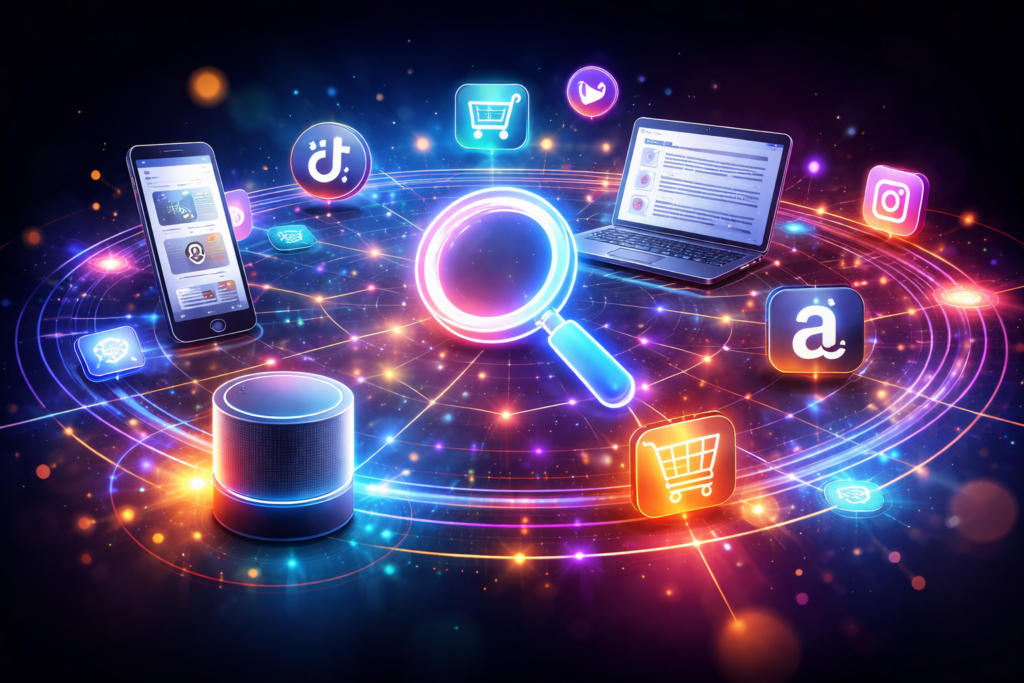
For years, marketers operated under a fairly predictable assumption: most customer journeys began with a search engine or a social platform.
That assumption is changing quickly.
Today, discovery happens across a growing ecosystem of platforms and interfaces. Consumers are finding brands through AI assistants, social feeds, marketplaces, visual search tools, and traditional search engines simultaneously. Instead of one starting point, there are now many.
This shift is creating both opportunity and complexity for brands trying to remain visible.
The Rise of AI as a Research Layer
One of the most notable changes is the growing role of AI in early-stage research. Instead of immediately visiting websites, many consumers are asking conversational AI tools for recommendations, comparisons, and product explanations.
AI is becoming an intermediary between curiosity and action. Consumers use it to narrow choices, learn about categories, and gather context before making purchasing decisions.
For brands, this means discovery may happen before a user ever lands on a traditional search results page. If your content is not structured clearly and accessible to these tools, you may miss that initial moment of consideration.
Social Platforms Are Functioning Like Search Engines
Another major shift is how users interact with social platforms. Increasingly, people search directly within platforms like TikTok and Instagram when researching products, trends, and experiences.
Instead of typing a query into a search engine, users may watch videos, scroll through recommendations, or explore influencer content to learn about a brand.
This behavior turns social media into a discovery engine, not just a communication channel.
Brands that treat social platforms only as advertising environments miss the growing role they play in organic research and product exploration.
Marketplaces Are Expanding Their Discovery Role
Marketplaces such as Amazon are also evolving into research hubs. Many shoppers now begin product exploration within marketplaces to compare features, pricing, and reviews before making a purchase.
In some cases, these platforms are replacing traditional search engines as the first stop for product discovery.
For brands selling through marketplaces, product detail pages, reviews, and structured listings play a significant role in visibility.
Structured Content Is Becoming Essential
As discovery becomes more fragmented, the way information is structured online matters more than ever.
Clear product descriptions, organized metadata, FAQs, and well-structured content make it easier for search engines, AI tools, and platform algorithms to understand and surface your brand.
When information is inconsistent, incomplete, or poorly organized, discovery becomes less reliable.
Brands that prioritize clarity and structure improve their chances of appearing accurately across multiple discovery environments.
Attribution Is Growing More Complex
When discovery happens across several platforms, measuring what actually drives conversions becomes more challenging.
A consumer might see a product recommendation in a video, ask an AI assistant for more information, read reviews on a marketplace, and finally convert through a paid ad or direct visit.
Traditional last-click attribution rarely captures the influence of these earlier touchpoints.
Marketers increasingly need broader measurement approaches that recognize how different platforms contribute to the overall journey.
The Strategic Takeaway
Discovery is no longer centralized. Instead, it is distributed across a network of platforms where consumers research, compare, and decide.
Brands that rely on a single discovery channel risk missing large portions of their potential audience. The most successful marketers focus on building visibility wherever customers begin their research.
That means optimizing not just for one platform, but for an ecosystem.
How Brands Can Respond
To stay competitive in this evolving environment, brands should begin by auditing where and how they appear across discovery platforms.
Strengthening structured content, improving product information, and maintaining consistency across channels can significantly improve visibility.
Testing across multiple discovery environments — including social, marketplaces, and conversational interfaces — also helps brands better understand how modern customer journeys unfold.
The goal is not simply to rank in one place, but to be discoverable everywhere customers search.
Need Help Navigating the New Discovery Landscape?
If you’re unsure how your brand appears across today’s fragmented discovery ecosystem, we can help.
At National Positions, we help brands adapt their search, content, and performance strategies to ensure they remain visible across evolving platforms.